“Intrinsically, there is nothing wrong with using Chinese CDMOs. But because of geopolitical issues, some large pharma want to have redundancy of that supply chain in the US.”
Dr. Reza Oliyai, President and CEO of Oliyai Consulting Corporation, spent 28 years at Gilead Sciences rising from research scientist to SVP overseeing 1,700 people across seven sites and multiple modalities including biologics, ADCs, small molecules, and sterile manufacturing.
In this PharmaSource podcast episode, Reza shares his framework for helping biotechs de-risk their external manufacturing strategy, navigate geopolitical supply chain challenges, and make phase-appropriate decisions that balance speed with resource constraints.
Supply Chain Resilience: Quality Over Redundancy
For resource-constrained biotechs, building resilient supply chains requires strategic thinking rather than expensive redundancy.
“Working with high-quality CDMOs is a good place to start,” Reza says. “Be mindful of geopolitical issues, but don’t have any knee-jerk reactions. Think about contingency planning beyond a paper exercise, but also be realistic.”
Three supply chain nodes currently face significant capacity constraints: bioconjugation for ADCs, sterile manufacturing, and spray dry dispersion.
“For sterile manufacturing, you need to think about 24 to 36 months in advance in terms of supply chain planning.”
The key is accepting trade-offs. Dual or triple sourcing across every manufacturing step isn’t financially viable for most emerging companies.
“You cannot compromise on working with high-quality CDMOs. It’s unrealistic to say you’re a small biotech with limited resources—why don’t you have redundancy at every node of the supply chain? You don’t have the money and you don’t have the internal capacity to manage that.”
Geography alone doesn’t guarantee reliability. “You can also use CDMOs in the US that have had quality and compliance issues.”
Navigating China: When to Use Chinese CDMOs and When to Transfer Out
Reza takes a pragmatic view on Chinese CDMO partnerships, rejecting blanket restrictions while acknowledging geopolitical realities.
The critical factor is planning for eventual tech transfer. “Because of geopolitical issues, some large pharma, when they’re looking to create partnership with a smaller biotech, they do want to have redundancy of that supply chain in the US.”
Reza recommends a phased approach. “We may start in China, but as the program evolves and there’s a higher degree of confidence in terms of clinical outcome, we start transferring some of the manufacturing processes to the US.”
Modality dictates geography. “If it’s sterile manufacturing, we typically like to do sterile manufacturing in US or in Europe. Those are preferred sites. If it’s an ADC, we typically like to do the conjugation in US or Europe. But for oral products, we would have no issue making drug products in China.”
This strategy allows biotechs to leverage China’s deep technical expertise and capacity for early-stage work while building supply chain optionality for later stages.
Phase-Appropriate Manufacturing: Getting to Clinic Fast Without Wasting Money
The biggest mistake small companies make is over-investing in manufacturing capabilities before clinical validation.
“You really have to be mindful about the work that the CDMO is doing to be phase-appropriate. What you don’t want to do is start investing a lot into a project without having appropriate clinical outcome.”
CDMOs are businesses focused on revenue generation. “Their heart is in the right place, but they’re also a business. They’re trying to create revenue. Balancing that revenue creation versus value creation for the client is really essential.”
Oliyai Consulting helps clients structure CDMO work orders to minimize upfront costs and financial risk. “If you’re doing an ADC project, we may have enough work for that CDMO around cell line development, and then the next scope of work would be around conjugation chemistry. We start dissecting the work orders to minimize upfront cost and make sure that cancellation fees are not overburdening.”
Early programs should prioritize speed to clinic above all else. Later-stage programs require robust, scalable, and transferable processes that can support commercialization.
“Early on, it’s all about speed to clinic. Later on, you really need to make sure the manufacturing process is robust, scalable, and transferable.”
Building Leverage and Getting Leadership Engagement from CDMOs
Small biotechs face a structural disadvantage when negotiating with large CDMOs—they lack leverage.
“One of the things that smaller companies lack is leverage. You have little to no leverage when they work with large CDMOs.”
Working with experienced consultants can help level the playing field. “We handle so many projects for so many clients. When we speak to CDMOs, they know that we have a deep understanding of what that interaction should look like. We bring that leverage for many of our clients.”
Beyond external support, small companies can build their own leverage through strategic executive engagement. “Get senior management engagement from the small company to the CDMO. Make sure the CEO or CFO of the smaller company is engaged and working with the CDMO. That level of engagement goes a long way.”
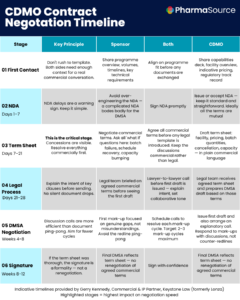
Contract negotiation requires technical expertise, not just legal review. “We know what terms are appropriate, what terms are not appropriate. Sometimes smaller companies go to attorneys. Attorneys are great in terms of reading a legal contract, but they may not have the technical expertise to know what are the true risks and risk mitigation strategies.”
Onshoring Trends and the Coming Talent Gap
Large pharma companies are making substantial commitments to bring manufacturing back to the US and Europe.
“What we see with a lot of pharma companies now is this desire to onshore manufacturing, either onshore or friendshore. I’ve seen up to $250 billion worth of at least verbal commitment in terms of bringing manufacturing back to the US, which is wonderful.”
But capital investment alone won’t succeed without addressing workforce challenges. “To build out manufacturing is one thing. To staff those manufacturing sites with high-quality individuals is something else.”
Reza predicts a significant talent gap will emerge as onshoring accelerates. “I believe there will be a talent gap once you start onshoring many of these manufacturing operations.”
Not everything will return to Western markets. “You’re not going to onshore early-stage, intermediate manufacturing for small molecules. That’s just—that’s China. That’s going to remain in China.”
Competing with Chinese Biotech Innovation
The competitive dynamics of global biotech have fundamentally shifted as Chinese companies accelerate timelines and reduce costs.
“The biotech industry has really evolved. Why? Because the Chinese biotech industry—not the CDMOs in China, but innovators in China—are getting to answers faster and cheaper.”
Patent filings tell the story. “If you look at the number of patents that US biotech companies used to file versus China, the ratio was 20 to 1—20 patents in US, one in China. Now, the ratio is almost one to one.”
Due diligence work reflects this shift. “80% of due diligence that we do for our VC clients are out of Japan, China, South Korea, Singapore.”
To compete, US and European biotechs must fundamentally change how they operate. “In order for US and European biotech companies to compete in the same environment, they have to find ways to get to a yes or no answer in terms of clinical outcome faster and cheaper.”
This requires avoiding large internal buildouts and leveraging external partnerships effectively. “Not building huge internal teams, because it’s very time consuming, very costly, and there’s a lot of uncertainty about the organizational capacity and capability.”