“If you take away funding from research and development, especially for diseases with pandemic potential, those programs will be delayed. We lose time, and some of that time can’t be recovered later with more funding.”
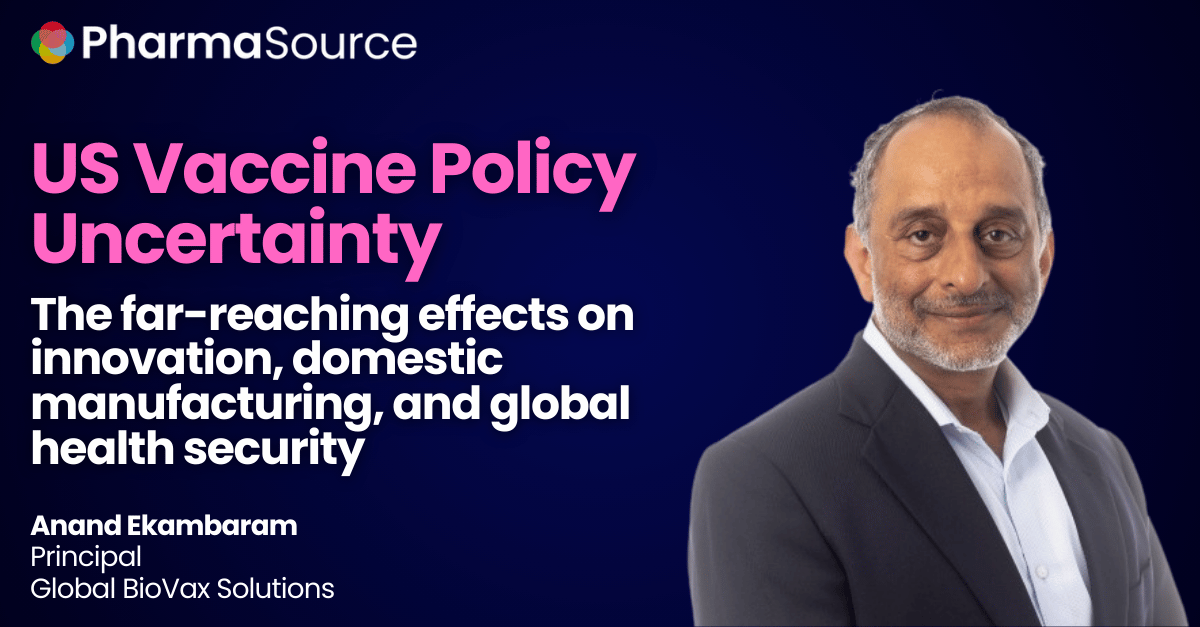
Anand Ekambaram has spent more than three decades at the intersection of vaccine development, manufacturing, and global supply chains. His career spans leadership roles at Merck, Bristol Myers Squibb, and CEPI, where he served as Executive Director and Head of Manufacturing and Supply Chain. Today, through Global BioVax Solutions, he advises global health organizations and investors on development, manufacturing, and supply chain strategy and technology transfer for vaccines and biologics
In the latest PharmaSource podcast, Anand reflected on how recent U.S. policy shifts are compounding disruptions across the global vaccine ecosystem—and why COVID exposed structural weaknesses that remain unresolved. His analysis connects policy, manufacturing realities, and long-term health security in ways that challenge simplistic narratives about reshoring and self-sufficiency. He provides his framework for building resilient regional manufacturing capacity that can withstand future crises.
Three Policy Shifts with Compounding Effects
Anand identifies three interrelated U.S. policy shifts that are reshaping global vaccine manufacturing:
- Withdrawal of funding from global health and immunization programs
- Accelerated reshoring incentives coupled with new trade and tariff pressures
- Policy and regulatory uncertainty around vaccine safety and oversight
Individually, each of these is disruptive. Taken together, they risk weakening both near-term pandemic preparedness and longer-term vaccine innovation.
Immediate Funding Gaps in Global Immunization
The most immediate impact has been the withdrawal of U.S. funding from global immunization programs. Organizations such as Gavi, the Vaccine Alliance—which has played a central role in expanding vaccine access in low-income countries—have relied on the U.S. for a meaningful share of their funding. Gavi, for example, estimated earlier that the loss of US funding could result in 75 million children not receiving routine vaccines in the next five years, which could result in 1.2 million deaths.
“That funding is no longer there,” Anand notes. “Organizations will have to find other ways to compensate, and in the near term that almost certainly means reductions in immunization coverage.”
The effects extend beyond any single institution. Reduced funding weakens routine immunization systems that underpin long-term health outcomes—and, critically, sustain the manufacturing operations that provide surge capacity during pandemics.
The Manufacturing Capacity Time Lag
At the same time, the pharmaceutical industry has announced nearly $300 billion in new U.S. manufacturing investments, driven by reshoring incentives and lessons from COVID-era supply disruptions. However, Anand cautions that these announcements mask a fundamental reality.
“New vaccine and biologics facilities don’t come online quickly,” he explains. “From construction to validation to licensure, you’re looking at four to five years at best.”
This timeline creates a peculiar market dynamic: political pressure for domestic manufacturing is intense, yet the physical reality of building and validating pharmaceutical facilities means any announced capacity today won’t produce vaccines until 2029-2030 at the earliest.
The reshoring trend started earlier than the current administration, driven by geopolitical tensions and COVID, which exposed supply chain vulnerabilities. However, the current policy environment has accelerated reshoring without addressing the fundamental constraints of pharmaceutical facility construction.
A Chilling Effect on Vaccine Innovation
Perhaps the most concerning impact, Anand argues, is on early-stage vaccine innovation. While broader biopharma investment indicators may appear healthy, vaccine-specific innovation has slowed sharply. “It’s the vaccine sector that has been very badly affected by policy changes because investors simply don’t want to take a risk on vaccines until they get clarity on policy”, Anand notes.
Changing attitudes toward vaccines reflected in policy changes at the FDA level have created uncertainty that’s proving disruptive to early-stage funding. “Investors are reluctant to take risks when policy signals are unclear,” he says. “I know of multiple companies with promising data that would normally have been funded that have lost funding or are unable to secure investment.”
This hesitation is especially problematic for diseases with pandemic potential, where early investment is essential. Lost time in vaccine development cannot be recovered later through emergency funding alone.
How CDMOs Will Weather the Storm
Despite the reshoring announcements, Anand believes the CDMO industry will remain resilient, though individual European operations may see volume pulled to US-based manufacturing.
“The CDMO and CMO industry as a whole, I think, will do fine,” he predicts, offering two reasons for his optimism.
First, the timeline factor means current CDMO relationships remain critical for at least four to five years while new capacity is being built.
Second, the structure of pharmaceutical innovation protects CDMO demand. “Over 50% of new clinical trial starts are by small and medium biotechs,” Anand explains. “They’re not the ones announcing these huge investments. It’s Big Pharma.” Small and mid-sized biotechs still need somewhere to manufacture clinical supplies, and that ecosystem remains vibrant regardless of Big Pharma’s reshoring plans.
The Compounding Effect on Pandemic Preparedness
The policy shifts create a compounding problem for future pandemic preparedness. Reduced funding for global immunization weakens the manufacturing operations that would provide surge capacity during a crisis. The innovation freeze delays development of next-generation vaccine platforms.
“If you take away funding from research and development, especially for those diseases that have pandemic potential, these programs are going to get delayed,” Anand warns. “We are going to lose time, and some of that time you just can’t make up later with more funding.”
The concern is particularly acute for diseases on the WHO Blueprint pathogen priorities list.
“I can’t see how other sources could make up for the withdrawal of U.S. funding, given that the U.S. was the largest backer of research and development for these products,” he states
What COVID Revealed About Structural Inequity
These policy shifts matter because COVID already exposed deep structural inequities in vaccine access.
“COVID exposed in a very stark manner that vaccine access followed manufacturing capability far more than public health need,” Anand explains. “Countries that had capacity immunized their people. Countries that didn’t had to wait in line.”
Advance purchase agreements, export controls, and domestic prioritization were predictable responses to scarcity. Even global mechanisms like COVAX were forced to compete for supply in a market where early production had already been allocated and faced export controls.
“The inequity we saw was structural,” Anand emphasizes. “It reflected decades of concentration of vaccine manufacturing in a small number of countries. COVID didn’t create that imbalance; it revealed it.”
Technology Transfer Takes Time
A common assumption during COVID was that technology transfer could rapidly close access gaps. In practice, Anand notes, this underestimated the complexity of technology transfer and vaccine manufacturing.
“Manufacturing isn’t a switch you turn on,” he says. “Technology transfer requires trained people, regulatory readiness, and mature quality systems. In a crisis measured in months, those gaps mattered enormously.”
This insight drove his work at CEPI, where the organization evolved from funding early-stage vaccine development to building the broader ecosystem needed to deliver vaccines in low and middle-income countries.
How to Build Resilient Vaccine Manufacturing Capacity
Given the funding gaps created by US policy changes and the structural inequities exposed by COVID, what’s the path forward? Anand shares his framework for building sustainable vaccine manufacturing capacity in regions that have historically depended on imports. The goal isn’t complete self-sufficiency in every country but creating resilient regional networks with meaningful participation and surge capacity for future crises.
The Strategic Case for Regional Manufacturing Capability
Domestic and regional manufacturing capacity delivers benefits well beyond crisis response. It improves supply reliability, strengthens routine immunization programs, builds skilled workforces, and gives countries greater agency over how vaccines are designed, priced, and supplied.
Importantly, manufacturing can also serve as an entry point into more advanced parts of the value chain, including product and clinical development.
However, Anand says that is clear that pandemic-only capacity is not economically viable.
“Pandemics are episodic. Routine immunization represents steady demand and an opportunity for economic viability,” he explains. In addition, he says, “for effective pandemic response, facilities have to stay ‘warm’” — producing routinely and sustaining the systems that are so vital to vaccine manufacturing, so they can pivot quickly during emergencies.
At CEPI, this principle shaped investments in manufacturing platforms that support routine vaccines while remaining adaptable for pandemic response.
Regional Solutions Over National Self-Sufficiency
Anand cautions against framing local manufacturing as universal self-sufficiency. Vaccine manufacturing is capital-intensive and difficult to sustain at small scale.
“It’s not feasible for every small or medium-sized country to have its own self-sufficient manufacturing industry because it’s a capital-intensive process,” Anand notes. “I estimate somewhere between half a billion to three-quarters of a billion population is needed before such investments become feasible.”
For countries below this threshold, regional consortiums offer the solution, though Anand acknowledges these are “easier said than done”.
“Regional approaches make more sense in many cases,” he notes. “The goal isn’t self-sufficiency — it’s resilience and meaningful participation.”
Quality Systems, Not Equipment, Are the Bottleneck
Across emerging manufacturing facilities, Anand sees a consistent pattern: equipment is rarely the limiting factor.
“Equipment is easy,” Anand summarizes. “The real challenge is building robust quality systems, data integrity, contamination control discipline, and an aseptic culture that can sustain performance long after the tech transfer team has left”. Sustainability requires a deep understanding of why GMP controls exist, not just how to follow procedures.
To address this, CEPI supported “sandbox” models—low-cost, small-scale environments where teams can practice vaccine production, aseptic operations, and deviation response under simulated GMP conditions, without commercial pressure.
“These exercises build technical know-how AND a quality culture,” Anand explains. “They’re inexpensive, but incredibly powerful.”
Designing Resilience Upstream
Supply-chain resilience, Anand argues, must be designed during product development, not retrofitted later.
Choices around platforms, consumables, and container formats determine how transferable and scalable a vaccine will be. Bespoke solutions may deliver short-term efficiency, but they create long-term fragility.
“If you select specialized bespoke equipment, you’re setting the stage for later problems,” Anand warns. “You may get efficiency in the short term, but you’ll get fragility in the long term.”
The Ideal Global Vaccine Network
Anand envisions a federated global network: a small number of advanced R&D centers linked to regional manufacturing hubs built on standardized platforms, particularly for sterile fill-finish, supporting routine immunization while maintaining surge capacity for pandemic products. Facilities must also remain continuously operational—producing routine vaccines—so that surge capacity is real, not theoretical.
Hubs would be distributed geographically to reduce concentration risk and align with regional disease burdens. The entire network would be designed for interoperability, with product and process choices favoring platforms, containers, and consumables transferable across sites.
Facilities must remain continuously warm, producing routine vaccines daily and building workforce skills and quality culture. “When a pandemic hits,” he says, “you should be scaling up, not starting over.”
“Supply chains should be built for resilience, particularly for vaccines, not just for cost,” Anand emphasizes.
Resilience cannot be bolted on during a crisis. It must be designed upstream: into product platforms, process choices, quality systems, workforce development, and supply-chain architecture.
Regulatory approaches would be harmonized so that the criteria for approval and technology transfer expectations are known up front.
Critically, such a system would include clear, enforceable allocation rules.
“Vaccines can’t go to the highest bidder or only to producing countries,” he emphasizes. “Allocation has to be based on public-health need.”
Why This Moment Matters
The combination of funding cuts, reshoring rhetoric, and innovation uncertainty risks weakening the very systems needed for future pandemic response. COVID offered painful lessons. Whether those lessons translate into durable change remains an open question.
As Anand’s experience makes clear, vaccine access is ultimately determined not by discovery alone, but by sustained investment across the full value chain – including regional manufacturing infrastructure, quality systems, people, and an equitable access framework based on public health need.