“The right CDMO is not the one with the biggest plant or the lowest price. It’s the one with the judgment, the systems, and the incentives to protect your molecule when complexity, scale, and scrutiny converge.”
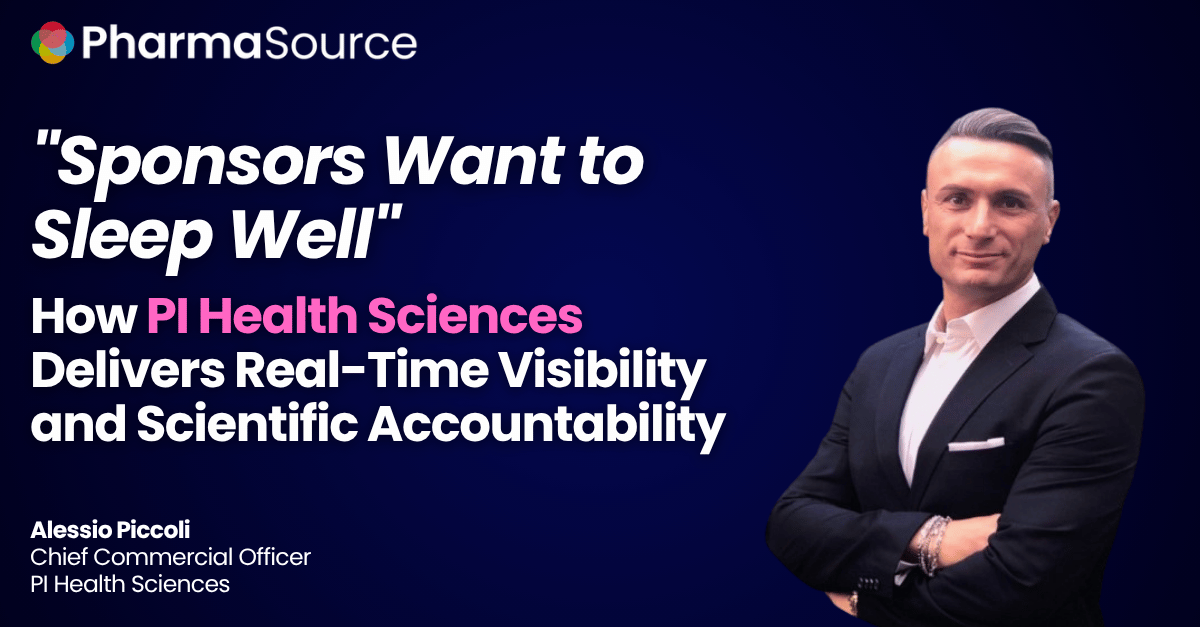
Alessio Piccoli, Chief Commercial Officer at PI Health Sciences (PIHS), a CDMO and CRO with discovery and process R&D capabilities in Jaipur and Hyderabad, India, and EU cGMP manufacturing in Lodi, Italy – a site holding FDA, AIFA, and KFDA approvals. The organization is backed by PI Industries, a global life sciences powerhouse with over 80 years of legacy in turning complex science into scalable real-world outcomes.
In this episode of the PharmaSource podcast, Alessio explains why the most consequential differentiator in CDMO selection is control. He shares how PIHS is building a model defined by scientific accountability, digital execution, and a partnership mindset that links development decisions to commercial reality.
Control Over Capacity: The Core Differentiator
In a market saturated with CDMOs competing on scale and price, Alessio argues that the most sustainable competitive advantage is control. Control of chemistry, development decisions, data integrity, and scale-up transitions across the full molecule lifecycle.
PI Health Sciences positions itself between deep scientific leadership, integrated development-to-manufacturing, and a digital-first compliance backbone. Unlike service-fragmented CDMOs that separate discovery, development, and manufacturing into discrete handoffs, PIHS operates with program-level accountability.
“Our core differentiator is not capacity; it is control. Control of the chemistry, development decisions, data integrity, and scale-up transitions across the full lifecycle of a molecule,” Alessio explains.
This means scientific leaders at PIHS define strategy and execution, rather than just resource allocation. Clients are expected to engage as partners rather than project managers, with PIHS functioning as an extension of their R&D organization. The model combines India-based discovery and process R&D with EU cGMP manufacturing in Italy, enabling seamless scale-up from gram to kilo to multi-ton manufacturing.
Flow Chemistry and Biocatalysis as Problem-Solving Tools
Flow chemistry and biocatalysis are central to the PIHS platform. “Flow chemistry and biocatalysis are not nice-to-have technologies. They are problem-solving tools that directly affect speed, safety, scalability, cost of goods, and regulatory robustness across development and commercial supply,” Alessio says. “We suggest them to clients only when there is a clear potential positive upside.”
The practical benefits include fewer synthetic steps, cleaner impurity profiles, safer scale-up, and more predictable transitions from development to commercial manufacturing. This capability is reinforced by PIHS’s parent company, PI Industries, which recently commissioned the world’s largest flow chemistry plant, capable of processing 60 metric tons per day through continuous synthesis. That operational track record translates into PIHS’s pharmaceutical offering.
Alessio explains that a CDMO with genuine continuous manufacturing expertise does not simply “run” a process at scale; it engineers risk out of that process from day one.
Digitalization: From Reporting to Real-Time Visibility
Digital investment at PIHS is tightly scoped around giving sponsors confidence that what they see reflects what is actually happening in the lab or plant.
“Sponsors want visibility that reflects reality, not polished summaries,” Alessio says. “They want to sleep well.”
PIHS’s digital investments fall into four core areas. First, digital R&D execution; electronic lab notebooks and instrument integration ensure decisions are made on live, traceable data rather than summaries prepared weeks after the fact. Second, a digital quality and compliance backbone comprising an electronic document management system, QMS, and electronic batch records, making quality a system behavior rather than a person-dependent discipline. Third, end-to-end process data integration across manufacturing, making scale-up a data-driven transition rather than an act of faith. Fourth, enterprise integration via SAP, Lead-to-Cash, and LIMS (currently in progress), aligning operations, quality, and finance on a single source of truth.
The result is near-real-time milestone tracking with structured escalation paths and earlier visibility of risk. This digital infrastructure is also central to PIHS’s greenfield manufacturing facility currently under development in Panoli, India, which is being designed as a fully automated site from the ground up.
Supply Chain Resilience: The India–Italy Advantage
Geopolitical uncertainty is reshaping how sponsors think about supply chain strategy. Many pharmaceutical companies are rethinking how to diversify without sacrificing cost efficiency or regulatory assurance.
PIHS’s India–Italy footprint was designed to address this. India provides cost-efficient innovation capacity and back-integration for intermediates. Italy’s Lodi facility functions as what Alessio calls a “safe harbor,” an EU-GMP regulated site for supplying Western markets with full FDA, AIFA, and KFDA approvals.
“Our India–Italy footprint is designed to decouple innovation from geopolitical risk,” Alessio explains. “Clients can leverage India for efficient development and intermediates, while relying on our EU-GMP site in Italy for regulated-market supply. This built-in optionality allows them to shift volumes, routes, or stages as trade, regulatory, or political conditions change without requalifying a new CDMO.”
The built-in transferability between the two sites is a key element of this model. Rather than maintaining parallel supply chains with separate CDMOs, sponsors can consolidate risk management within a single partner relationship that spans both geographies.
From Fee-for-Service to Shared Outcomes: The Modern Partnership Model
The CDMO commercial model is evolving. Sponsors are no longer satisfied with transactional arrangements measured in hours consumed or batches delivered. They are seeking partners who share in the outcome of the molecule rather than just the execution of the current work order.
“Fee-for-service is evolving from transactions to shared outcomes,” Alessio says. “A modern partnership means program-level ownership, flexible commercial models that evolve with the molecule, embedded transparency, and a long-term mindset that links development decisions to commercial reality.”
For Alessio, the defining characteristics of a truly successful client relationship go beyond contractual terms. They include early involvement in program strategy, open discussion of challenges, scope that evolves naturally as the science develops, and a shared investment in the molecule’s long-term success.
“The starting point is always the current work order,” he notes, “but the work order is good only for the moment. We have to leverage that starting point with trust and transparency to move to the next step.”
What Will Separate CDMOs That Thrive in 2030
Alessio explains where he sees the CDMO market heading. Many capabilities that currently differentiate a CDMO, such as geographic diversification, digital GMP execution, ESG credibility, and lifecycle coverage, will become minimum requirements by 2030. CDMOs that cannot demonstrate all four will not make shortlists.
The real differentiators, he argues, will be superior decision-making in early development, the ability to industrialize complex molecules, and a genuine partnership mindset where outcomes, not capacity utilization, define success.
“The devil is always in the details,” Alessio observes. “And potentially these are the details that make the difference. Choosing the right route early, designing processes with commercial reality in mind, and taking risk intelligently in terms of total program success, not just the work order in front of you.”
PIHS is investing accordingly. Small molecules remain the core, with increasing focus on high-potency APIs, hazardous and high-energy chemistries, and continued expansion of flow chemistry and continuous manufacturing capabilities. Peptides and tides are identified as a significant area of growth. In geography, Hyderabad will see expansion of CRO and discovery capabilities, while the Panoli greenfield site is being built as a fully automated, digitally integrated manufacturing facility.
Advice for Biotech CEOs Evaluating CDMOs Today
“Ignore the marketing decks first,” Alessio advises when asked what he would tell a biotech CEO evaluating CDMOs. “Ask questions that help you understand whether the partner is ready to protect the enterprise value of your program. Look for scientific accountability and early ownership, the ability to industrialize complex molecules, and operating-model maturity under pressure; governance, digital project visibility, and vertical accountability.”
The right CDMO partner builds the scientific and operational foundation that makes scale-up, regulatory review, and commercial supply not just possible, but predictable.