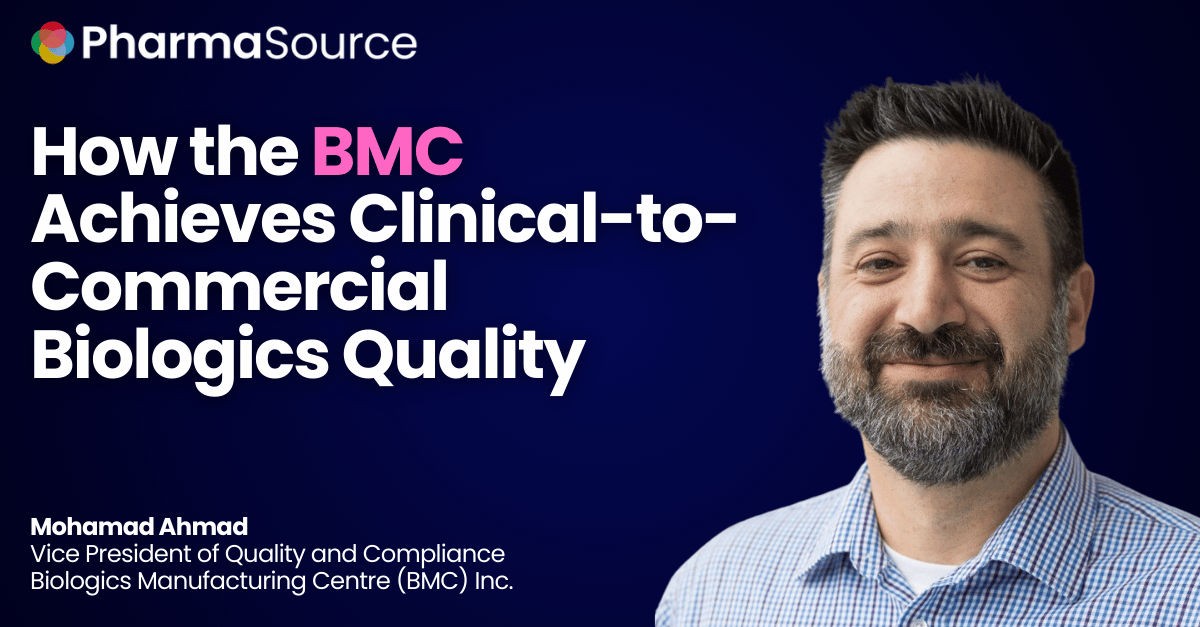
“Sponsors don’t want to know how many SOPs you have on the shelf. They’re really looking to see if you have sound judgment to take care of their program.”
Mohamad Ahmad, Vice President of Quality and Compliance at the Biologics Manufacturing Centre (BMC) Inc., brings extensive quality leadership experience across the pharmaceutical industry. The BMC is a Canadian non-profit CDMO established in response to Canada’s effort to strengthen domestic biologics manufacturing capacity following the pandemic. There, Mohamad oversees quality systems across all biologics manufacturing operations, from early clinical through commercial scale.
In this episode of the PharmaSource podcast, Mohamad explains why a risk-based, science-driven approach to quality is the defining factor that separates strong CDMO partners from the rest — and how the BMC has built its quality organization to deliver that across every stage of a program’s lifecycle.
Quality System Built in Real Time
The BMC was established during the COVID-19 pandemic, when Canada’s lack of domestic biologics manufacturing capacity became critically apparent. The Canadian government built the facility and subsequently established it as a non-profit, with a mandate to support domestic health priorities while contributing to the broader biomanufacturing ecosystem.
The BMC’s quality system was forged in parallel with active construction and the onboarding of its very first client.
“The quality system wasn’t built in a vacuum. It was built in a real-life situation where you actually need to make sure the client is key and that you have the right system to support GMP manufacturing.”
Within its first two years of operation, the BMC secured its Drug Establishment License from Health Canada, enabling commercial-scale manufacturing. The quality team simultaneously built out supplier qualification, raw material release, batch review, and a full stability program — all while supporting live client programs.
The site operates two single-use GMP manufacturing suites capable of bioreactors up to 2,000 liters, supporting mammalian and insect cell platforms across drug substance, drug product fill-finish, and in-house QC release testing. Single-use design is deliberate as it enables faster changeovers and supports multiple simultaneous programs.
Where CDMOs Create the Most Value
Mohamad identifies transition points, particularly the move from late clinical development into early commercial readiness, as the moments where CDMO partnerships become most critical.
“Early development decisions made around speed can create problems when you get to scale. Small gaps in data, process understanding, or documentation can turn into significant delays if not addressed early.”
The BMC positions itself to support sponsors across this entire arc. Mohamad argues that the continuity of having a single partner from early clinical to commercial creates a structural advantage. Fewer handoffs, fewer surprises, and a quality system that scales with the program rather than requiring re-validation at each new site.
What to Evaluate in a Quality System
When sponsors assess a CDMO’s quality capabilities, Mohamad says the most important question is not the complexity of the system; it’s whether the system fits the stage of their program.
“An early clinical program doesn’t need the same level of complexity as a full commercial product. Flexibility becomes very important. Sponsors want to know whether the system can support a lean development program while still being strong enough to scale later.”
The BMC applies GMP principles proportionally. For clinical-stage programs, speed and practical change management are prioritized. For commercial programs, the focus shifts to thorough validation, lifecycle management, and long-term regulatory readiness.
Above all, Mohamad emphasizes that sponsors are evaluating decision-making quality, not documentation volume.
“They’re really looking to see if you have sound judgment to make sure they can take care of their program. Are decisions risk-based? Are they scientifically justified?”
Transparency and Trust: How Quality Partnerships Are Built
For Mohamad, transparency is structural rather than reactive. It starts at the beginning of every engagement with clear alignment on what gets shared, when, and how decisions will be made.
When programs run smoothly, the BMC shares regular quality metrics, batch status updates, and trend data — all governed by quality agreements agreed upfront. When issues arise, the approach does not change.
“Even if the investigation is still ongoing, the client is advised as soon as something happens. The principle is simple: stay open, be timely, be honest. This is where trust gets built.”
Mohamad rejects the transactional framing of sponsor-CDMO relationships. The BMC’s operating model is built around partnership — working jointly on problem resolution rather than managing liability boundaries.
Technology in Quality: A Tool for Humans, Not a Replacement
The BMC has deployed an electronic quality management system (eQMS) that centralizes deviations, CAPAs, change controls, and audit management in a single platform. Mohamad credits the system with improving visibility and ensuring investigations are tracked and resolved systematically.
On AI, Mohamad takes a measured position — acknowledging the potential while resisting premature adoption.
“We’re not sure yet how AI can help the space. We want to make sure the human aspect stays key, especially for risk-based decision-making. We’re still early in that journey from the AI perspective.”
The overarching philosophy is that technology surfaces data and identifies patterns, while people interpret them.
“Technology helps show what’s happening. People decide what it means. That’s key to taking the right decisions.”
Building a Quality Culture That Drives Execution
Mohamad argues that culture, not systems, determines what happens when the unexpected occurs. At the BMC, quality ownership is distributed. The person doing the work is responsible for doing it correctly and for raising issues early.
“Culture shows up in small moments. When someone feels comfortable stopping a process or raising a deviation early, it’s the right thing to do. That tells you what kind of culture you have.”
He identifies three cultural pillars that the BMC actively reinforces: psychological safety (no repercussions for raising issues), collaborative problem-solving (quality as a partner to operations, not a policing function), and visible leadership commitment to doing the right thing even when it’s not the easiest option.
Managing Regulatory Pressure Without Creating Rework
Rising regulatory expectations and compressed timelines are a permanent feature of the industry, not a temporary challenge. Mohamad’s approach is to organize work to meet both rather than trading one off against the other.
“A lot of delays don’t come from the regulations themselves. They come from work being redone, decisions being revisited, or information arriving too late. The worst thing you can do under timeline pressure is create work that has to be done again.”
The discipline of clear decision-making, thorough documentation, and anticipating downstream requirements, rather than cutting corners under pressure, is what allows programs to maintain regulatory compliance without accumulating technical debt.
What to Look for in a Long-Term CDMO Partner
Mohamad closes with advice for sponsors evaluating CDMOs framed around long-term partnership fit rather than near-term milestone delivery.
His key evaluation questions:
- Can this partner still serve the program two to three years from now, not just through the qualification batches?
- How does the CDMO handle change? When scope, volume, or timelines shift, does every adjustment feel like starting over?
- Will the knowledge stay? When a sponsor transfers their technology, will the institutional knowledge be retained, or leave with the people?
- How are transitions managed? Including, if the program outgrows the CDMO, how will they facilitate handover to a larger partner?
“Think about whether the partnership still works two or three years down the road. Look beyond the first milestone. These are the questions that usually reveal how a CDMO really operates.”