“At Kindeva, we want to be viewed as a fully Annex 1 compliant facility and partner that can pivot when needed and supply uninterrupted to the patients that need it.”
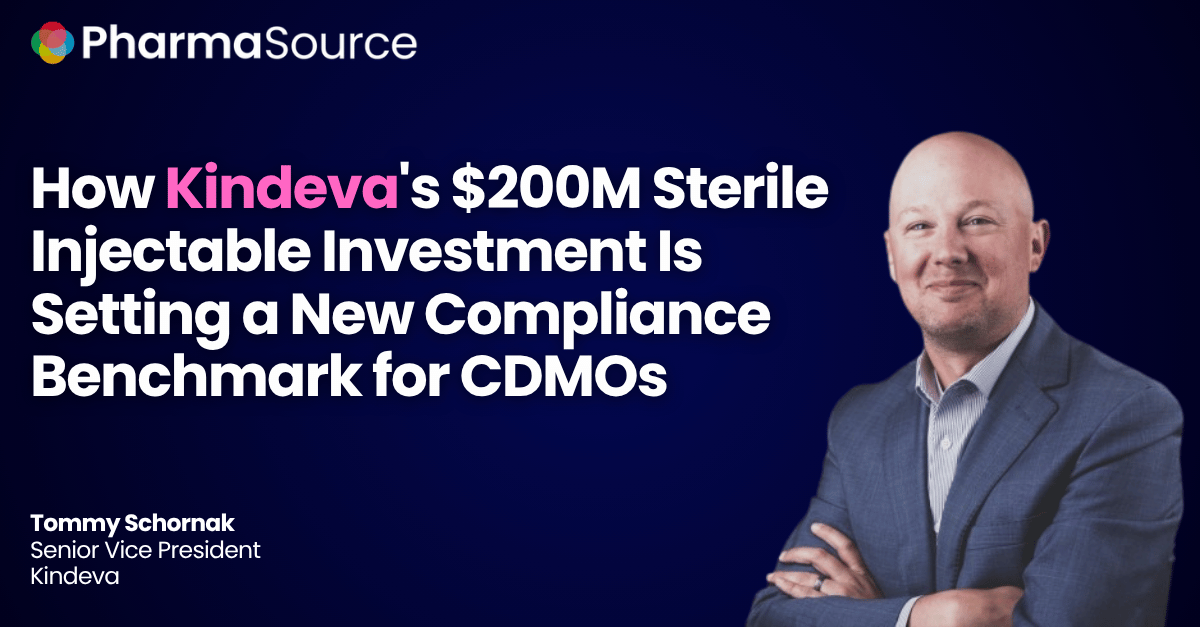
Tommy Shornak, Senior Vice President of Sterile Injectables at Kindeva, brings nearly 20 years of sterile manufacturing operations experience from organizations including AMRI, Thermo Fisher Scientific, and Gilead Sciences. Since joining Kindeva in 2025, Tommy has been at the center of the company’s investment strategy.
In the latest PharmaSource podcast, Tommy explains why Kindeva’s approach to sterile injectable CDMO services, anchored by a $200 million facility investment, a no-single-source supply policy, and a shift toward flexible commercial models, is designed to position the company as a one-stop partner for drug sponsors navigating an increasingly complex outsourcing landscape.
A $200 Million Bet on the Future of Sterile Fill-Finish
At the core of Kindeva’s long-term strategy is its new state-of-the-art Bridgeton facility, which received recognition as an ISPE Facility of the Future finalist in 2025. The investment signals a move away from reactive capacity management toward proactive market alignment.
“We’ve moved away from a reactive approach to what our customers need, and toward being proactive in terms of alignment on what we think they’ll need in the future,” Tommy explains. The Bridgeton facility features four fill lines coming online, all designed not merely for current regulatory compliance but for long-term compliance durability.
Complementing the fill-finish infrastructure is an end-to-end capability footprint in St. Louis, enabling Kindeva to manage everything from tech transfer through packaging and delivery. For sponsors, this translates into the ability to transfer a product in and complete all services without navigating multiple partner relationships.
Beyond fill-finish, Kindeva is also investing in microneedle technology, positioning itself as an innovator in complex drug delivery systems. The company has additionally reserved strategic expansion space for partners seeking to co-invest in specific modalities or additional capacity.
Supply Chain Resilience: No Single-Source, No Exceptions
In a market shaped by geopolitical uncertainty and post-COVID supply chain disruption, Kindeva has a strict no single-source strategy for any vendor-supplied material.
“COVID taught everybody a whole lot around global supply uncertainty,” Tommy says. “We found out everybody was really sole-sourced. And that just can’t be a component of what we’re doing moving forward.”
In practice, this means that dual supply is a standard requirement during product onboarding, with tertiary sourcing applied where the risk profile warrants it. Tommy describes a structured scenario planning process in which Kindeva works collaboratively with sponsors to map vendor origins, qualify alternative suppliers, and anticipate how global policy shifts might affect supply continuity.
Kindeva’s current geographic footprint for sterile injectables is centered in the St. Louis region. While the immediate focus is on onboarding customers and bringing Bridgeton fully online, Tommy acknowledges that further geographic expansion may follow as strategic needs evolve.
Data Transparency as a Partnership Imperative
For Kindeva, data sharing is foundational to how partnerships are structured from the start. Sponsors expect real-time visibility into what is happening on the manufacturing floor, and Kindeva has built its model around meeting that expectation.
“Our customers have real-time access to any data that they think they would need or want. And if we don’t or can’t offer that, we figure out a solution,” Tommy says.
The data-sharing framework is bidirectional. Kindeva also expects timely and transparent input from sponsors around product specifics, forecasting, and supply chain details. Establishing this cadence upfront as a formal component of the partnership structure is how Tommy describes avoiding the “no surprises” standard that sponsors increasingly expect.
Evolving Commercial Models: From Fee-for-Service to Pre-Qualification
The commercial structures governing CDMO relationships are shifting. Tommy identifies a clear market trend toward sponsor pre-qualification of CDMOs; a model in which sponsors vet and secure capacity before committing to a specific product tech transfer.
“Sponsors want access to capacity, guaranteed capacity, and they want to know that a facility has been well vetted and is compliant prior to spending all the time and effort into tech transferring a product into that facility,” he explains.
Kindeva is adapting its commercial structure accordingly. The company is open to master service agreements established prior to any formal product engagement, traditional fee-for-service models with forecasting mechanisms, and capacity reservation agreements for sponsors anticipating accelerated ramp-ups. This flexibility, rather than a one-size-fits-all commercial structure, is presented as a key differentiator in an increasingly partnership-driven market.
Sustainability: Designing for Environmental Impact from the Ground Up
Kindeva integrated sustainability considerations into the Bridgeton facility design from the outset, incorporating low water usage, waste reduction systems, and LED lighting as baseline features. Tommy acknowledges the inherent tension in sterile manufacturing between environmental goals and the carbon footprint of single-use systems, and emphasizes working with vendors to align sustainability programs with sponsor requirements.
To measure and communicate progress, Kindeva engaged an independent contractor to conduct a baseline sustainability assessment using the EcoVadis scoring framework. Between 2025 and 2026, the company increased its EcoVadis score by 12 points through targeted actions on waste control and energy consumption. The intent is to establish an independently verified baseline, then drive continuous improvement over 12-to-18-month cycles.
Table Stakes vs. Differentiators: Where the Market Is Heading by 2030
Looking ahead to 2030, Tommy draws a clear distinction between what will become minimum viable requirements and what will genuinely separate leading CDMOs from the rest.
On the table stakes side: regulatory compliance, and specifically Annex 1 compliance. The updated EU GMP Annex 1 requirements, which mandate the removal of personnel from sterile fill zones and the adoption of isolator technology, represent a threshold that CDMOs must clear. Tommy expects that operating on older RABS or legacy fill line technology will simply not be viable within the coming years. “You are, or you are not” compliant, he says. Kindeva has already made this transition through the Bridgeton investment.
On the differentiator side: the ability to provide end-to-end, uninterrupted supply from a single CDMO. Tommy points to the significant operational burden placed on sponsors who must manage multiple CDMOs across fill-finish, inspection, packaging, labeling, and shipping. The shift toward consolidating these services under one roof with a single point of accountability is where he sees sponsor expectations heading. “If they just come to Kindeva for fill-finish and then have to go to somebody else for inspection, packaging, labeling, shipping — that’s an incredible amount of time that the patient has to wait for the medicine.”
What Good Partnership Looks Like
For Tommy, the definition of a strong CDMO partnership is mutual transparency, clear commitments, and honest communication when commitments cannot be met. Sponsors must be transparent about performance, forecasting, and supply chain details. Kindeva, in turn, commits to delivering what it says it will deliver and to being open about constraints when they arise.
“What we do is so important in terms of providing life-saving or life-extending products to patients who need them around the world,” Tommy says. “It’s of extreme importance that we have a good, transparent partnership in which we can deliver to those patients who are waiting on it.”
With its $200 million facility investment now operational, a hardened supply chain resilience policy in place, and a commercial model built for flexibility, Kindeva is positioning itself to be the integrated, end-to-end sterile injectable partner that sponsors, and ultimately patients, will increasingly require.