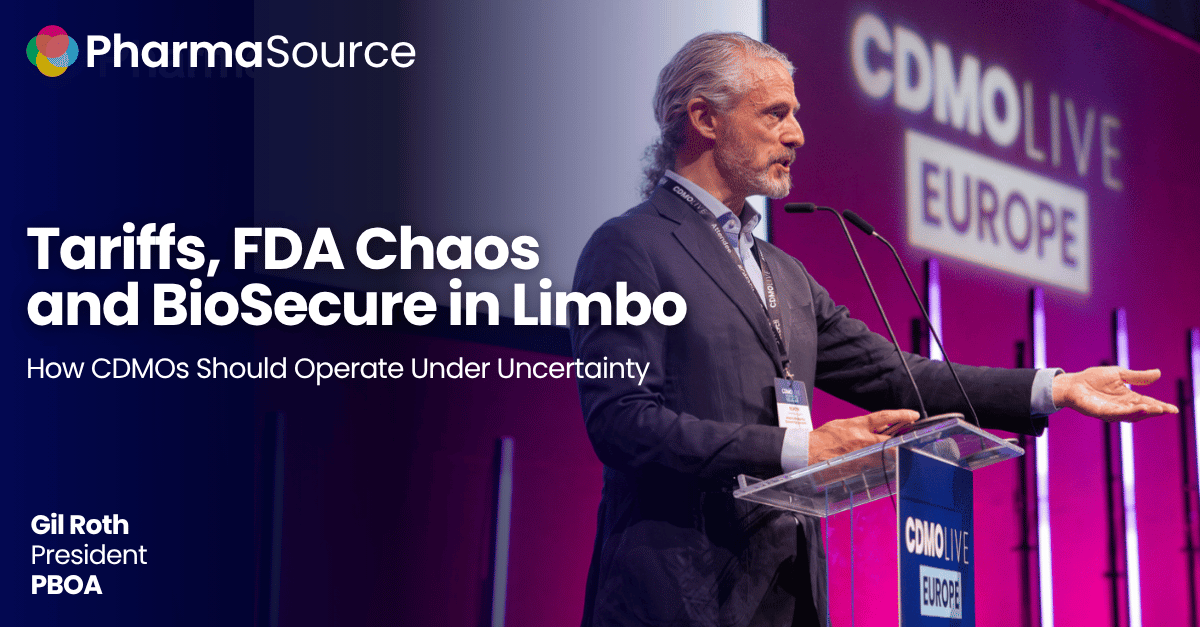
Gil Roth, President of the Pharma & Biopharma Outsourcing Association (PBOA), walked CDMO Live Europe delegates through the full matrix of US policy pressures bearing on contract manufacturers, from Section 232 tariffs and Most Favored Nation pricing to FDA workforce collapse and a stalled BioSecure Act.
Tariffs: What the New Regime Actually Means
With the Supreme Court striking down the original “Liberation Day” tariffs late last year, the US administration shifted to a Section 232 probe of the pharma supply chain. A mechanism with legal precedent, grounded in national security. The result, announced roughly a month before the conference, is a 100% tariff on pharma products imported from countries that have not signed trade agreements with the US.
The EU, UK, Japan, and South Korea are capped at 15%, with routes to zero for orphan drugs and antibody drug conjugates. Countries including India and China face the full 100% rate unless their pharma company clients have an onshoring agreement in place, which reduces the rate to 20%. The rate can then fall to zero if the companies also enter into a most favored nation (MFN) pricing agreement.
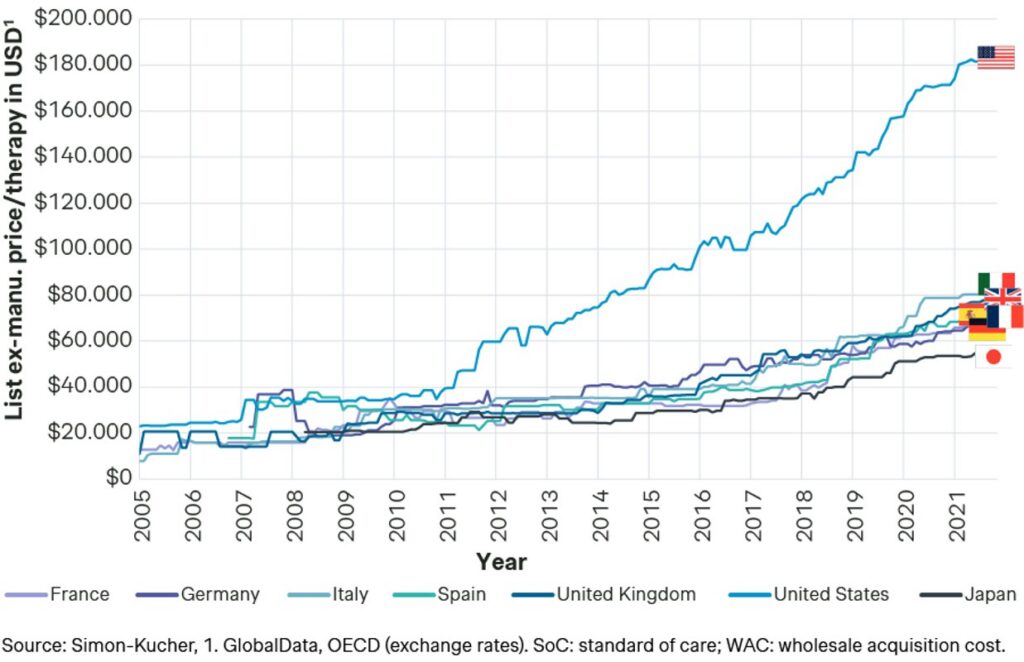
Median annual WAC / list prices for oncology therapies, 2005-2021 (Source: Simon Kucher)
Onshoring Investment: How Much Is Real?
Major pharma companies have announced hundreds of billions in US investment since the current administration took office, with J&J at $55 billion, Pfizer and Merck each at $70 billion, and AstraZeneca at $50 billion. Roth highlighted the gap between announcement and reality: early announcements from Lilly and J&J were genuine CapEx commitments, but later ones increasingly bundled R&D spend, ongoing operations, and previously committed expenditure into headline figures. Regeneron’s initial announcement consisted entirely of an existing agreement with Fujifilm Diosynth. Sanofi’s $20 billion figure included work with domestic manufacturing partners already underway.
CDMO investments are in a different order of magnitude — mostly in the millions rather than billions, with Thermo Fisher as the main exception. But Roth argued the impact justifies the scale. He also noted that non-US CDMOs are beginning to acquire US facilities as a hedge, citing Rovi, Samsung Biologics, and Celltrion, the latter purchasing a former Lilly plant for $500 million.
The longer-term opportunity may be larger still. Roth cited the CEO of Recipharm, who said publicly that within 10 years, 75% of the newly announced domestic pharma sites will be for sale. Roth said he expects that timeline to be shorter. Equipment bottlenecks, construction constraints, and workforce shortages compounded by immigration policy tightening the available labor pool mean many of these facilities may never reach full utilization. When they come to market, CDMOs will be positioned to acquire them.
FDA: Instability at Every Level
Roth described the current FDA as operating in near-total leadership flux. The commissioner resigned under pressure weeks before the conference. The Centers for Drug Evaluation and Research (CDER) and Biologics Evaluation and Research (CBER) are both under acting directors. The Chief AI Officer position is vacant. During GDUFA negotiations — which Roth participated in — FDA cycled through four CDER directors and two commissioners between October and the end of March.
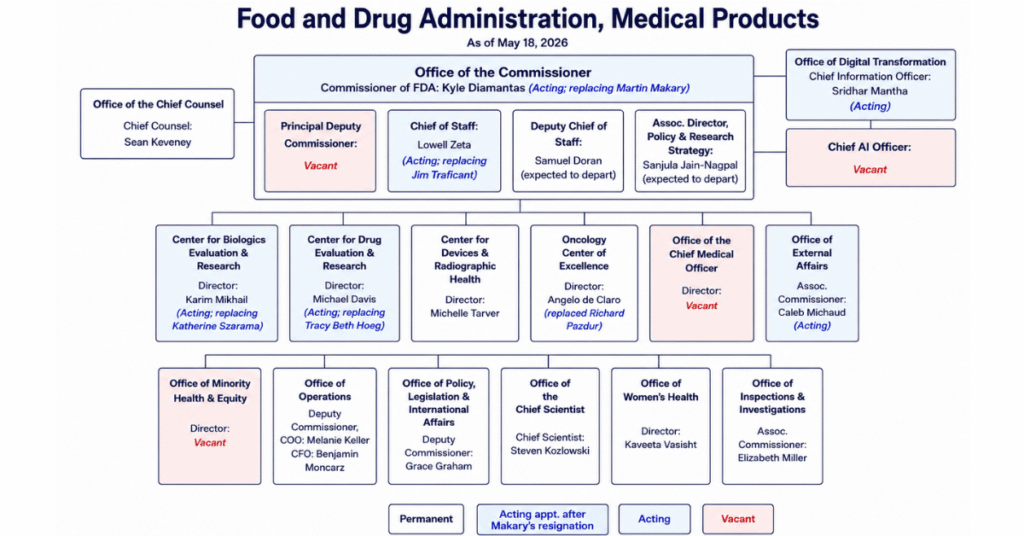
The agency is attempting to rehire after firing or offering early retirement to 3,500 staff last year. The previous commissioner announced plans to bring in 1,000 scientists, then 3,000 more. Roth’s concern is that new hires cannot replicate institutional knowledge on anything like the timeline required. He noted anecdotal reports that inspector training, historically 18 months, may now be as short as six weeks of computer-based coursework before field deployment. CDMOs may start seeing more observations from less experienced inspectors covering their checklists thoroughly rather than with calibrated judgment.
On user fees, the new Generic Drug User Fee Amendments (GDUFA) cycle — beginning October 1 of the year following the negotiation — will raise the foreign facility differential from $15,000 to $25,000 above the domestic rate. Overall fee levels will increase only with inflation: the negotiation was conducted on a resource-neutral basis, meaning FDA cannot expand its headcount beyond current levels.
BioSecure, passed in a weaker form as part of the 2025 National Defense Authorization Act, remains in limbo. No companies are named in the enacted version; instead, it depends on the Department of Defense’s annual 1260H list. That list was published, then withdrawn from the Federal Register within 15 to 20 minutes. It has not been reissued. Until it is, no BioSecure decoupling timeline is in effect.