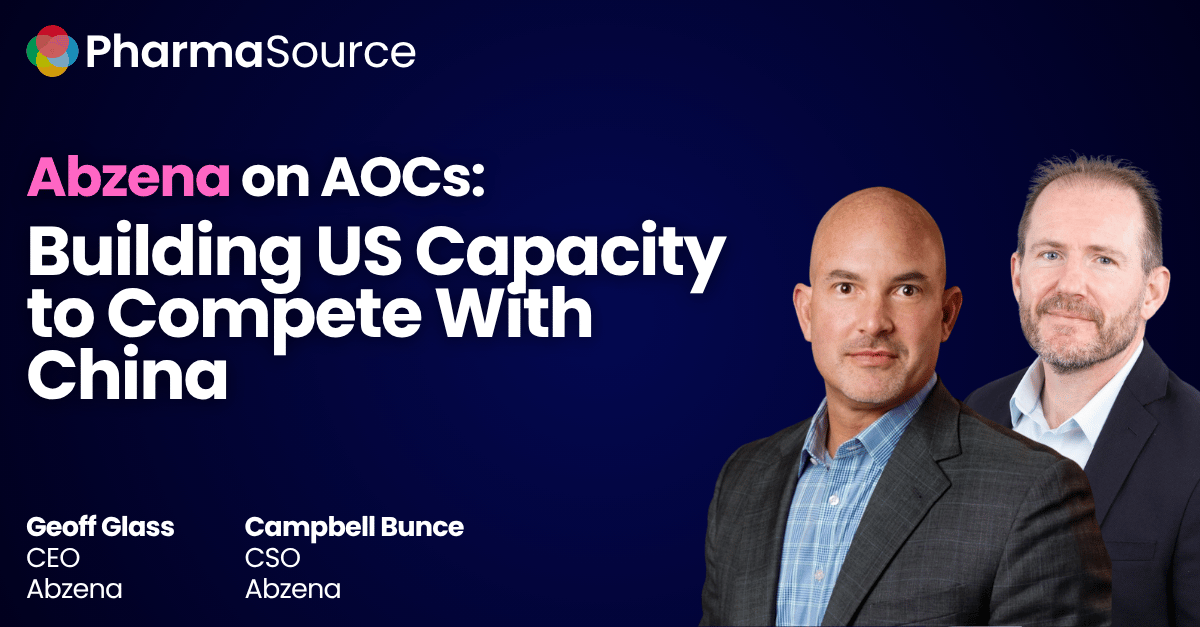
“There isn’t enough capacity for antibody-oligo conjugates out there today, full stop,” says Geoff Glass, CEO of Abzena. “And it’s really because of the volume requirements for the diseases.”
Geoff Glass is Chief Executive Officer of Abzena, the end-to-end, fully integrated CDMO and CRO for complex biologics and bioconjugates. He brings 30 years in life sciences, including at Patheon, Avadel, and Ncardia, and he chaired Abzena’s board before taking the CEO seat last year. He’s joined by Campbell Bunce, Abzena’s Chief Scientific Officer, who runs discovery through GMP manufacturing across the company’s San Diego, CA, Bristol, PA, and Cambridge, UK sites.
Antibody-oligonucleotide conjugates (AOCs) have moved from concept to late-stage development in just a few years, attracting major investment along the way. In the latest PharmaSource podcast, Geoff and Campbell walk through where the modality came from, manufacturing considerations compared to ADCs, and the broader geopolitical and capacity challenges in the US.
AOC Capacity
While antibody-drug conjugates (ADCs) are used almost exclusively in oncology, where potent payloads keep doses, and therefore batch sizes, relatively low, AOCs are moving into diseases that could require much larger manufacturing volumes.
“When we start going after diseases like Duchenne’s that require real dosing, or we go after huge disease states like Alzheimer’s, we’re going to have volume requirements as an industry that far outstrip what exists around the world today,” Geoff says.
That capacity challenge is emerging before the first AOC has even reached the market. Abzena already has more than 20 AOC projects underway, yet the facilities needed to manufacture these products at commercial scale do not currently exist, even within Abzena.
The company is now designing what Geoff describes as a potential “unique marquee facility” in the US, which would bring protein manufacturing and conjugation together at a single site. According to Geoff, no US facility is currently designed to handle conjugation at the scale likely to be required for commercial AOCs.
At the same time, Abzena is working with equipment manufacturers to enable larger conjugation batch sizes, which will be important for improving manufacturing efficiency and bringing cost-of-goods (COGS) down to commercially viable levels.
But increasing physical capacity is only part of the challenge. Campbell, who told PharmaSource a year ago that ADC demand was already outpacing US capacity, says the industry also needs the right technical expertise.
“Not just capacity, but expertise as well. That’s fundamentally important,” he says. “That must go hand in glove with capacity.”
AOC demand could eventually exceed current manufacturing capabilities, and the industry needs to expand both manufacturing capacity and specialist expertise to keep up.
The Front Lines Against China
Asked how geopolitics is shaping sourcing decisions, Geoff starts with Abzena’s competitive geography.
“We at Abzena are very much on the battleground, on the front lines against China, because our number one competitors that can do the kind of things we can do, that are unique, difficult scientific things in a turnkey way to create an IND for things like AOCs and ADCs. That competition is in China.”
His frustration is that US policy has pushed big pharma toward commercial manufacturing investment at home, but hasn’t addressed early-stage development, which is where the molecules and the IP get created.
“Would we outsource the next generation of leading semiconductors for research and development into China to save an incremental 20% cost? Would we do that? Why is the next generation of life-saving complex biologics any different? We should ask ourselves that. Because I don’t think it is. But I can tell you, our potential customers, they can’t resist the siren song when they’re a cash-strapped early private biotech, of saving some short-term money now and dealing with other problems later.”
Campbell, back from BIO in June, thinks the calculation is starting to shift, at least in the US. He describes meeting a founder who’d brought technology out of China and had decided not to manufacture there.
“He said he wasn’t going to manufacture in China because, since moving to the US, they’d built new proprietary aspects to it, and they didn’t want to share that with China, because they know that their technology’s going to be taken from them, certainly the IP. I think the penny’s dropping with a lot of early-stage companies, certainly in the US. Europe it’s a little bit slower, I would say, at the early stage.”
A New Pipeline
Oligonucleotides can silence or modulate the RNA targets sitting behind many disease pathways. That part has been understood for a long time. The problem was always delivery.
“The problem with oligonucleotides is twofold,” Campbell explains. “Their size and their high negative charge. This blocks them from getting into cells, but it also makes them vulnerable to degradation.”
Antibodies happen to be very good at exactly what oligos are bad at: finding the right cells and getting inside them.
“If we can chemically link oligos to antibodies, we can essentially post oligonucleotides directly to and into the cells where they will hopefully have their impact in knocking down the disease pathway.”
People have been tinkering with conjugating oligos to proteins for around three decades, Campbell says. What changed is that Avidity got an AOC into the clinic first, Dyne followed, and both are now at BLA stage — both, as it happens, chasing Duchenne muscular dystrophy. Everything since has followed those two.
The pipeline behind them, in Campbell’s words, “on the surface looks narrow, and deep.” Avidity, Dyne, Arrowhead and Novartis dominate the headlines. But Abzena is working with a growing set of earlier-stage developers, some in stealth, going after cardiomyopathy, Alzheimer’s, Parkinson’s and even obesity.
“We see that some of these folks are standing on the shoulders of the Dynes and the Aviditys who have carved a path for them. So, there’s an expectation that we’re going to see many more of these enter the clinic very quickly.”
The Economics of AOCs
Novartis paid $12 billion for Avidity last year in a landmark acquisition for the industry. Geoff points out that wasn’t even the whole story.
“Not only did Novartis have a monster deal with Avidity for $12 billion, but they also had a monster preclinical deal, the largest of the year, that was nearly $300 million upfront for an AOC product that had no clinical data yet. That tells you in stereo a really clear signal from somebody who’s committed to the space.”
He goes on to compare AOCs with gene therapy.
Fifteen years ago there was a rush into AAV. Geoff notes that Novartis acquired AveXis for about nine billion, which brought it Zolgensma for spinal muscular atrophy — “still to this day probably the most successful commercial gene therapy.” But he argues the promise hasn’t been delivered economically. “They’re expensive to make, and they come with real drawbacks… All viruses run to and are cleared by the liver. And so you have real limits in dosing, where many of those AAVs can only be dosed once, and then you have toxicity issues.”
“For big pharma, how they look at things is: can I get an effect? Can I get paid for the work I’m gonna do for the effect I’m gonna have on patients? And that has been a tough puzzle for gene therapy.”
AOCs go after a lot of the same tissue and disease territory, but the math is different.
“I can make this drug more cheaply, and patients can take it repeatedly over time instead of only getting one dose. That’s better for patients because they can keep benefiting from the treatment. It’s also better financially for pharmaceutical companies because the drug costs less to manufacture and can be sold/given repeatedly. That’s why pharma companies are willing to pay huge amounts for these drugs, even before they’re approved, because they can see how profitable they could become.”
AOC Manufacturing Considerations
AOCs are comparable to ADCs and are made in a similar way, using an antibody, linker, and payload. Campbell names two key differences in their manufacturing process.
AOCs carry a non-toxic oligonucleotide payload rather than a toxic drug payload. This is an important commercial advantage because the non-toxic payload can be handled and manufactured in more facilities, making production less restrictive and potentially cheaper.
“Unlike classical ADCs that use highly toxic payloads and consequently require to be handled within specialist handling environments from a safety perspective, oligos are not toxic,” Campbell says. “So rather than shipping the monoclonal antibody to a high potent API facility for the manufacture of the AOC, we can run conjugation in proximity to antibody manufacture.”
However, AOCs are more difficult to manufacture than ADCs because the oligonucleotide and antibody have opposing electrical charges, making them harder to attach together. While an ADC can carry up to 12 payloads, an AOC typically carries only one or two. As a result, much of the manufacturing challenge comes after the components are joined, particularly in the downstream purification and processing steps.
“This can be particularly challenging for the AOCs, as we need to account for and reduce or remove the undesired oligonucleotide formats. We can see that undesired hairpin formations, miscellaneous annealing, and diastereomers are often problematic. Now you can manage this through salt concentration adjustments, or really understanding and controlling the optimal melting temperatures that we apply to the downstream process. And unlike ADCs, we rely heavily on ion exchange to purify out the desired format of these highly charged molecules.”
He’s quick to add that none of this means the molecules should be over-engineered. “You don’t need to get overly complex in the design of these molecules. This is about delivering a payload that’s highly effective within the cell. So we know how to make these things, and we’re getting better at it.”
There’s also a genuine platform advantage here, and it’s where the two of them get most animated. If your antibody targets multiple cell types across several indications, you can lock the antibody process down and just swap the cargo.
“Let’s say I develop my platform on my first product,” Geoff says. “That’s typically a fourteen- to sixteen-month process to go all the way through all the protein conjugation, everything, get into the clinic, get my IND filed. But then if you skip all that protein development work, and then you just go right into interchanging an oligo in the conjugation method, you compress half of your development time.”
Campbell adds that the reuse goes further than the antibody. “The same bioconjugation and manufacturing process can be reused across different AOC products. Only the oligonucleotide sequence needs to change. This means manufacturers could develop a standardized platform process, rather than creating a new manufacturing process for every AOC.”
For a fuller breakdown of where AOC design diverges from ADCs, see ADCs vs. AOCs: Shared Design Principles & Key Differences in Bioconjugate Engineering.
What’s Next?
Radioconjugates (RDCs) are the next modality on Campbell’s watchlist, which invert the AOC volume problem as “you can actually make a small batch and see that go very far.” According to Campbell, degraders (DACs) and multi-payload bispecifics are also ones to watch.
The first bispecific conjugate was approved in China earlier this year; Abzena is working on bispecifics carrying multiple payload combinations.
Geoff’s future outlook: “We have decades of clinical and commercial data that demonstrate that proteins are very good at targeting cells and in delivering payloads intracellularly to cells to create effective therapies. That isn’t going away. What will develop and change over time is what we are delivering to those cells. Is it a small-molecule cytotoxic? Is it a radioisotope? Is it some RNA through some other chemistry? And where the magic happens is in designing the drug so that it can be repeatably made at scale.”