“You can design all the quality systems you want, but without the right culture, it’s going to mean nothing — because the decisions get made based on the values of the organization, not based on the systems,” says Jeff Broadfoot, VP Quality Operations at Emergent.
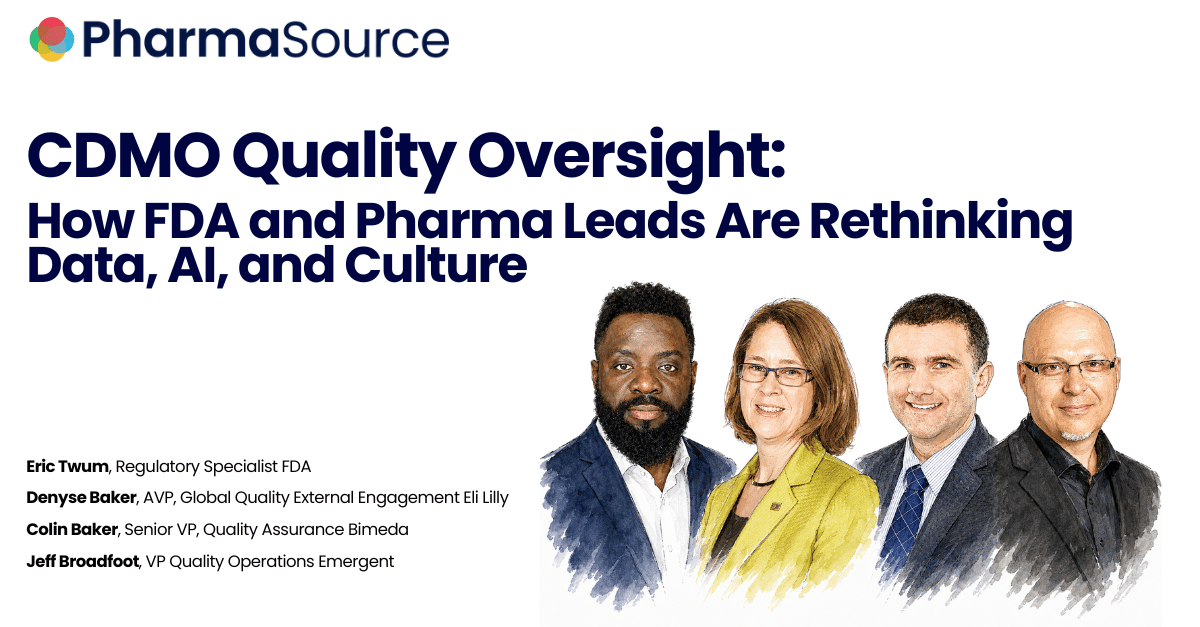
Jeff is one of four quality leaders joining “Next-Generation Quality Management: From CDMO Oversight to Partnership Excellence” at CDMO Live Americas, October 20-21 in Boston. Ahead of the session, PharmaSource spoke with the panelists about the challenges shaping quality oversight of external manufacturing right now.
The panel brings together four perspectives that rarely share a stage:
- Denyse Baker, AVP Global Quality External Engagement at Eli Lilly and a former FDA official, who works on how sponsors and CDMOs engage on quality
- Jeff Broadfoot, VP Quality Operations at Emergent, with 33 years in pharma, currently working both sides of the contract manufacturing relationship
- Colin Baker, Senior VP Quality Assurance at Bimeda, who oversees a multi-region network of CMOs while also serving as a CMO for other companies’ products
- Eric Twum, Regulatory Specialist in the Office of Quality Surveillance, Office of Pharmaceutical Quality, CDER, FDA, one of the agency’s leading voices on Quality Management Maturity
Quality oversight of external networks is increasingly more complex. Sponsors are managing more CDMOs, across more geographies and modalities, while AI raises expectations for real-time visibility that current data-sharing arrangements were never designed to support.
From Reactive Oversight to Predictive Quality
For Colin, the defining shift in external quality management is moving from responding to problems to anticipating them, and that depends on data access.
“You can’t be reactive. You have to be able to look at it in a way where you can start to anticipate where the trends are going, versus just waiting until something happens and then reacting to it,” he says. “If you can find a partner where they do have electronic data and they’ll give you access into it, it can be a very powerful tool because then you can work directly with them, you can give them information to say, here’s what you might want to consider.”
Managing partners across the US, Canada, Europe, and Latin America, Colin structures oversight around common pillars with region-specific content: “The pillars that I’ve been using are around business performance, compliance, risk, and general facility preparedness. They can still follow the same basic framework, but the metrics are going to be very different.” Oversight intensity is then allocated by risk assessment (product type, market requirements and modality), a tiered approach the panel will unpack in detail.
The Data-Sharing Dilemma: Visibility vs. Confidentiality
Denyse explains that sponsors increasingly want to see not just their own batch data, but the overall health of a CDMO’s quality system.
“Everybody wants their own data, but from a quality system standpoint, I would also like to see the overall health of the quality system,” she says. “How does the CDMO share that without compromising their agreements to keep things proprietary across the different companies?”
Colin, who sits on both sides of that exchange, is candid about the risk: “I’d be hesitant to turn over access to any of our systems. You may need to tie it more closely into your quality agreements so you can be more confident about how the data is used and how it’s stored. I think you’d need to develop frameworks surrounding it specifically.” He even sees a possible role for neutral third parties sitting between sponsor and CDMO systems.
AI is Raising the Bar For Industry and Regulators Alike
Panelists are already using AI in quality, and both are watching the FDA do the same. Jeff’s team has turned to AI for long-term trending: “FDA has started looking at data over two, three years… We’ve been starting to use AI to look at long-term trends, so that we catch a trend earlier and we can do something about it earlier, before it becomes a problem.”
Colin is realistic about the current limits: “Everything I’ve seen so far is that it can get you 75% of the way there. It’s not going to replace anything directly, but it should make it a lot quicker to get information, so we can spend more time trying to deal with trends versus spending a month trying to make up a trend report.” He’s also preparing his teams for inspections where the agency arrives with its own AI tools in hand.
Influence, Not Authority
Internally, a quality leader can mandate change. Across a CDMO network, they can’t, and Jeff argues this is the skill gap the industry underestimates. “You don’t have that kind of sway with CDMOs, and you have to influence them. It becomes a question of: do you know how to effectively influence your partners?”
What he’s trying to influence partners toward is proactive quality thinking, acting on what a deviation could have meant, not just what it technically was. He gives an example from his own organization: a deviation during an engineering run was classified as minor, which was correct by the letter of the SOP, because an engineering run has no product impact. But the same failure during a commercial run would have been serious. “If that had happened during a commercial run, we have a major problem. You can prevent that. That’s the proactive part of this thinking — make it a major and go figure it out, rather than a minor where we just say direct cause and shuffle it under the carpet.”
Getting an organization, internal or external, to think that way is a culture change, and quality leaders have to be prepared to work toward long-term gains rather than quick wins, Jeff explains: “You’re talking about one, two, three years to see tangible outcomes from the change in culture. It takes time and patience.”
The Regulator’s View: Quality Maturity as Business Value
Eric brings the FDA perspective to the CDMO Live Americas panel. Through CDER’s Quality Management Maturity (QMM) Program, the agency is building a framework that assesses the behaviors and practices behind an establishment’s quality culture, explicitly beyond CGMP compliance, across five practice areas: management commitment to quality, business continuity, advanced pharmaceutical quality systems, technical excellence, and employee engagement and empowerment.
The stakes are supply security: FDA data shows quality issues and manufacturing delays accounted for 42% of new drug shortages between 2022 and 2024, and the QMM program was designed to fix a market that doesn’t recognize or reward mature quality systems. In recent presentations, Eric has shared results from the first prototype assessment cohort: nine establishments scored across the five areas, with advanced PQS and technical excellence emerging as the lowest-scoring practice areas, and the program has now opened its third cohort.
What you’ll take away
- How to implement tiered governance frameworks that allocate oversight resources based on CDMO criticality and performance
- Strategies for harmonizing quality standards across diverse CDMO partners without stifling their operational flexibility
- Practical approaches to building quality culture and transparency into external manufacturing relationships from day one
- How to navigate the emerging challenge of data sharing and IP protection as AI and automation raise expectations for real-time quality visibility across CDMO networks
Join the conversation at CDMO Live Americas, October 20-21, Boston.