Antibody-drug conjugates (ADCs) exploit the inherent selectivity of monoclonal antibodies to achieve targeted delivery of cytotoxic agents. By conjugating a potent small-molecule payload to an antibody recognizing a tumor-associated surface antigen, the cytotoxin can be preferentially delivered to cells or tissues that overexpress the target, thereby enhancing therapeutic index. However, when this paradigm is extended to oligonucleotide payloads, although antigen-mediated selectivity is retained, several additional challenges emerge that differentiate these bioconjugates from classical ADCs.
Oligonucleotide therapeutics offer a distinct and complementary modality relative to conventional ADC payloads. Antisense oligonucleotides (ASOs) and small interfering RNAs (siRNAs) enable sequence-specific modulation of gene expression through mechanisms such as RNase H-mediated degradation, RNA interference, or splice modulation. These mechanisms allow access to targets that are often considered undruggable by small molecules or biologics, thereby significantly expanding the therapeutic landscape.
Despite these advantages, oligonucleotides present intrinsic delivery and stability limitations. Their polyanionic backbone impedes passive diffusion across cellular membranes, resulting in inefficient cellular uptake. Furthermore, unmodified oligonucleotides exhibit poor stability in biological fluids, with rapid degradation by endo- and exonucleases leading to half-lives on the order of minutes in serum. Chemical modifications such as phosphorothioate (PS) linkages, 2′-fluoro substitutions, and 2′-O-methyl modifications can enhance nuclease resistance, improve pharmacokinetic properties, and increase plasma protein binding. However, these modifications alone are insufficient to confer selective delivery to specific cell types or tissues.
Targeted delivery can be achieved through conjugation to a monoclonal antibody, giving rise to antibody-oligonucleotide conjugates (AOCs). These constructs leverage receptor-mediated endocytosis to drive uptake into antigen-expressing cells, thereby imparting tissue selectivity and enhancing intracellular delivery efficiency. Structurally, AOCs share the same fundamental architecture as ADCs, comprising three key components: a monoclonal antibody, a linker, and a payload. In ADCs, the payload typically consists of a highly potent, often hydrophobic cytotoxin, whereas in AOCs the payload is an oligonucleotide such as an siRNA, ASO, or phosphorodiamidate morpholino oligomer (PMO). Critically, the design of the linker connecting the oligonucleotide to the antibody is a key determinant of AOC performance. Linker chemistry influences stability in circulation, intracellular release, and overall pharmacological activity, and is therefore a central factor governing the success or failure of AOC therapeutics.
Optimizing Drug Loading for AOCs
In ADCs, the cytotoxic payload is conjugated to the antibody at a defined drug-to-antibody ratio (DAR), most commonly in the range of two to eight. Within this range, payload loading is relatively well tolerated: increasing DAR enhances intrinsic potency generally without proportionally compromising pharmacokinetic behavior, although high DAR can still influence aggregation propensity, systemic clearance, and tolerability depending on the physicochemical properties of the payload and the nature of the linker (1).
In contrast, more stringent constraints on payload loading apply for AOCs. Oligonucleotide payloads are substantially larger than conventional ADC cytotoxins (typically 5 to 15 kDa versus < 1 kDa), often highly anionic due to their phosphodiester or phosphorothioate backbone, and capable of forming secondary and higher-order structures. These attributes collectively render AOC performance significantly more sensitive to increases in oligonucleotide-to-antibody ratio (OAR).
The contribution of charge is particularly consequential. Each phosphate group introduces an additional negative charge, resulting in a marked increase in overall conjugate charge density with rising OAR – an effect not observed with most hydrophobic ADC payloads. Empirical observations for some siRNA-based AOCs have indicated a steep, non-linear relationship between OAR and systemic clearance: increasing OAR from 1 to 2 can accelerate plasma clearance by approximately five-fold, while OAR 3 constructs may exhibit clearance increases on the order of thirty-fold or greater (Figure 1). This behavior is likely driven by more pronounced non-specific uptake of highly charged conjugates, particularly in clearance organs such as the liver (2). Notably, charge-neutral oligonucleotide analogues such as phosphorodiamidate morpholino oligomers (PMOs) demonstrate improved tolerance to higher OARs, supporting the conclusion that electrostatic effects rather than molecular size alone are a dominant determinant of pharmacokinetic liability in these systems (3).
Consequently, siRNA-based AOCs are frequently optimized at low payload loading, often favoring OAR 1 architecture. Antisense oligonucleotide-based AOCs may exhibit similar trends, although the optimal OAR appears to be more dependent on sequence, chemistry, and overall construct design, and thus cannot be generalized to a single preferred value (3) Achieving a OAR of 1 is inherently challenging using stochastic conjugation approaches, as these generate a statistical distribution of drug-loaded species; instead, to efficiently achieve the defined, homogeneous conjugate profile required for low-OAR architectures, a site-specific conjugation approach is required. For PMO-based AOCs, the constraint is less severe, and the charge-neutral backbone tolerates higher loading without the rapid hepatic clearance that drives siRNA AOCs toward OAR 1 (3).
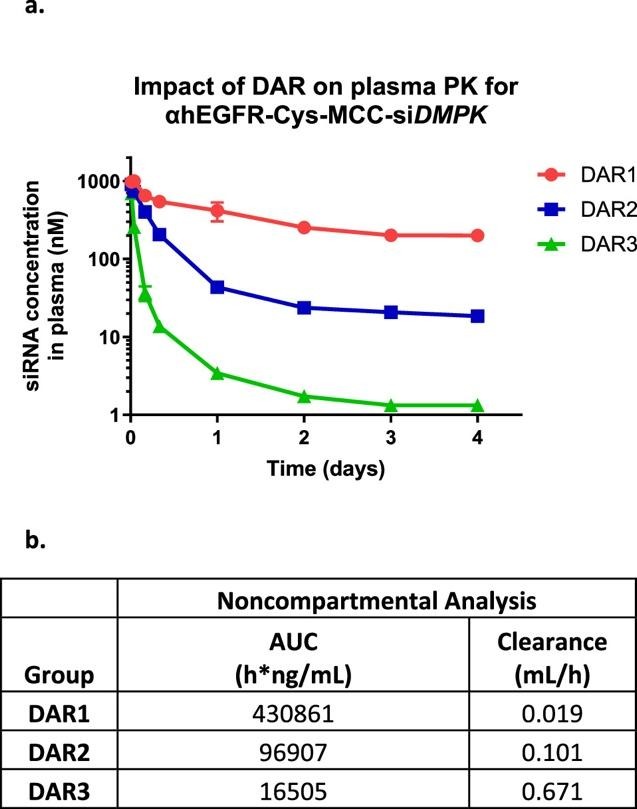
Figure 1. (a) Mouse plasma PK of AOCs (αhEGFR-Cys-MCC-siDMPK) comprised of αhEGFR mAb conjugated to one, two, or three siRNAs targeting DMPK mRNA. (b) Noncompartmental analysis of plasma PK data (0–96 h). Figure and legend from Cochran et al. 2024) https://doi.org/10.1021/acs.jmedchem.4c00802.
Despite typical drug loading differences between ADCs and AOCs, similar requirements, often competing, apply to their linkers. The linker must (i) maintain conjugate integrity during systemic circulation, (ii) enable efficient intracellular release of the payload in a biologically active form, and (iii) preserve both antigen binding by the antibody and the molecular mechanism of the payload. As such, AOC linkers necessitate careful design and systematic optimization.
Stability: Keeping the Oligonucleotide Attached Until it Reaches the Target
For both ADCs and AOCs, plasma stability is a critical parameter defined by the sustained retention of the payload on the antibody scaffold throughout systemic circulation, slow clearance kinetics and minimal premature release that could lead to off-target toxicity. Despite differences in payload class, both modalities are subject to similar chemical liabilities, with instability frequently originating from the conjugation chemistry itself.
The most widely employed conjugation strategy involves maleimide-functionalized linkers reacting with free thiols on cysteine residues generated through partial reduction of interchain disulfides. However, this linkage is intrinsically labile: maleimide-thiol adducts are susceptible to retro-Michael deconjugation under physiological conditions (4). Consequently, conjugates undergo progressive deconjugation in circulation, leading to payload loss and impacting pharmacokinetics.
Site-specific conjugation strategies directly address these limitations giving access to homogenous, stable bioconjugates. ThioBridge® technology, for example, enables the rebridging of reduced interchain disulfides via a three-carbon linker, forming highly stable thioether bonds with no observed deconjugation of the linker in systemic circulation or during storage. This approach has been shown to produce highly homogeneous conjugates, achieving up to ~80% single-DAR species for ADCs (Figure 2). Importantly, the underlying chemistry is transferable to AOCs, where it mitigates the same hydrolytic liabilities associated with conventional maleimide linkages and simplifies downstream analytical workflows by reducing species heterogeneity. This chemistry is particularly well-suited to Fab-format AOCs, where a single interchain disulfide provides a defined, low-copy conjugation handle; rebridging it via ThioBridge® preserves the fragment’s structural integrity and delivers a homogeneous product (5).
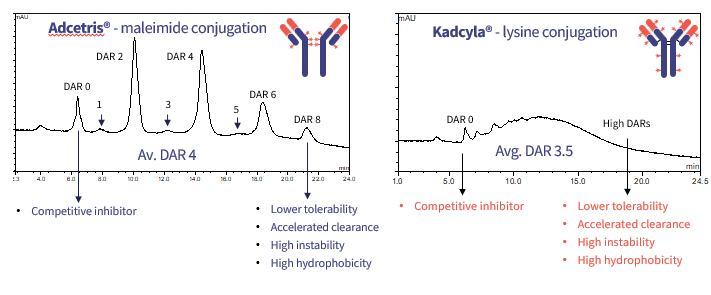
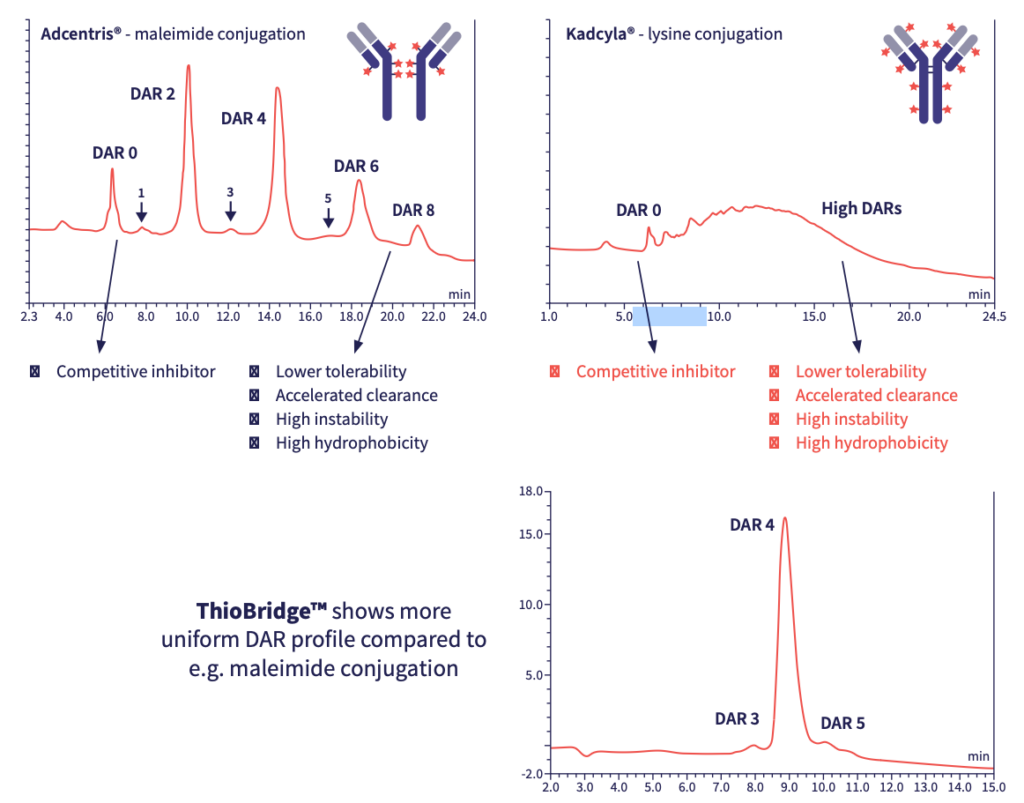
Figure 2. Drug-to-antibody ratio (DAR) distribution comparison of first-generation conjugation technologies assessed by hydrophobic interaction chromatography (HIC). Adcetris® represents maleimide conjugation, while Kadcyla® represents lysine conjugation. Both DAR profiles are more heterogeneous than ADCs produced by ThioBridge® conjugation.
Release: Balancing Plasma Stability with Intracellular Delivery
Plasma stability represents only one aspect of the design challenge. Equally critical is the efficient intracellular release of the oligonucleotide cargo following target cell uptake of the AOC. Achieving an optimal balance between systemic stability in circulation and controlled, efficient payload release within the target cell is therefore a key consideration in the rational design of AOC linkers.
Different mechanisms can be engineered in the linker for payload release
Three release strategies dominate AOC design when active cleavage is the intended mechanism:
- Enzyme-cleavable peptide spacers, often valine-citrulline, associated with a self-immolating para-aminobenzyl (PAB) group for traceless release, are cleaved by cathepsins present in endosomes and lysosomes. Dyne’s DYNE-251 (anti-TfR1 Fab-PMO conjugate designed for the treatment Duchenne muscular dystrophy (DMD) in patients amenable to exon 51 skipping) incorporates this type of protease-cleavable valine–citrulline linker for instance.
- Acid-labile linkages (hydrazones, acetals, carbonates) cleave at the lower pH of the endosomal-lysosomal compartment (pH 4.5–6.0 versus 7.4 in plasma).
- Reducible disulfides exploit the reducing cytosolic environment, where glutathione concentrations can be a thousand-fold higher than in plasma.
Each approach has a corresponding plasma half-life and an intracellular release profile, and these two profiles are not independent. A hydrazone that releases reliably at endosomal pH is also more susceptible to background hydrolysis in serum. A disulfide highly stable in circulation may not reduce efficiently once inside the cell.
Non-cleavable linkers are still an option
A cleavable linker is not universally required, as illustrated by multiple examples of AOCs targeting the transferrin receptor 1 (TfR1) (6). Avidity’s AOC 1001 for instance – an anti-TfR1-siRNA conjugate currently in Phase III clinical development for myotonic dystrophy type 1 (DM1) – employs a non-cleavable SMCC linker. This highlights the multiplicity of valid linker options leading to efficacious AOCs. Target trafficking and endosomal escape are key parameters beyond linker design.
Endosomal escape represents an additional downstream constraint that is not fully addressed by linker design alone. Quantitative NanoSIMS analyses of GalNAc-conjugated phosphorothioate ASOs indicate that only approximately 1–2% of the internalized oligonucleotide payload successfully escapes the endosome into the cytosol, where it engages its molecular target (7). While linker optimization cannot fully compensate for these intrinsic losses, the site of payload release – whether in early endosomes or within the late endosomal-lysosomal pathway – may influence the fraction of oligonucleotide that reaches the cytosol in a functionally competent form.
Attachment Position Matters on Both the Antibody and the Oligonucleotide
The site of conjugation on the oligonucleotide is a critical determinant of functional activity. For siRNA modalities, functionalization at either terminus of the sense strand is generally well tolerated, with minimal impact on RNAi activity, as only the antisense strand is incorporated into the RNA-induced silencing complex (RISC) to mediate target mRNA cleavage (8). Conjugation at the 5′ end of the sense strand is therefore the conventional approach and preserves full biological activity. In contrast, internal modifications – such as attachment at the 2′ position of a ribose moiety – often result in a loss of activity, even when total tissue exposure is equivalent, possibly indicating impairment of RISC loading rather than delivery efficiency (2). This trend tends to verify for cleavable and non-cleavable linkers placed mid-strand.
The site of conjugation on the antibody represents an equally critical determinant of in vivo stability and pharmacokinetics. In a comparative study evaluating cysteine-, lysine-, and Asn297 glycan-based conjugation in siRNA AOCs, cysteine-linked constructs exhibited favorable plasma exposure, whereas lysine-conjugated variants display more rapid clearance, largely attributable to increased heterogeneity within the conjugate population (2). Taken together, these data point to site-specific cysteine conjugation as the most robust and defensible strategy for maximizing stability and ensuring consistent biopharmaceutical performance across conjugate modalities.
How the Trade-offs are Resolved in Practice
The combinatorial design space remains extensive and continues to expand for AOCs. Multiple interdependent parameters must be considered, including conjugation chemistries (e.g., maleimide-thiol, NHS ester, copper-free DBCO/azide click, and site-specific platforms such as ThioBridge®), release mechanisms (pH-sensitive, enzymatic, reductively cleavable, or non-cleavable systems), linker length and composition, spacer architecture, polyethylene glycol (PEG) or other polymer incorporation, oligonucleotide chemical modification patterns, and the site of attachment on both the antibody and the oligonucleotide. These variables exhibit significant interplay, underscoring that no single linker strategy is universally optimal for all AOC constructs.
Navigating this broad design space requires a data-driven approach. Bioorthogonal conjugation strategies, particularly copper-free DBCO-azide click chemistry, enable the rapid generation of modular linker libraries in which key parameters – such as release mechanism, OAR, conjugation chemistry, and incorporation of solubilizing elements – can be systematically varied in parallel.
At Abzena, this capability is leveraged through structured, head-to-head comparative studies across candidate constructs to balance systemic stability with efficient intracellular oligonucleotide release. Lead candidates are subsequently advanced into robust and reproducible manufacturing processes suitable for scale-up.
These comparative evaluations are conducted across multiple dimensions, including antibody format (e.g., full-length IgG, Fab, VHH), conjugation site, and target OAR. Downstream analytical characterization encompasses orthogonal techniques such as SEC-MS, CE-based methods, and hybridization assays to assess critical quality attributes, including purity, aggregation profile, integrity of the oligonucleotide payload, completeness of conjugate assembly, and overall biological activity.
Our approach does not rely on the systematic application of an abstract ‘optimal’ linker. Instead, linker selection is driven by alignment with the specific target product profile (TPP) of the AOC under development. This encompasses the oligonucleotide modality, the biological target and its intracellular trafficking pathway, the therapeutic indication, manufacturability considerations, and the regulatory expectations governing impurity profiles and control strategies.
Linker design for AOCs cannot be entirely addressed by directly translating linker strategies developed for ADCs to alternative payload modalities. Rather, it constitutes a distinct optimization problem in which commonly used descriptors – such as cleavable, non-cleavable, and plasma-stable – acquire different functional implications. These differences arise from the unique physicochemical behavior of oligonucleotide payloads and the critical influence of target biology on defining what constitutes sufficient systemic stability and effective intracellular release.
Successful AOC constructs emerge from an integrated design approach in which the linker, oligonucleotide, antibody, conjugation chemistry, and manufacturing process are selected in concert. In this framework, inherent trade-offs are anticipated and rationalized during early design phases, rather than being identified retrospectively through analytical characterization. This integrated optimization process is fundamental, and it is precisely where extensive bioconjugation expertise delivers the greatest value.
Contributing author
This article was developed with contributions from Dr. Nicolas Camper, VP of ADCs & Bioconjugates at Abzena, who provided expert insight into bioconjugation, linker design, and antibody-oligonucleotide conjugate (AOC) development.
Looking to advance an AOC program?
Abzena supports biopharma companies across AOC development, from linker and conjugation strategy through analytical characterization, process development and scalable manufacturing. Learn more about Abzena’s bioconjugation capabilities or speak with their experts about your program.
References
1. K.J. Hamblett, P.D. Senter, D.F. Chace, M.M. Sun, J. Lenox, C.G. Cerveny, K.M. Kissler, S.X. Bernhardt, A.K. Kopcha, R.F. Zabinski, D.L. Meyer, J.A. Francisco, Effects of drug loading on the antitumor activity of a monoclonal antibody drug conjugate. Clin Cancer Res,10, 7063-70 (2004)
2. M. Cochran, D. Arias, R. Burke, D. Chu, G. Erdogan, M. Hood, P. Kovach, H. W. Kwon, Y. Chen, M. Moon, C. D. Miller, H. Huang, A. Levin, V. R. Doppalapudi, Structure–Activity Relationship of Antibody–Oligonucleotide Conjugates: Evaluating Bioconjugation Strategies for Antibody–siRNA Conjugates for Drug Development. J. Med. Chem. 67, 14852–14867 (2024).
3. M. Cochran, I. Marks, T. Albin, D. Arias, P. Kovach, B. Darimont, H. Huang, U. Etxaniz, H. W. Kwon, Y. Shi, M. Diaz, O. Tyaglo, A. Levin, V. R. Doppalapudi, Structure–Activity Relationship of Antibody–Oligonucleotide Conjugates: Evaluating Bioconjugation Strategies for Antibody–Phosphorodiamidate Morpholino Oligomer Conjugates for Drug Development. J. Med. Chem. 67, 14868–14884 (2024).
4. S.C. Alley, D.R. Benjamin, S.C. Jeffrey, N.M. Okeley, D.L. Meyer, R.J. Sanderson, P.D. Senter, Contribution of linker stability to the activities of anticancer immunoconjugates. Bioconjug Chem. 19, 759-65 (2008)
5. G. Badescu, P. Bryant, M. Bird, K. Henseleit, J. Swierkosz, V. Parekh, R. Tommasi, E. Pawlisz, K. Jurlewicz, M. Farys, N. Camper, X. Sheng, M. Fisher, R. Grygorash, A. Kyle, A. Abhilash, M. Frigerio, J. Edwards, A. Godwin. Bridging disulfides for stable and defined antibody drug conjugates. Bioconjug Chem. 25,1124-1136 (2014)
6. M. Li, H. An, J. Zhang, W. Li, C. Yu, L. Wang, Advances in the pharmaceutical development of antibody-oligonucleotide conjugates. Eur. J. Pharm. Sci. 215, 107292 (2025).
7. C. He, M. T. Migawa, K. Chen, T. A. Weston, M. Tanowitz, W. Song, P. Guagliardo, K. S. Iyer, C. F. Bennett, L. G. Fong, P. P. Seth, S. G. Young, H. Jiang, High-resolution visualization and quantification of nucleic acid–based therapeutics in cells and tissues using Nanoscale secondary ion mass spectrometry (NanoSIMS). Nucleic Acids Res. 49, 1–14 (2020).
8. J. W. Lee, J. Choi, Y. Choi, K. Kim, Y. Yang, S. H. Kim, H. Y. Yoon, I. C. Kwon, Molecularly engineered siRNA conjugates for tumor-targeted RNAi therapy. J. Control. Release 351, 713–726 (2022).