Artificial intelligence (AI) agents could dramatically accelerate clinical drug development, delivering 35 to 45 percent productivity gains across all clinical functions while cutting trial design timelines in half, according to a comprehensive analysis from McKinsey & Company.
The consulting firm’s study of pharmaceutical workflows found that AI agents—autonomous systems that can perform tasks independently rather than simply serve as tools—show particular promise in clinical development, with applications spanning trial design, site management, data collection, and regulatory documentation.
Clinical Development Productivity Gains by Function
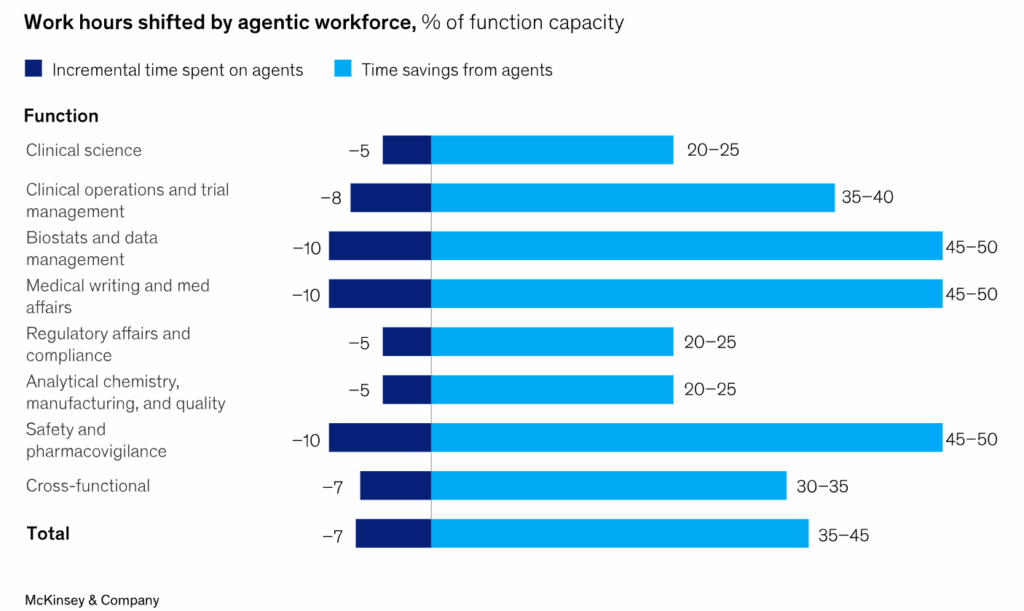
McKinsey’s analysis reveals varying productivity impacts across clinical development functions. Biostats and data management could see the largest gains, with 45 to 50 percent time savings after accounting for the 10 percent of capacity needed to manage AI agents. Medical writing and medical affairs, along with safety and pharmacovigilance functions, could achieve similar productivity improvements.
Across all clinical development functions, the analysis projects an average of 35 to 45 percent time savings, with only 7 percent of capacity required for agent management and oversight.
Agents can Benefit Roles in Every Clinical Development Function
Seven Key Agent Roles in Development
The report identifies seven critical roles AI agents could play in clinical development:
- Optimizing trial designs using machine learning and benchmark data retrieval
- Orchestrating sites, vendors, and sponsors for faster start-ups
- Managing clinical data from electronic capture design through anomaly detection
- Engaging sites and investigators with personalized communications
- Managing trials with root cause investigations and action recommendations
- Assembling submission materials with regulatory intelligence
- Automating document production throughout trial lifecycles
Trial Design Transformation
In trial design, McKinsey envisions a network of specialized agents working collaboratively. A clinical-trial benchmarking agent would identify similar trials and establish enrollment benchmarks, while a literature-explorer agent evaluates competitive landscapes. These outputs would feed a trial-optimizer agent using machine learning to refine designs under human supervision.
The process concludes with a document-generation agent creating protocol drafts in minutes using design element libraries, with refinement through feedback from critic agents and clinical scientists. McKinsey projects this approach could enable 50 percent faster trial design with 25 percent fewer amendments.
Site Activation and Data Management
For study start-up, the analysis describes a systematic agent-driven approach beginning with site feasibility questionnaires and machine learning-based site selection. Subsequent agents would handle contract drafting based on fair market value benchmarks and generate site-specific documents, including investigator brochures.
This coordinated approach could potentially double site activation rates while requiring 30 to 50 percent fewer staff, according to the report.
Clinical data flow could be similarly transformed, with agents extracting protocol metadata to create case report forms, flagging data entry delays, detecting anomalies, and producing analysis datasets. McKinsey estimates this could boost data management and programming productivity by 60 percent while reducing database build timelines from two to three months to under two weeks.
Real-World Implementation
The report cites an unnamed major pharmaceutical company that has already deployed a multi-agent trial copilot to improve development oversight. The system uses specialized agents focused on site activation, subject enrollment, data management, and trend analysis, all coordinated by a supervisor agent.
These agents access the company’s clinical control tower data to provide real-time insights and initiate proactive interventions for on-time trial completion. The company plans to grant greater independence to agent teams, including direct engagement with principal investigators and clinical research associates.
Industry Context and Implications
McKinsey positions these clinical development advances within broader industry challenges, including rising R&D costs, regulatory complexity, and pressure for faster time-to-market. The analysis suggests companies implementing agentic AI could “operate radically differently and more competitively five years from now.”
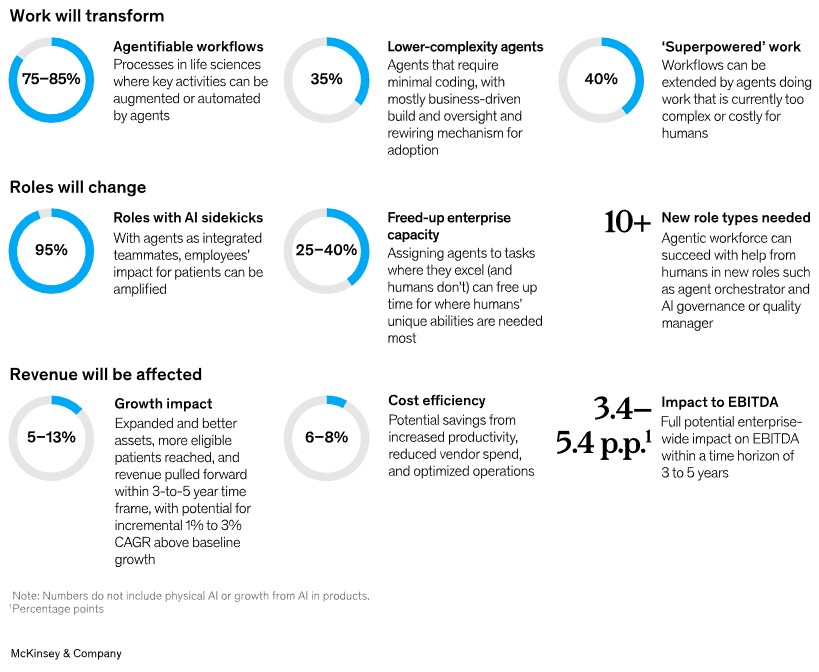
The productivity gains in clinical development represent part of a larger transformation McKinsey projects across pharmaceutical operations, with potential EBITDA increases of 3.4 to 5.4 percentage points over three to five years.
Source: McKinsey & Company analysis “Reimagining life science enterprises with agentic AI,” September 2025