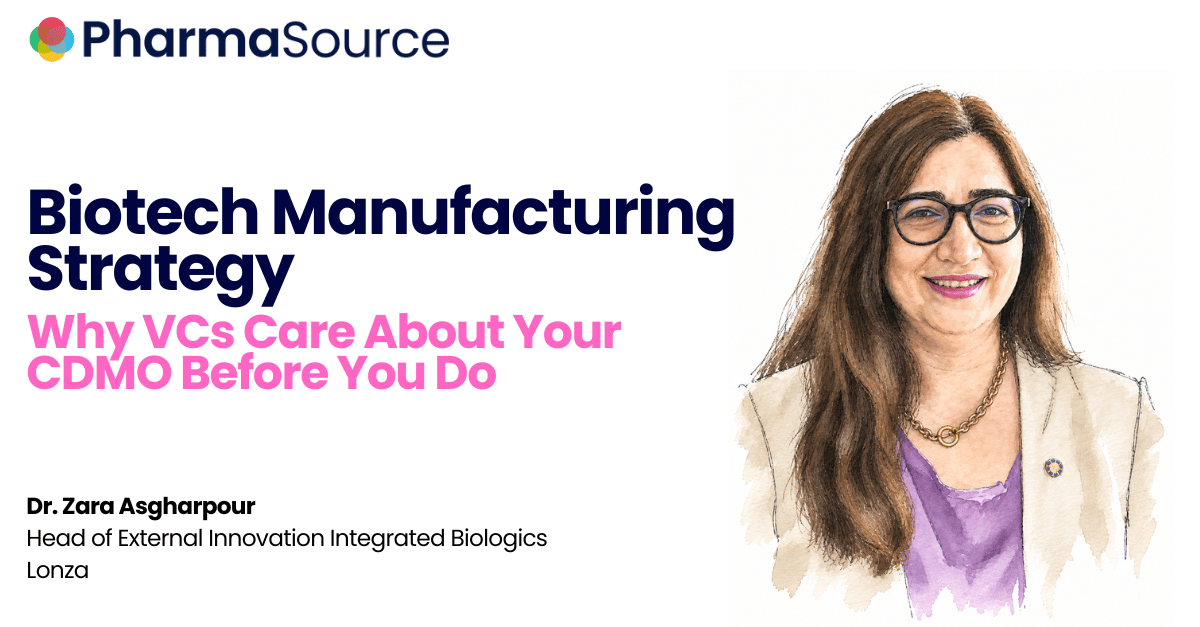
“Developing something in the lab and providing a drug that is going to serve billions of people is a completely different thing.”
Dr. Zara Asgharpour, Head of External Innovation Integrated Biologics at Lonza, describes what venture capital firms are doing when they ask a biotech founder how their drug will get made. Often, first-time founders aren’t ready for that question. They’ve invested time and runway into perfecting the science story, the target, the mechanism, the early data, but often lack a well-defined CMC strategy. Chemistry, manufacturing, and controls (CMC) is what bridges the gap between a promising molecule in the lab and a product that can be manufactured safely, consistently, and at scale.
Zara Asgharpour is Head of External Innovation for Lonza’s Integrated Biologics division — the team that scouts and evaluates 400 to 500 biotech companies a year for potential partnerships. Before this, she worked in corporate venture capital, doing exactly the due diligence she now describes from the other side of the table. Her message for founders is that investors are already assessing your manufacturing thinking, whether or not you’ve started it.
The Question Hiding Inside Every VC’s Diligence Process
Zara explains that a key evaluation criterion for VCs is execution risk. “No matter what type of molecule or what type of therapy they want to try to bring into the market, they look into whether or not they have chosen a trustable CDMO,” she says — a CDMO being a Contract Development and Manufacturing Organization, the outside partner most biotechs rely on to make their drug rather than building their own factory. “Developing something in the lab and providing a drug which is going to serve billions of a population is a completely different thing.”
The specific risks investors probe, in her account: “developability, manufacturability, and formulatability assessments, alongside immunogenicity evaluations, whether the companies have been thinking about that.” Manufacturability is whether your molecule can actually be produced reliably at scale. Many promising lab compounds turn out to be extremely difficult or expensive to manufacture consistently.
A founder who hasn’t thought about either is, in effect, asking investors to fund a decade of uncertainty on faith. “Drug development is a long journey, as everyone in pharma knows — it can take up to 10 years from idea into commercial launch,” Zara says. “VCs want to make sure that the money that they are investing is not going to be wasted.” A CDMO relationship that’s been chosen well is, in her framing, a form of insurance for the capital already committed: “Throughout the partnership with a CDMO, they don’t have to worry about these things, because the CDMOs master the knowledge and the know-how in those areas, CMC as well.”
Why “We’ll Figure Out Manufacturing Later” is The Wrong Plan
Opinions on the correct CDMO strategy differ across the industry. Partner with a specialist for early-phase work, or find one provider who can take you all the way to commercial. Both have considerations, but Zara believes finding a partner who can take you all the way to commercial is the safest choice.
“Time is money,” she says. “As a biotech CEO, you really want to take the minimum risk, and you burn your capital and cash on the things that are really needed. The last thing you want is to switch the providers.”
This is a pattern she sees repeatedly among companies that treated the choice as an afterthought. “We see that a lot of clients, when they start up with one CDMO, it is very likely that they carry on, because switching at a later stage comes at a huge cost. And the cost is not necessarily cash — it’s things like tech transfer, building a relationship with a new team, and whether the CDMO is capable or not.” A “tech transfer” is the process of moving a manufacturing process from one facility to another. Every detail has to be re-documented and re-validated, which eats months and money a young company doesn’t have. None of it is fully avoidable, in Zara’s view, but it “can be accelerated if you partner in an earlier stage.”
You can read more about common CDMO selection mistakes here.
What a First-Time Founder Should Actually be Evaluating
Founders who’ve never chosen a manufacturing partner often don’t know where to start. Zara’s own team’s process is a useful template, not because a startup needs Lonza’s scale of diligence, but because it shows what a serious partner actually checks for, which tells you what to ask in return. Lonza’s evaluation starts with fit: does the proposed technology solve a real, defined gap? From there it moves to a proof-of-concept study against clear technical criteria, then diligence on the team itself — “do they have a track record in whatever they are doing now? Is this a good combination between scientific knowledge and the business?” — and a check on financial stability.
A founder can run the same questions in reverse: does this CDMO understand what my molecule actually needs, do they have a track record with something comparable, and can they show me a real proof-of-concept process rather than a general capabilities brochure? Those are the questions that signal a founder is thinking seriously about manufacturing, which is precisely what Zara says investors are trying to detect.
External Innovation Partnering Can Become Part of Your Growth Story
It’s not all risk-avoidance. Zara describes how an external innovation partnership that starts small can become a genuine strategic asset. “Everything starts with a proof of concept study with the R&D department. After this early evaluation is done, there are multiple pathways to decide whether that platform technology was really suitable and enhances our current offerings or creates a new service offering for Lonza. In the following steps, a business case is then prepared, and we move into the next stages of collaboration while also engaging with other departments, such as Licensing.
For a founder, the message is the same one investors are sending, just phrased more optimistically: a manufacturing partner chosen carefully and early isn’t a fixed cost to minimize. It’s a relationship that can compound in your favor the same way it compounds in a CDMO’s.
Takeaways for first-time biotech founders
- Learn the term CMC before your first serious VC meeting. If you can’t explain how your molecule will be manufactured at scale, expect that gap to surface in diligence.
- Start engaging with CDMOs before you think you need one. Waiting until after a funding round means starting the relationship under time pressure instead of on your terms.
- Prioritize a CDMO that can go the distance, not just the fastest one available now. A provider limited to early-phase work sets up a costly tech transfer later.
- Ask a prospective CDMO how they evaluate partners. Their answer tells you whether they’re set up to scale with you or just to take the work.
- Bring your manufacturing thinking into the pitch itself. Founders who can speak to manufacturability and immunogenicity risk unprompted are answering a question investors were going to ask anyway.