“When you are in Phase 1, that is the time you should select a CDMO who can take you all the way to the end.”
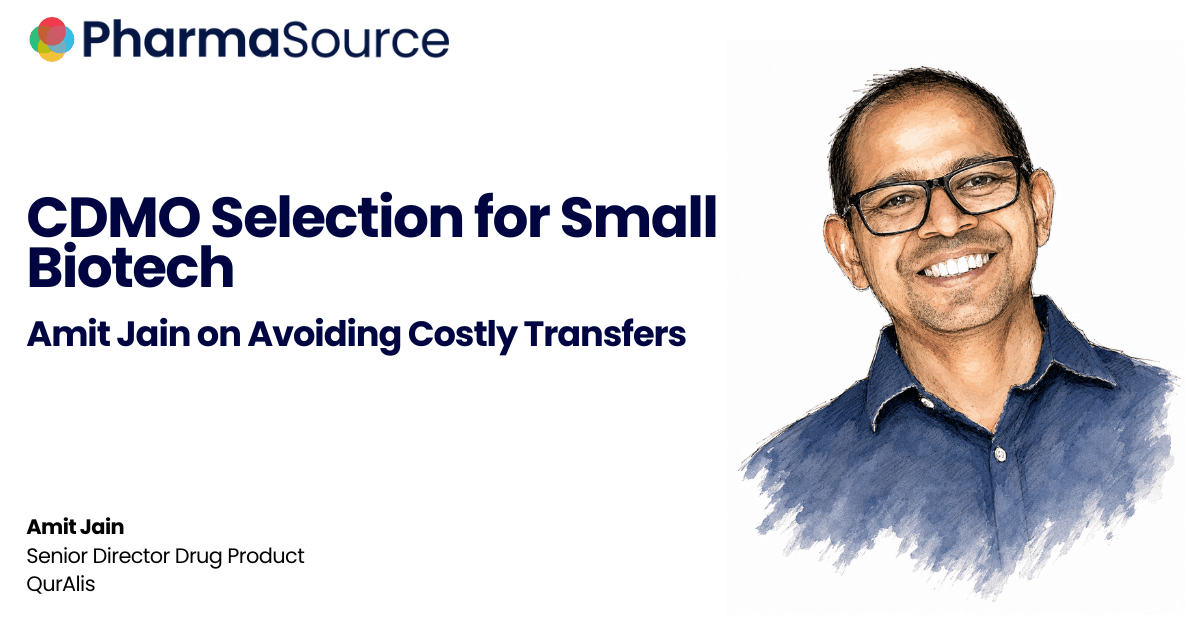
Amit Jain, Senior Director, Drug Product and CMC at QurAlis
Every small biotech faces the same squeeze: management wants continuous data to keep investors excited, but the budget and calendar to generate that data sit inside a CDMO you don’t control.
Amit Jain leads drug product and CMC at QurAlis, a Cambridge-based clinical-stage company developing therapies for neurodegenerative and neurological diseases. He has 20+ years of formulation and development experience across small biotechs, spanning first-in-human through NDA.
His argument cuts against standard practice — the “stage-appropriate” CDMO that looks affordable in Phase 1 is often the more expensive choice by Phase 3.
The stage-appropriate CDMO costs more than it saves
The instinct at first-in-human is to match the CDMO to the phase: pick someone who can run Phase 1 and Phase 2, defer the bigger decision until there’s data and money to justify it. Amit has done exactly this, and his lesson from the experience is, don’t.
“Do not keep changing the CDMOs,” he says. “That is cost-intensive, as well as it takes time and resources.” Each transfer to a new provider re-incurs setup, method transfer, and relationship-building costs that a single partner would have absorbed once. The fix is to select for the destination, not the current step: “If you are selecting a CDMO for Phase 1, you should take a step forward and make sure that CDMO will take you all the way till NDA.”
The objection is obvious — large, commercial-capable CDMOs are harder for a small biotech to access. Amit acknowledges this. “With a big CDMO, you don’t get that visibility, you don’t get that calendar slot.” He explains that those hurdles are solvable through relationship-building and by making the clinical importance of your product visible to the partner, whereas a repeated tech transfer is a fixed cost you pay every time you switch.
“Everything in one location” is a real selection criterion
A second lesson concerns how modern CDMOs are structured. Large providers are global conglomerates with multiple sites, and during selection, they present a unified capability set. The granularity only surfaces once work begins.
“When you start the project, then you realize that one experiment can be done in San Diego, the other would be going to Toronto, and others are somewhere else,” Amit says. The consequence is shipping time, shipping error, and coordination overhead that erodes the timeline the biotech is under pressure to protect. His takeaway is to confirm that a single site holds most of what your program needs, rather than accepting “we have everything” at the network level.
The capacity gap nobody admits to at RFP
Amit is most pointed on the difference between what a CDMO promises during selection and what it delivers under real clinical conditions. The gap, he says, is capacity flexibility.
“Usually, they provide a calendar slot based on your needs the first time. Second time onwards, they don’t honor your expectation or your need.” In clinical development, slot dates move — a readout from a prior study pushes a manufacturing campaign by a month or two. That is normal. What Amit finds is that CDMOs treat the original slot as the only slot: “Once you lose the slot, you miss the train.”
Asking about flexibility upfront doesn’t help, because the answer is always yes. “If you ask this question upfront, whether you’re flexible or not, they say ‘I am flexible.'” So at Quralis, now selecting for commercialization, the team probes differently. At the RFP stage, they walk providers through specific scenarios — a campaign delayed by a quarter, both in fee terms and in calendar-slot terms — and they push those answers beyond the BD contact to the site head. Where possible, they also seek to document slot-retention expectations in the MSA, clarifying how scheduling commitments would be handled if timelines shift.
Amit is candid that none of this is a clean solution. “I can’t say a particular element makes them very flexible.” The two levers he trusts are the formal escalation route through a steering committee and a relationship strong enough to buy visibility into the CDMO’s real capacity.
What a successful tech transfer actually looks like
Underlying all of this is tech transfer, the recurring failure point. Amit frames success as a function of planning quality, with a measurable endpoint.
“A successful transfer is a result of good planning for transfer,” he says — a complete package covering formulation composition, material grades, the process, and critical process parameters, worked through with the partner before anything moves. He’s seen the alternative: rushing, missing one detail, and realizing too late that it should have been communicated. A checklist beats speed.
The endpoint he watches for is the first engineering batch. “If your first engineering batch is meeting your spec — and when I say meeting the spec, it means your analytical methods are working — so method transfer is done, and your engineering batch passes your product spec,” then the transfer worked.