GMP audits confirm a CDMO can meet regulatory requirements. They say little about whether it can actually deliver. Two independent consultants make the case for operational assessment as standard practice.
This guest editorial is by Marta Kijanka, Principal, MK Bio Consultancy BV, and Anna Myra Koopmans-Hoven, Principal, AMK Compliance Insight.
Case Study: Outsourced, Not De-Risked
A rare disease company outsources its only approved product to a CDMO with a strong track record, one that has successfully delivered its clinical batches. What the company didn’t know: a single highly experienced production manager personally held all process knowledge and troubleshooting capability for this product. This dependency was never formally assessed. When that manager left, batches began to fail, and no one could identify the root cause.
The operational risks ran deeper. Commercial-scale equipment was running above 90% utilization with no backup capacity, and batch scheduling was managed through spreadsheets. When a product from another customer was delayed and overran its slot, the schedule collapsed: trained personnel were unavailable, materials weren’t in place, and swapping batches wasn’t an option. Due to cultural differences at the CDMO, none of these issues were raised until after the damage was done.
A thorough operational assessment would have caught all of this before making the commitment — undocumented technical ownership, unrealistic capacity assumptions, and a planning infrastructure too fragile for commercial-scale demands.
Instead, the company now faces a lengthy remediation process and an emergency second-source qualification under extreme time pressure.
Compliance and Operational Performance Are Not the Same Thing
It’s important to know that regulatory compliance and operational performance are not the same thing. Even stronger, assuming one guarantees the other carries real risk for sponsor companies. A CDMO can be fully GMP-compliant and simultaneously struggle with chronic planning failures, high staff turnover, informal quality systems, or limited capacity to scale. Such operational realities rarely surface in a compliance-focused GMP audit, yet they are often the primary drivers of batch failures and technology transfer delays.
Sponsors who have experienced CDMO-related supply crises frequently report that warning signs were operational rather than regulatory in nature. In hindsight, there were signals: slow response times, informal quality systems, optimistic capacity commitments, or over-reliance on key individuals. Identifying these signals requires a different assessment framework than compliance auditing alone.
While GMP compliance remains a non-negotiable foundation of any drug manufacturing outsourcing relationship, it has become increasingly clear that compliance alone does not guarantee reliable execution or resilient supply. As sponsor dependency on external manufacturing deepens and CDMO operations grow more complex, the differentiating factor is no longer whether a CDMO partner can pass an audit, but whether it can consistently perform under real-world operational pressure.
What Operational Assessment Should Examine
An operational performance assessment goes beyond documentation review and regulatory compliance verification. It examines a CDMO’s day-to-day execution capability: how it plans and schedules production, how it manages improvements and change control in practice, how its quality systems function under operational pressure, and whether its organizational structure supports reliable and scalable performance.
It also evaluates softer, but critical dimensions such as leadership stability, decision-making capability, cross-functional communication, and the degree to which performance is system-driven rather than person-dependent. The case above illustrates what happens when these dimensions go unexamined.
The Commercial Case Is Straightforward
The cost of a rigorous, independent operational assessment is modest relative to the financial and reputational consequences of a failed technology transfer, a clinical supply delay, or a commercial manufacturing disruption. By embedding operational assessments throughout the CDMO relationship lifecycle, sponsors are better positioned to anticipate problems, stabilize performance, and safeguard supply.
The question is not whether such assessments are justified, but how their systematic use (alongside compliance auditing) elevates outsourcing into a truly responsible practice, aligned with a sponsor’s commitments to patients and continuity of care.
Quality and Regulatory Responsibility
Even when manufacturing is transferred to an external partner, the ultimate responsibility for product quality and regulatory compliance always stays with the sponsor. Both the FDA and EMA are very clear on this. The FDA states that “the sponsor is responsible for ensuring that all manufacturing, processing, packing, and holding of the drug product conform to applicable requirements” (21 CFR Part 312, Guidance for Industry), while the EMA emphasizes that “contracting out activities does not absolve the marketing authorization holder from their legal obligations with respect to the quality, safety, and efficacy of the medicinal product” (EMA Guideline on GMP for IMPs).
Keeping this in mind, CDMO partner selection becomes much more than simply a checkbox exercise. Choosing the right partner isn’t anymore just about speed, compliance, expertise, or cost – it is about trust, shared standards, and rigorous quality systems. Choosing wrongly can make or break your program.
About the Authors
Dr. Marta Kijanka, PMP, leads MK Bio Consultancy, bringing experience from both biotech and CDMO environments. MK Bio Consultancy offers support in CMC project management, technical transfers, vendor selection and operational strategy.
Anna-Myra Koopmans, Pharmacist, QP, and leader of AMK Compliance Insight, brings decades of experience in pharmaceutical quality assurance, auditing, and compliance consulting. AMK Compliance Insight supports organizations with audit execution, quality system strengthening, and inspection readiness.
MK Bio Consultancy and AMK Compliance Insight are excited to join forces to deliver operational performance assessment of CDMOs, a service designed to assess regulatory compliance and provide insight into true execution capability and operational risk from a sponsor-company perspective.
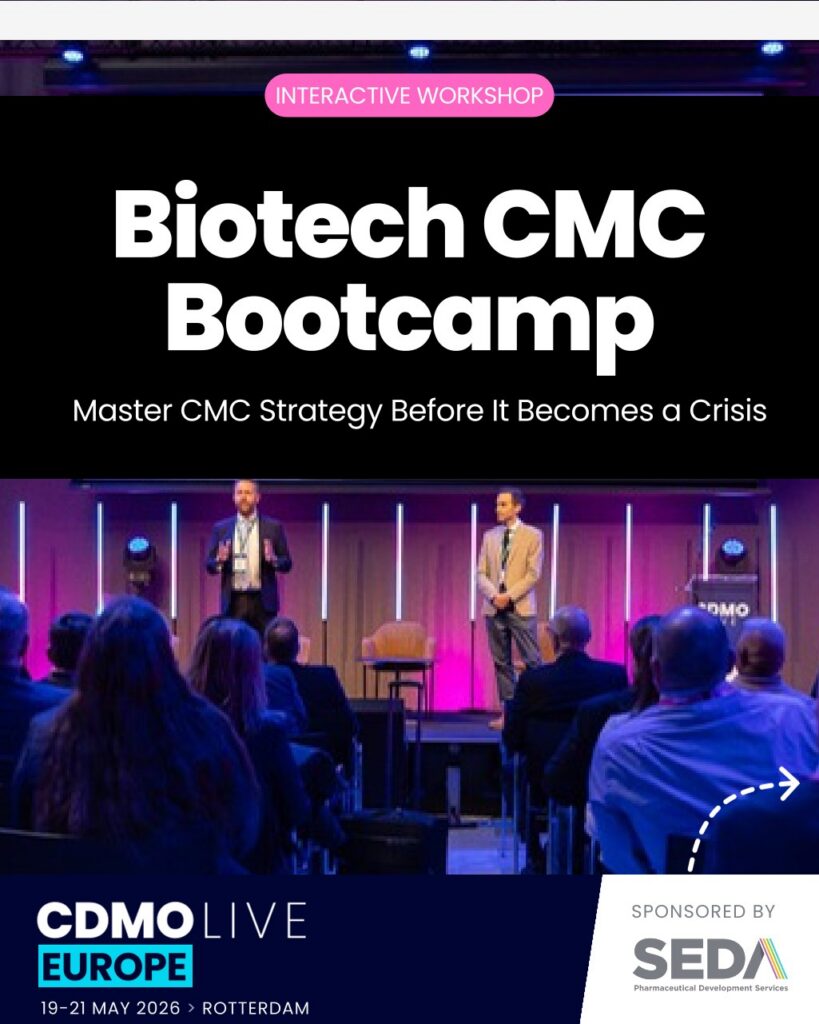
Marta will be running a workshop at CDMO Live Europe 2026, in Rotterdam, May 19-21. The Biotech CMC bootcamp will explore investor-ready CMC roadmaps, realistic budgets, and CDMO evaluation frameworks.
References:
- https://www.prnewswire.com/news-releases/contract-development-and-manufacturing-organization-cdmo-outsourcing-market-surges-to-usd-60-3-billion-by-2033–propelled-by-7-3-cagr—verified-market-reports-302560539.html
- https://www.outsourcedpharma.com/doc/2026-cdmo-forecast-the-shifts-sponsors-need-to-prepare-for-0001
- https://www.outsourcedpharma.com/topic/managing-cdmo-relationships
- https://www.drugpatentwatch.com/blog/cdmo-vendor-management-best-practices/
- https://www.pharmaadvancement.com/market-moves/surge-in-cdmo-expansion-why-pharma-companies-are-increasing-outsourcing
- https://www.drugpatentwatch.com/blog/cdmo-vendor-management-best-practices/