“I have been in the industry for almost 30 years. I have never seen this much evolution in a short 12-month cycle.”
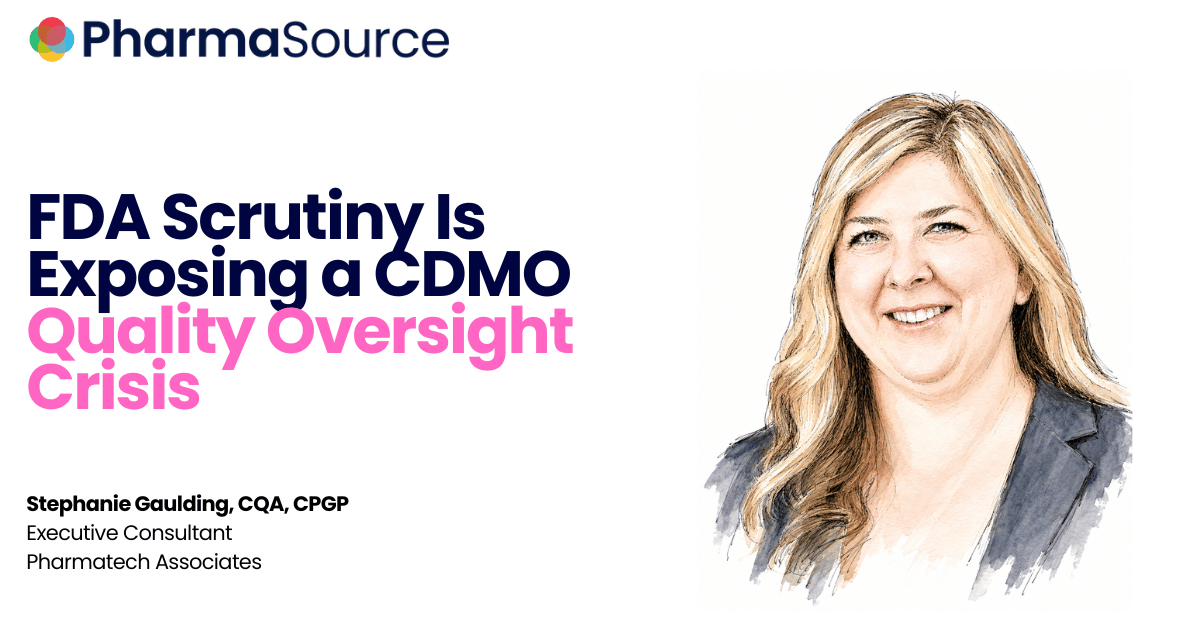
Stephanie Gaulding is an executive-level pharmaceutical quality consultant with more than 30 years of experience spanning GMP compliance, CDMO oversight, and quality systems across small-molecule and biologics manufacturing. She teaches through ISPE and PDA and has been tracking FDA enforcement trends closely over the past year because the agency’s enforcement posture is changing faster than most sponsor organizations have adapted.
FDA Warning Letters
The FDA issued more warning letters in the six months ending early 2026 than it had in the entire prior decade, according to the agency’s own statements. For quality directors and external manufacturing leaders, this means the margin for unresolved observations, undocumented deviations, and insufficient CDMO oversight has narrowed considerably.
FDA warning letters to drug manufacturers surged approximately 50% in FY2025, with a substantial share targeting GMP violations and data integrity failures at contract manufacturing sites, according to a 2026 analysis by IntuitionLabs. Early indicators from Q1 2026 suggest that the pace has continued, with weekly warning letter volumes running roughly double the prior year’s level.
At the same time, the FDA’s operational leadership has been in almost continuous flux. Commissioner Marty Makary resigned in May 2026, and acting directors are now running both CDER and CBER. Tracy Beth Høeg — the fifth person to lead CDER in 16 months — was fired in the same week. Kyle Diamantas, a corporate lawyer with no medical or scientific background, is serving as acting FDA commissioner. The tension between accelerating enforcement and hollowed-out agency leadership defines the regulatory environment sponsors are navigating right now.
Into that environment, Stephanie offers a read of where quality oversight is actually breaking down and why the FDA’s escalating prescriptiveness is, in her view, a consequence of the industry’s failure to self-correct.
The FDA Is Being More Prescriptive Because the Industry Hasn’t Fixed the Basics
Looking at the enforcement data from FY2025, Stephanie explains, the same two issues remain at the top of FDA observations across warning letters — quality systems and data integrity.
“When you look across the warning letters, those two issues are still at the top,” she says. “The fact that they have consistently been at the top for, I don’t know, over 10 years — we still haven’t figured out how to permanently fix those issues.”
What has changed is the agency’s response to that persistent failure. Where the FDA once flagged inadequate responses with general language, it is now dictating remediation specifics: hire a consultant, produce a risk assessment, submit a detailed CAPA execution plan, and expect a follow-up inspection to verify it happened.
“The prescriptivity in warning letters has increased significantly over the last five years,” Stephanie observes. She reads this as a signal that the industry has not moved on its own. “Because industry hasn’t been able to move itself, it is getting more prescriptive.”
For organizations that spend the time reading compliance program guidelines and understanding how FDA investigators are trained to conduct inspections, the increased prescriptiveness is actually useful — it removes ambiguity and makes the agency’s expectations explicit. “We clearly see what they’re expecting, instead of it being vague and subject to interpretation.”
But the agency stepped in because the sector couldn’t self-regulate. Janet Woodcock’s mid-2000s vision of a self-sufficient, self-regulating manufacturing ecosystem, Stephanie says, remains the end goal. The current prescriptive enforcement posture is what happens on the road to getting there.
Unannounced Foreign Inspections Are Changing the Risk Calculus
The enforcement trend that Stephanie considers most structurally significant is the FDA’s implementation of unannounced foreign inspections — a practice that represents, in her words, “a paradigm shift for the FDA.”
Historically, foreign facilities received advance notice of FDA visits, sometimes weeks out. That window allowed facilities to shift into preparation mode: pulling documents, reviewing records, rehearsing responses. “They get the notice from the FDA that they’re coming. They all of a sudden go into preparation mode,” she says. “They no longer have that window.”
For sponsors with outsourcing partners in Asia, Europe, or Latin America, this matters immediately. “If you are working with outsourcing partners that are in other regions of the world and they haven’t had one yet, they will,” Stephanie says. Her advice is to treat it as a planning exercise now. Simulate an unannounced inspection where only the CEO or head of quality has advance knowledge. “Put the unit through the paces.”
Handling an unannounced inspection is a materially different operational challenge from preparing for a scheduled one. Facilities that have only ever operated in announced-inspection environments are not ready for the shift in pace and pressure.
This dovetails with a parallel development Stephanie cites from the Novo Nordisk acquisition of Catalent. As the FDA integrated its oversight of Catalent under Novo’s ownership, it made clear that the acquiring company was accountable for remediation — even for quality failures that predated the deal. “We know you didn’t cause the problems, but you bought them,” she characterizes the agency’s message. “You are now responsible for fixing them.”
The implication for sponsors evaluating CDMOs or managing existing relationships is that the FDA’s extension of sponsor accountability to contract sites is not new language, but it is being enforced with fresh intensity.
Where Quality Oversight Breaks Down
Stephanie draws a line from the enforcement uptick to a set of specific, recognizable failures in how sponsors manage CDMO relationships. She describes the cumulative effect as “the illusion of oversight.”,
The first breakdown point is the quality agreement itself. “They’re put in a document repository and kind of left there,” she says. More critically, the language in most quality agreements is too vague to be enforceable. She offers an example: the word “timely.” “When you’re trying to enforce a quality agreement, and it says ‘timely’ all the way through it — how do you enforce that? Your definition of timely and my definition of timely may be very different.”
Quality agreements that QA staff do not reference because they lack sufficient direction cannot function as governance documents. In her view, if an agreement isn’t being used to manage the relationship in real time, it is a compliance checkbox rather than a tool.,
The second failure is audit quality. Stephanie explains that sponsors send auditors to CDMO facilities, those auditors spend the majority of their time in a conference room reviewing documents, check through a prescribed list of items, and leave. “You can’t really understand what’s going on by looking at pieces of paper,” she says. She points to European health authorities as a counterexample — agencies that spend significant time in labs and production areas because the observable evidence tells them more than documentation alone.
The deeper problem, she argues, is that auditors often stick rigidly to a predefined scope even when the information they encounter during the audit points to something more significant. “When I tap into something that I think is a big issue, I will tell the firm: we need to spend time on this and this is going to change what we get covered.” That adaptive approach mirrors how FDA investigators are trained to operate. Most sponsor auditors, she suggests, are not operating that way.
The third breakdown is in CAPA programs — specifically, the failure to reach the actual root cause. “They’re fixing the wrong things, doing the wrong actions, and so the issues keep coming up,” she says. The analogy she uses is: “You can’t pull a weed out of a garden and not take the roots with it and expect that it’s not going to come back.”
One practical signal she offers: if CAPAs at a facility repeatedly fail effectiveness checks, the facility has a root cause investigation problem. That is a meaningful diagnostic for quality teams conducting audits or reviewing periodic performance data.
Technology is also entering the picture. Stephanie notes that the FDA is deploying AI tools as part of both application review and inspection processes. Sponsors and CDMOs that are not tracking how the agency is integrating these capabilities are operating on an incomplete picture of the direction enforcement is heading.
What This Means for Industry Leaders
For external manufacturing leaders, the combination of unannounced foreign inspections and the FDA’s explicit position that CDMO quality failures are sponsor failures changes the risk calculus for how much operational knowledge sponsors need to maintain about their contract sites. Light-touch oversight is now a documented liability.
For quality organizations, Stephanie’s critique of audit practice is worth translating into internal review. How much of the last three audit reports from a key CDMO consisted of conference room time versus direct observation in manufacturing and lab environments? Are auditors empowered to expand their scope when they identify a significant issue during an audit?
For procurement leaders evaluating CDMOs, quality agreement language deserves more attention at the drafting stage than it typically receives. The document needs to define what “timely” means numerically, what constitutes a major change requiring notification, and who bears responsibility for escalation at each stage.traces
For biotech executives managing development timelines, it is worth watching whether the FDA’s leadership instability affects the predictability of application reviews. As PBOA President Gil Roth noted in previous PharmaSource coverage, manufacturing-related CRLs have been running at elevated levels, and a significant share trace to outsourced manufacturing deficiencies. Fewer approvals means delayed revenue — and fewer future manufacturing contracts for the CDMOs supporting development-stage programs.
Stephanie Gaulding will be hosting a roundtable titled Quality Oversight Across Your CDMO Network at CDMO Live Americas 2026, taking place in Boston, October 20th-21st. Download the agenda or book your ticket now.