“Business continuity remains a strategic priority because disruptions are inevitable.”
For global biopharma supply chains, disruption is no longer an exceptional event to plan around, but an operating reality. Cyber incidents, supplier failures, network outages, and geopolitical uncertainty are converging with increasingly complex manufacturing networks, making preparedness a strategic imperative.
Alfredo Vidal is Director of Commercial Global Supply Chain Risk Management and Resilience at Vertex Pharmaceuticals, with 18+ years spanning energy, utilities, and biopharma. He runs Vertex’s commercial manufacturing and supply chain risk management program, including its core processes and tools.
Abhi Naravane Ph.D. is Sr. Director, Global Manufacturing Network at Vertex. He came from PwC and PA Consulting with 40+ CDMO capability assessments and 50+ operations diligence transactions behind him.
Vertex supplies cystic fibrosis programs, a non-opioid acute pain medicine, and a commercial cell therapy. Abhi and Alfredo will explain how Vertex built one enterprise framework that flexes by modality at CDMO Live Americas in Boston on October 21. Ahead of the session, they share Vertex’s approach to risk management and supply chain resiliency.
Risk Management at Vertex
Vertex Pharmaceuticals has spent several years building risk management and supply chain resiliency capability, and is now extending that foundation into business and supply continuity planning and incident management. “Over the past several years, we have built a stronger, more scalable foundation in risk management and supply chain resiliency,” says Alfredo. “As that foundation matures, our focus is expanding to business and supply continuity planning and incident management.”
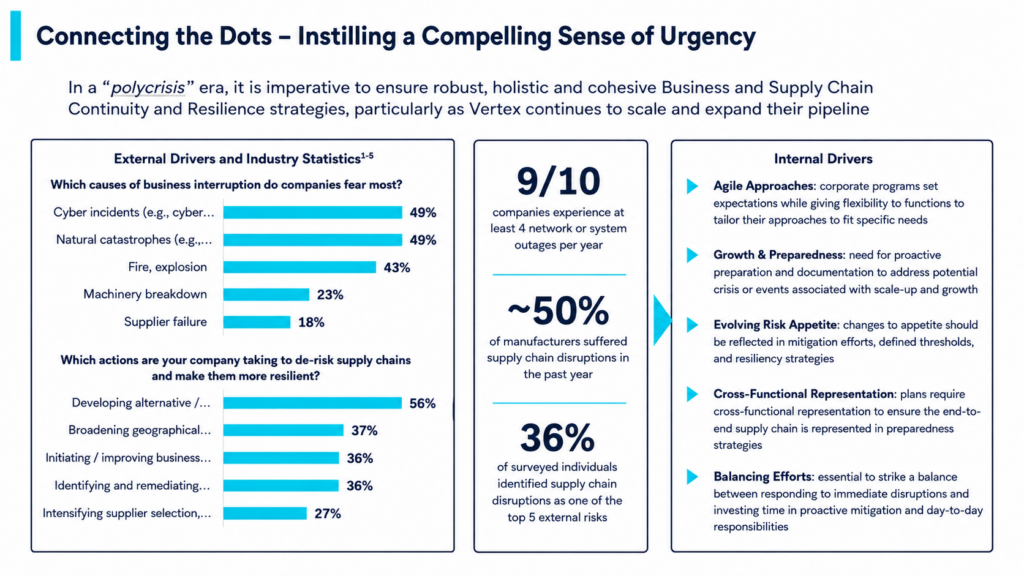
Research highlighted by Vertex shows cyber incidents and natural catastrophes among the disruptions companies fear most, while nine in ten companies experience at least four network or system outages each year. Around half of manufacturers experienced supply chain disruption in the past year, and 36% of surveyed respondents identified supply chain disruption as one of their five leading external risks.
For Alfredo, resilience therefore cannot sit within a single function or be reduced to a business continuity document that is only consulted when something goes wrong.
“This next phase requires an approach that is cross-functional, integrated, digitally enabled and data-driven, and supported by strong external partner collaboration,” he says.
That becomes particularly important as Vertex grows and its manufacturing network spans different modalities, partners and sources of supply. The organization must be able to balance immediate incident response with the longer-term work of identifying vulnerabilities, mitigating concentration and supplier risks, and preparing the network for future growth.
“Business continuity remains a strategic priority because disruptions are inevitable,” Alfredo says. “Whether driven by cyber events, supplier issues, network outages, or other operational challenges, the impact can be significant.”
Resilience by Design
The challenge is to embed resilience into the decisions that shape the manufacturing network in the first place.
“As we continue to grow, our environment becomes more complex, and our exposure to risk evolves with it,” says Alfredo. “That makes early planning, clear coordination, and organizational agility more important than ever.”
At CDMO Live Americas 2026, Abhi and Alfredo will explore how Vertex is putting those principles into practice across small molecule, biologics, and cell and gene therapy manufacturing. Their session will examine modality-specific governance, risk champions, actionable KPIs, supplier concentration and single-source dependencies, as well as how CDMO risk management connects with broader corporate resilience and strategic network planning.
The objective, as Alfredo puts it, is to: “Strengthen preparedness. Improve response. Minimize disruption. Protect continuity of supply and business operations.”
For supply chain, external manufacturing and network strategy leaders, that is increasingly the distinction between having a risk-management process and building a manufacturing network designed to withstand what comes next.
Attend the full discussion at CDMO Live Americas 2026, taking place in Boston, October 20th-21st. Download the agenda or book your ticket now.