Most products spend development in vials. Moving them into commercial pre-filled syringe manufacturing exposes every early decision on formulation, device and primary packaging. In a PharmaSource masterclass, experts from Siegfried and SKAN explained where these transfers lose time, what a successful one looks like, and how Annex 1 and regional sourcing are changing European sterile fill-finish.
Pre-filled syringes (PFS) are becoming one of the most important formats in injectable drug delivery, and transferring products into PFS manufacturing is becoming one of the most demanding jobs in fill-finish. A syringe transfer that looks straightforward on paper can surface risks that stayed hidden throughout development, and those risks tend to appear at the worst possible moment: during validation or early commercial supply.
To explore where those risks hide, PharmaSource hosted a live masterclass with three experts who have spent their careers moving sterile products from development into production:
- Jens Klein, Technical Project Manager for PFS at Siegfried, who is building Siegfried’s new PFS filling and visual inspection lines. He spent more than 20 years in production at CDMOs and marketing authorization holders before joining Siegfried.
- Katrin Solmsdorff, Head of Project & Program Management at Siegfried’s Hameln site in Germany. She has worked in the pharma industry since 2004, across process validation, technology transfer and project management.
- Thomas Zinn, Chief Officer of Aseptic Manufacturing Services at SKAN AG. A pharmaceutical technology engineer, he has served the industry for close to 30 years, working at the interface between development, scale-up and site-to-site transfers.
Why Pre-Filled Syringes, and Why Now
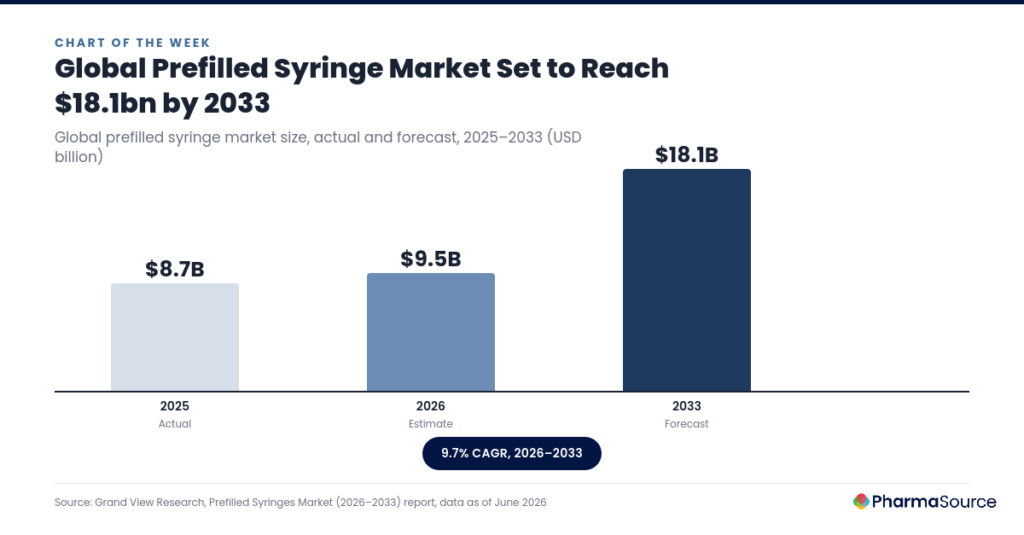
Grand View Research values the global PFS market at $8.7 billion in 2025 and estimates $9.5 billion for 2026, growing at a 9.7% CAGR to $18.1 billion by 2033, almost doubling in seven years. Four forces drive that growth.
Biologics and biosimilars. More monoclonal antibodies and chronic therapies are moving toward fixed-dose, subcutaneous administration. For sensitive, high-value biologics, the syringe and delivery system become part of the product.
Home administration. GLP-1 therapies have put self-administered injectables in the spotlight and shown how quickly demand for injectable delivery can scale. The same shift toward pre-filled syringes, safety devices and autoinjectors is spreading across biologics, moving treatment out of hospitals and infusion centers.
More demanding devices. More concentrated, high-viscosity biologics are driving demand for 2.25 mL syringes, low-friction systems and autoinjector-compatible platforms. Volumes are rising at the same time as technical requirements tighten.
Ready-to-administer care. For healthcare providers, pre-filled formats mean fewer preparation steps, less drug wastage and lower risk of medication errors.
The industry is investing heavily in response. Siegfried is adding two PFS and cartridge lines at its Hameln site in Germany. BD has announced a $110 million investment in US prefillable-syringe manufacturing, citing demand from biologics and GLP-1 drug delivery. SCHOTT Pharma is building a $371 million prefillable-syringe facility in North Carolina, pointing to the same demand.
New capacity solves only half the problem. Sponsors still have to get products onto those lines, transferring processes and knowledge from development into commercial manufacturing, between lines, between sites and between manufacturing partners.
Significant Technical and Regulatory Challenges
A pre-filled syringe is at once a sterile container, a delivery device and often a combination product, and a failure in any of those layers can delay launch or threaten supply. The challenges span Annex 1 compliance, combination product complexity, high-viscosity delivery, container integrity, capacity constraints, and the costs and supply risks that come with premium components, long lead times and cold-chain demands.
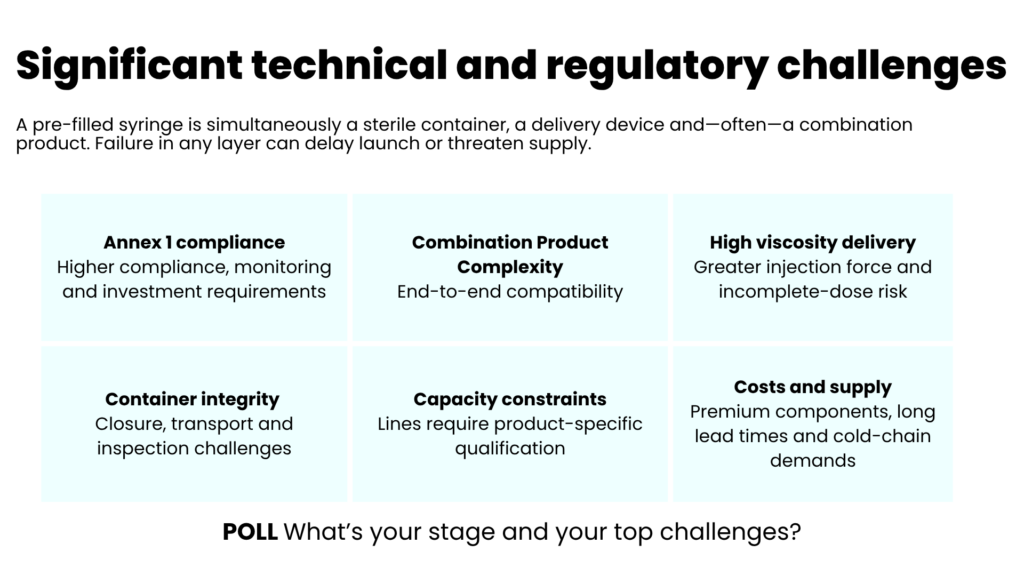
Two audience polls, answered by all 25 respondents, showed who had joined. Almost half (48%) were evaluating options with no active PFS program, while 36% already had products in commercial supply. The rest were spread across early development (8%), Phase I to II (12%) and Phase III or preparing for PPQ (4%). Annex 1 compliance and costs and supply tied as the top challenges, each cited by 40% of respondents, followed by drug-container compatibility (16%). High-viscosity delivery, container integrity and capacity constraints each drew 8%.
When PFS Enters The Picture
Thomas Zinn opened by describing how the timing of the PFS decision has shifted. Ten to fifteen years ago, development teams prioritized speed and flexibility: get the product to market, then add a pre-filled syringe or cartridge later as part of lifecycle management. Over the last five to ten years, he has seen some companies develop the PFS formulation as the first dosage form.
Which Molecules Suit PFS
Nearly any molecule can go into a pre-filled syringe, Thomas said. Historically the format served emergency products such as adrenaline pens, and insulin in cartridges and autoinjectors. The new wave of modalities has changed that. “We are in the century of biology,” he said. Researchers can now address targets once considered undruggable, and most of these new drug substances are proteins, monoclonal antibodies, polypeptides and even mRNA, which must be injected.
When injection is the only route, it makes sense to decide early whether a syringe or combination product is the right setup. Thomas framed the format choice as a decision about how the patient or caregiver will use the medicine, with a ready-to-use injectable bringing benefits for patient safety, caregiver safety and reduced complexity in hospitals.
Katrin Solmsdorff added the commercial logic. Most of the requests Siegfried is evaluating come from the biologics and biosimilars sector, with few from small molecules. Ready-to-use syringes and cartridges cost more than vials, and self-administration adds the cost of an autoinjector or pen. Products that justify that investment are generally high-value drug substances, which is why PFS clusters around biologics and biosimilars.
What Sponsors Now Require From a PFS Tech Transfer
Jens Klein described a clear shift in sponsor priorities. A few years ago, capacity sold itself. Capacity is now more widely available, though still scarce in places, and sponsors are judging CDMOs on other criteria.
Partnership and reliability. Sponsors want confidence that the CDMO will still be there in several years to supply their product.
Supply chain resilience. More sponsors want a second source or a supplier in another region.
Supply chain integration. Jens has seen sponsors given access to parts of a CDMO’s SAP system to track their own inventory in real time.
Quality system alignment. Jens called this the most important trend. The CDMO’s quality system is becoming an extension of the marketing authorization holder’s. The sponsor remains responsible for that quality system and has to defend it in front of regulators, so both systems must fit together precisely.
Katrin added that PFS demands end-to-end control in a way vials and ampoules do not. A vial can be inspected, packed and shipped. A syringe usually goes through an assembly step after inspection, which counts as real manufacturing and must maintain container closure integrity (CCI). Transport carries its own risk: a vial’s stopper is fixed by a crimped cap, while a syringe or cartridge relies on a plunger stopper sitting inside a glass barrel, which must stay in place through assembly and shipping while sterility holds. “The last 10%,” covering assembly, packaging and transport, gets far more attention with PFS than with vials.
Where PFS Transfers Run into Difficulty
Every tech transfer depends on close collaboration and communication with the sponsor, Katrin said, and PFS raises the stakes because of long lead times. Teams need to work out assembly programs and downstream steps in detail at the start. A team that begins with compounding, filtration and filling, and leaves assembly and transport for later, will run into timeline and material problems.
Siegfried addresses this with a project leader team structure. An experienced project manager leads a cross-functional team for every transfer. For PFS, the people who set up and qualified the line, and who know the machines in detail, join transfer projects as subject matter experts. That carries knowledge directly from the generic line process qualified during media fills into the specific product process.
Jens pointed to primary packaging as the most common source of late surprises. “A syringe is not just a syringe,” he said. Teams must define the flange type (round or cut), the needle gauge and other specifications early. Even then, a vendor may offer a particular combination only in non-GMP or single-bagged form, when the receiving site’s quality system requires ready-to-use, double-bagged components. Assembly and packaging add further variables: with or without a safety device, which label, which cartons or moldings, and whether syringes are packed singly or in multiples. Jens acknowledged that sponsors cannot always settle every detail at the start, yet the earlier the receiving site sees the full end-to-end picture, the better.
What a Successful PFS Transfer Looks Like
For Thomas, success criteria for any tech transfer come down to quality, time and cost. Many elements of a PFS transfer map one-to-one onto a vial transfer. The difference lies in the detail.
Filling a syringe with a glued-in staked needle already creates a combination product under 21 CFR Part 4, because the needle interacts with the patient and the syringe holds the medication. Teams must account for combination product requirements from the filling step onward, including the protection of the needle by its rigid needle shield. In a vial process, compounding, filling and inspection can run independently of labeling and packing. For a combination product, assembly is defined as a manufacturing step that must be validated.
“The devil is in the detail,” Thomas said, listing needle gauge, flange shape and siliconization, whether baked-on or sprayed and at what level. Teams must understand the primary container in far more depth, and they must know the complete end-to-end setup to be confident the finished combination product works. Ready-to-use primary packaging can carry lead times of up to a year, so teams must also act proactively.
Speeding up Transfers Without Cutting Corners
Katrin walked through Siegfried’s model PFS tech transfer timeline. The fastest transfers pair experts directly: people who know the process on the sending side with people who will run it on the receiving side, and matching counterparts for analytical method transfer and formulation.
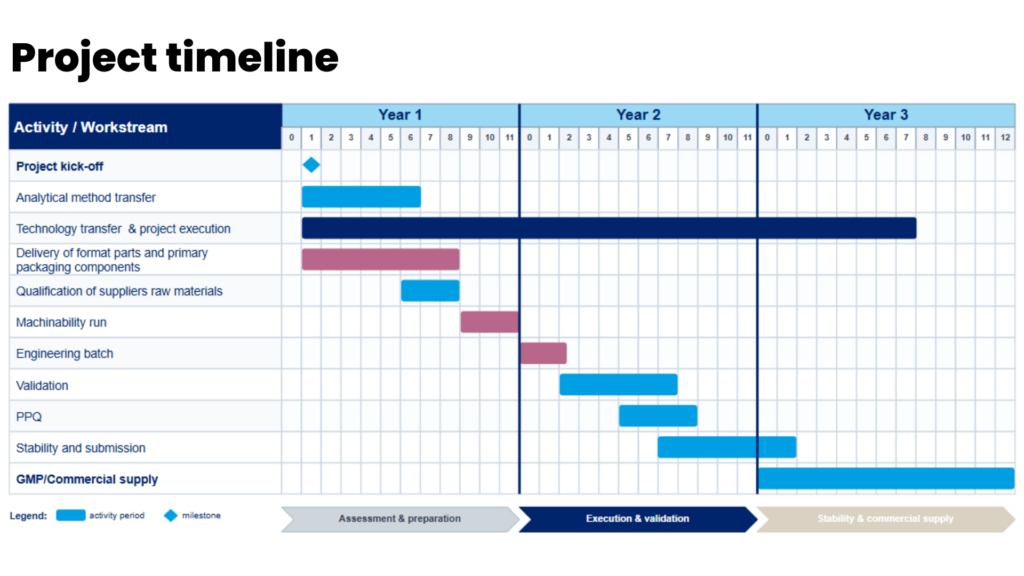
Siegfried’s model timeline runs in three phases: assessment and preparation in year one, execution and validation in year two, and stability and commercial supply in year three. Analytical method transfer runs through the first six months. Format parts and primary packaging components take around eight months to arrive, and supplier and raw material qualification follows in months six to eight.
Long-lead items dominate the schedule, and syringe deliveries can take longer than eight months. A receiving line rarely gets exactly the same syringe it ran before; a slightly longer or shorter needle or a different needle shield usually means new format parts for filling and visual inspection. Katrin advised working with established primary packaging suppliers such as BD and Stevanato Group, and noted that CDMOs may receive different supply terms from marketing authorization holders. Sponsors and CDMOs should talk to suppliers together to secure components on time.
Katrin was equally clear about where to spend time. Setting up the format and product on the line, running machinability trials to program the line, confirming fill volume and pressure, checking stopper insertion and executing engineering batches as a dry run before PPQ all deserve full attention. Cutting testing at this stage undermines everything that follows. Thorough preparation lets the validation campaign run with few or no deviations, so batches go on stability on schedule and the submission proceeds. The complete plan spans roughly three years, with stability and submission overlapping the start of commercial supply in year three.
Jens added a point from experience. When a transfer does not go as expected, sponsors value direct expert-to-expert conversation about what happened, why it happened and how to move forward.
How Annex 1 has Changed European Sterile Fill-Finish
Thomas noted that many Annex 1 requirements, including contamination control, containment and the use of closed barrier systems or isolators, were good practice before the revision. What Annex 1 changes is the depth of understanding regulators expect. Owning an isolator line is no longer enough. Sites must understand, on a risk basis, the best way to transfer material into and out of the Grade A isolator and how to design the most effective VHP cycles.
Regulations of this scale arrive once every 10 or 20 years, he said, and the industry is still working out what “current GMP” means in practice. Full adaptation will take time.
Jens then turned to one of the hottest topics in the Annex 1 discussion: first air. First air is the sterile-filtered air that flows from the HEPA filters above a filling line and meets unfilled containers, or filled containers not yet stoppered. Ideally, that air touches nothing on its way. In practice, filling needles and needle holders sit in its path, and the expectation is that anything it passes must be pre-sterilized and untouched by non-sterile items such as isolator gloves.
Expectations are still moving. A line ordered two or three years ago may no longer meet current first-air expectations in some respects, forcing a site to negotiate refits with its equipment vendor or rely on organizational and procedural controls, which regulators are increasingly reluctant to accept. Siegfried designed its two new isolator lines with a strong first-air focus, Jens said, and continues to monitor the discussion. The essential thing for a CDMO is to track the debate and act before sponsors ask.
Katrin stressed staying open-minded, watching published inspection findings and listening to customers and suppliers. “At the moment, you will not reach a status where you can say you are completely safe,” she said. “I think no one can,” Jens added.
Thomas addressed sites running existing lines. Annex 1 expects surfaces that could affect first air quality to be sterilized. Where a surface cannot be sterilized, the site needs a detailed risk assessment to show whether cleaning, disinfection and the VHP cycle provide enough control. Transparency and close listening to both regulators and sponsors open a way forward.
From Global Supply to Regional Sourcing
Katrin sees sponsors moving toward regional supply, particularly across the US and European markets, and sees the case as strongest for PFS. Geopolitics plays a part, and product logistics matter as much. Biologics and biosimilars are often cold-chain or frozen products, and shipping high-value material halfway around the world to a filling site and back to market adds risk. Air freight creates specific problems for syringes: pressure changes threaten container closure integrity, and product left waiting on a hot tarmac in summer faces temperature risk unless protected at considerable cost. Keeping drug substance, fill-finish, assembly and packaging within one region, ideally close to the market and reachable by truck, reduces those risks.
Thomas agreed that proximity to market is the ideal, while urging realism about cost. Drug substance, drug product, assembled combination product and finished pack could each sit in every region, but that carries a price tag, and sponsors must ask whether duplicating every step in every geography makes business sense. COVID showed how fragile supply chains become when one geography drops out, a lesson he feels the industry has partly forgotten. Sponsors should weigh business continuity and dual-supply setups, and take advantage of regulatory alignment through schemes such as PIC/S. Operating a single quality standard that satisfies Europe, the US and other major markets strengthens that resilience.
How Siegfried’s PFS Offering is Evolving
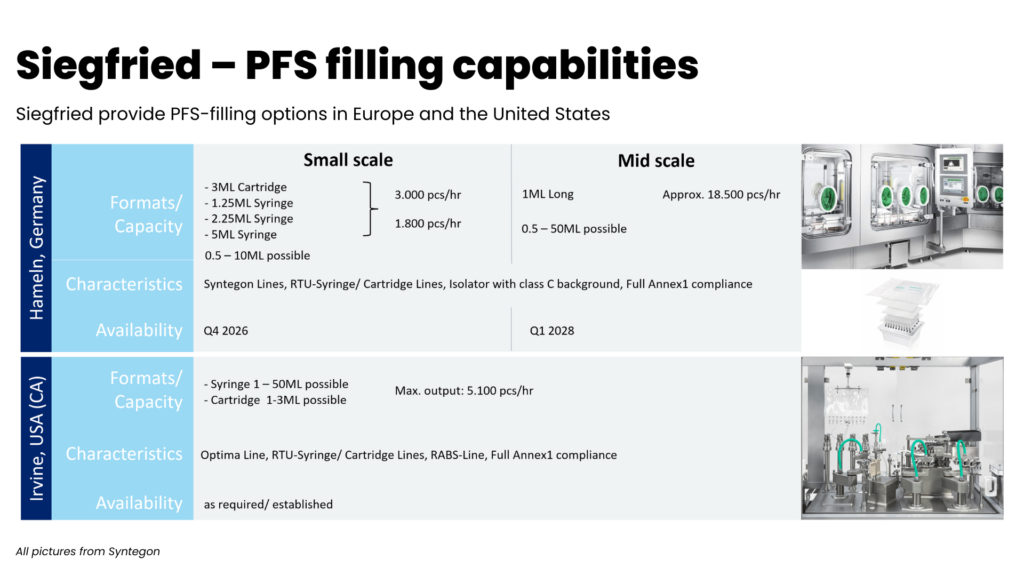
Jens described Siegfried’s PFS and cartridge capacity on both sides of the Atlantic. At Hameln, Siegfried is building two Syntegon lines for ready-to-use syringes and cartridges, both in isolators with a Grade C background and designed for full Annex 1 compliance. The small-scale line, available from Q4 2026, fills 3 mL cartridges and 1.25 mL, 2.25 mL and 5 mL syringes at 1,800 to 3,000 units per hour, with fill volumes from 0.5 to 10 mL possible. The mid-scale line, due in Q1 2028, starts with 1 mL long syringes at around 18,500 units per hour, roughly six times the small-scale output, and can handle 0.5 to 50 mL. It suits larger batches with shorter processing and holding times.
In Irvine, California, Siegfried already runs an established Optima RABS line for ready-to-use syringes from 1 to 50 mL and cartridges from 1 to 3 mL, with a maximum output of 5,100 units per hour and full Annex 1 compliance. Together, the two sites give sponsors options for regional supply and supply chain resilience.
Audience Q&A
Does sponsor IT/OT influence help receiving sites? One attendee asked whether sponsors that control IT and OT standards (MES, LIMS, historians, data standards) from headquarters help receiving sites during transfer. Katrin explained that sponsors sometimes request direct access to a CDMO’s IT or OT domain during projects. Siegfried protects confidentiality across all its customers and must guard its systems against unauthorized access, so it can share inventory information from SAP and transfer data, while keeping MES and LIMS closed to direct customer access.
How do Annex 1 and FDA expectations differ? Thomas sees FDA and European expectations as closely aligned, along with other major agencies such as those in Japan and South Korea. Five years ago, he might have said the FDA allowed more leeway on areas such as water for injection generation. Today, regulators share platforms and a common goal. “When you fully fulfill Annex 1, you should also not have a hard time with the FDA,” he said, and the reverse also holds. For long-time isolator users, he highlighted two genuinely new elements in Annex 1: expectations for the room surrounding the isolator, which now point toward a Grade C background where many sites previously placed isolators in Grade D, and the first-air requirements, which extend to every piece of equipment in contact with stoppers and plungers. Anything that can be steam sterilized should now be steam sterilized.
Will dual-chamber syringes grow for at-home reconstitution? Thomas linked the answer to formulation capability. Twenty years ago, formulating monoclonal antibodies as liquids was difficult, so lyophilized products and dual-chamber syringes made sense for self-administration. Large pharma companies now develop liquid antibody formulations. Antibody-drug conjugates, however, are bringing lyophilization back, and some ADCs may end up in dual-chamber syringes. Where formulation development cannot avoid a lyophilized state, dual-chamber syringes remain a valuable option. Jens, who once ran a dual-chamber filling line, called the format a specialty: capacity is low, and fitting multiple lyophilizers into the process layout severely constrains what a facility can do.
What data package should an early-phase transfer include? “The more, the better,” Katrin said. A product developed in vials may never have contacted silicone oil, which syringes require, so the receiving site may need to run compatibility studies. Viscosity matters too: a viscous product destined for an autoinjector may need shorter special needles so the device can deliver the dose in the required time. Siegfried supports this development work, sometimes alongside device suppliers.
Thomas described the ideal package: complete development data covering drug substance freezing and thawing, filling, combination product assembly and packaging validation, since the packaging protects the combination product. It should define CQAs and CPPs, and include the analytics and in-process controls needed to confirm the combination product works, such as break-loose and gliding force testing and any special test equipment for the autoinjector. He added a recommendation: development teams should engage the commercial supply site early. If device selection still has some flexibility, sponsors can choose a device for which the commercial site already has assembly capacity installed.
Which differences matter most when moving to a new filling line? Jens noted that Siegfried fills entirely with single-use filtration and filling systems. Extractables and leachables data may already exist, but if a product or fill volume requires a different filter or tubing, teams must reassess. Thomas added that transfers compare one manufacturing system to another, including product-contact surfaces and the mechanical stress the process puts into the product. For antibodies especially, teams should compare energy input across every step, from mixing during formulation to the dosing system and fill-kit tubing diameter on the line.
Which line-specific attributes should be assessed to minimize regulatory risk? Thomas said anything that is a critical process parameter or affects a critical quality attribute belongs in the transfer assessment. Katrin singled out container closure integrity testing as a strongly increasing focus in inspections. Using the same primary packaging does not allow a site to rely on CCIT studies from another site or line; the receiving site must show that this plunger, this syringe and this filling line together produce an integral container. Beyond CCI, teams must assess every step: filling speed, peristaltic versus piston pumps, nitrogen gassing where required, and even the rotation speed of syringes during visual inspection, which could generate particles. Comparing equipment against equipment, durations against durations and temperatures against temperatures shows teams exactly what work the transfer requires.
Key Takeaways
Decide primary packaging early. Flange type, needle gauge, siliconization and supplier configuration drive lead times of up to a year and shape every later step.
Plan the transfer end to end. Assembly is a validated manufacturing step, and transport puts container closure integrity at risk. Both belong in the plan from day one.
Put experts in direct contact. Pairing sending-site and receiving-site specialists speeds transfers and resolves problems faster when they arise.
Protect engineering runs and testing. Machinability trials and engineering batches set up a PPQ campaign with few or no deviations.
Treat Annex 1 as a moving target. First-air expectations are still evolving, and CDMOs need to track the discussion and act ahead of sponsor requests.
Repeat CCIT on every line. Regulators expect proof of container integrity for each syringe, plunger and filling line combination.
Weigh regional supply against cost. Proximity to market reduces cold-chain and transport risk, and full duplication in every region carries a price.