The PROTAC era has officially begun. With vepdegestrant (Veppanu) becoming the world’s first FDA-approved PROTAC in May 2026, targeted protein degradation has crossed its most critical threshold — from promising science to approved medicine. For PROTAC CDMOs, that moment changes everything: commercial-scale manufacturing demand is no longer a future planning exercise. It is happening now.
PROTACs, Proteolysis Targeting Chimeras, represent one of the most structurally novel drug modalities to enter clinical development in the past decade, using bifunctional molecules to redirect the cell’s own protein degradation machinery against previously undruggable targets.
Quick stats:
- Vepdegestrant (Veppanu) approved by the FDA on May 1, 2026, the first PROTAC ever approved in the United States, developed by Arvinas and Pfizer
- 30+ PROTAC candidates in active clinical trials as of 2025, with over 90 leads under evaluation and about 20% in clinical development
- 25.3% CAGR through 2032, growing from USD 0.50 billion (2025) to USD 2.42 billion by 2032
- First PROTAC built in 2001; first FDA approval came 25 years later, a timeline that gives current CDMO capacity planning added urgency
This PharmaSource guide covers the global PROTAC market, how targeted protein degradation works, how AI is reshaping PROTAC design, and what to look for when selecting a CDMO partner for your degrader program.
A PROTAC CDMO is a contract development and manufacturing organization that specializes in the synthesis and production of Proteolysis Targeting Chimeras, bifunctional small molecules that recruit an E3 ubiquitin ligase to a disease-causing target protein and direct it for proteasomal degradation. Manufacturing PROTACs requires advanced synthetic chemistry capabilities available at only a limited number of CDMOs globally, including multi-step linker synthesis, conjugation chemistry, and complex purification of bifunctional impurity profiles. These CDMOs support pharma and biotech sponsors from early discovery chemistry and medicinal chemistry iteration through IND-enabling synthesis and GMP clinical supply.
History and Evolution of PROTAC Technology
PROTAC technology traces back to 2001, when Craig Crews and Raymond Deshaies developed the first PROTAC, a peptide-based molecule that recruited the SCF-beta-TrCP E3 ligase to degrade methionine aminopeptidase-2.
This first generation faced a fundamental problem: peptide-based PROTACs could not cross cell membranes efficiently, sharply limiting their usefulness as drugs. The field’s second major breakthrough came in 2008, when researchers reported the first small-molecule PROTAC, using nutlin-3a to recruit the MDM2 E3 ligase for degradation of the androgen receptor. Source: PMC, “PROTAC-DB: an online database of PROTACs”. Replacing peptide-based components with small molecules solved the permeability problem and opened the door to oral PROTAC drugs.
The current generation of PROTACs, the ones now reaching the clinic and, with vepdegestrant, regulatory approval, predominantly recruits cereblon (CRBN) or Von Hippel-Lindau (VHL) E3 ligases, with active research expanding into IAP, MDM2, DCAF15, and AhR-based recruiters to work around CRBN and VHL resistance mechanisms and reach a broader range of tissues. For sponsors and CDMOs alike, understanding this history matters commercially, not just scientifically: it explains why current PROTAC manufacturing infrastructure is built almost entirely around CRBN and VHL chemistry, and why CDMOs with novel E3 ligase capability are positioned to capture next-generation programs. For a deeper technical reference, PROTAC-DB 3.0, a freely accessible academic database, now catalogs 959 target-PROTAC-E3 ternary complex structures alongside pharmacokinetic data.
Market Size, Growth & Key Trends
The Global PROTAC Market is estimated to be valued at USD 0.50 billion in 2025 and is expected to reach USD 2.42 billion by 2032, growing at a compound annual growth rate (CAGR) of 25.3% from 2025 to 2032.
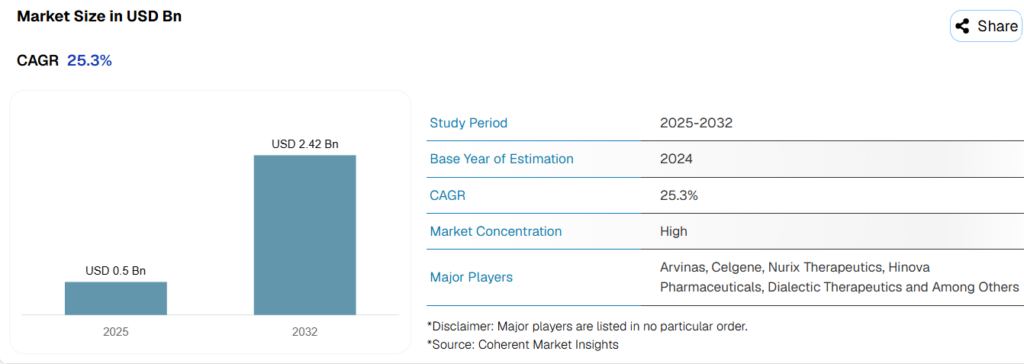
That trajectory positions targeted protein degradation as one of the fastest-growing sectors in all of drug discovery and early-stage pharmaceutical development, driven by the convergence of an expanding undruggable target landscape, clinical proof-of-concept in oncology, and the first regulatory approval.
Clinical Pipeline — 2026 Snapshot
- Vepdegestrant (Veppanu), Arvinas/Pfizer, FDA approved May 1, 2026, ER+/HER2-/ESR1-mutated advanced breast cancer, world’s first approved PROTAC
- Catadegbrutinib (BGB-16673), BeOne Medicines (formerly BeiGene), Phase 3 for CLL, small lymphocytic lymphoma, and B-cell malignancies, most advanced BTK-targeting PROTAC in development
- Gridegalutamide (BMS-986365), Bristol Myers Squibb, Phase 3 rechARge trial (NCT06764485) in mCRPC, dual mechanism of AR degradation and antagonism
- KT-474 (SAR444656), Kymera/Sanofi, IRAK4 degrader, Phase 2 in hidradenitis suppurativa and atopic dermatitis, Sanofi has since discontinued KT-474 in favor of next-generation degrader KT-485, still cited as the first PROTAC to show clinical activity outside oncology
- ARV-102, Arvinas, first PROTAC designed to cross the blood-brain barrier, Phase 1 in neurodegenerative disease, first-in-human dosing announced February 2024
Latest PROTAC CDMO News:
-
Ofichem to Acquire Kinentia Biosciences and Expand Into U.S. Market
-

Shilpa Medicare Launches Dedicated Complex Small-Molecule CDMO
-

Ofichem Acquires Meribel’s Uppsala Site to Expand Early-Stage CDMO Capabilities
-
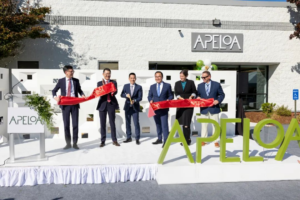
Apeloa Opens 17,000 Sq. Ft. CDMO R&D Center in Billerica
-

Arvinas Licenses Prostate Cancer Drug ARV-766 to Novartis
-
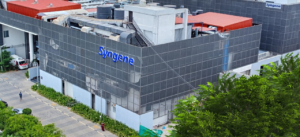
Syngene Upgrades High-Capacity Biologics Facility in India
Macro trends defining the PROTAC CDMO landscape in 2026-
1. The First PROTAC Approval Has Landed, and Everything Changes
On May 1, 2026, the FDA approved vepdegestrant (Veppanu), developed by Arvinas and Pfizer, for adults with ER-positive, HER2-negative, ESR1-mutated advanced or metastatic breast cancer. This marked the first time the FDA has ever approved a PROteolysis TArgeting Chimera, ending more than a decade of clinical development without a single approved product.
The approval was based on the VERITAC-2 Phase 3 trial, where vepdegestrant reduced the risk of disease progression or death by 43% versus fulvestrant, with a median PFS of 5.0 months versus 2.1 months (HR 0.57; p=0.0001). The FDA also approved Guardant360 CDx as a companion diagnostic to identify ESR1-mutated patients, setting a regulatory precedent for biomarker-defined PROTAC approvals.
What this means for CDMOs:
- Every sponsor with a degrader in the pipeline is accelerating partner selection
- Commercial-scale PROTAC manufacturing demand is now immediate, not theoretical
- The manufacturing and regulatory precedent for the entire modality class is set
- CDMO capacity for PROTAC synthesis faces its first real commercial stress test
2. Expansion Beyond Oncology
While oncology still dominates the PROTAC pipeline, 2025 and 2026 have seen the modality move meaningfully into new therapeutic areas, each bringing distinct chemistry, formulation, and delivery challenges that CDMOs must be equipped to handle:
- Dermatology: GT-20029 from Kintor Pharma became the first topical PROTAC candidate, targeting androgenetic alopecia in Phase 2, opening an entirely new formulation category for CDMOs beyond oral solid dosage
- Inflammatory disease: KT-474 (SAR444656), Kymera’s IRAK4 degrader, was the first PROTAC to show clinical activity outside oncology in hidradenitis suppurativa and atopic dermatitis, though Sanofi has since discontinued KT-474 in favor of next-generation degrader KT-485, the clinical proof-of-concept for non-oncology PROTAC degradation stands
- Neuroscience: ARV-102 from Arvinas became the first PROTAC designed to cross the blood-brain barrier, entering Phase 1 for neurodegenerative disease, introducing CNS penetration and tissue-selectivity requirements that most current PROTAC CDMOs are not yet equipped to support
3. How AI Is Transforming PROTAC Design
AI has become central to PROTAC development in a way that’s qualitatively different from conventional small-molecule discovery, because PROTAC pharmacology depends on a three-body ternary complex (target protein, E3 ligase, bifunctional molecule), a problem that’s extremely difficult to solve with conventional computational chemistry.
- Structure prediction: AI models trained on cryo-EM and crystallography data predict ternary complex geometry, letting chemists prioritize synthesis candidates with far higher confidence than empirical screening
- Generative linker design: AI platforms now design linker structures that optimize ternary complex cooperativity and predict hook effect behavior before a single compound is synthesized
- ADMET prediction: machine learning estimates pharmacokinetic properties specific to bifunctional molecules, which fall outside Lipinski’s Rule of Five
- Degradability prediction: emerging tools forecast DC50/Dmax outcomes to guide which candidates are worth advancing to wet-lab testing
CDMOs with genuinely integrated AI-assisted PROTAC design, not just AI as a marketing claim, are emerging as differentiated partners, particularly given how capacity-constrained the global PROTAC CDMO market remains.
BIOSECURE Act / China sourcing risk
- The BIOSECURE Act was signed into law in December 2025
- WuXi AppTec and WuXi Biologics were named as “biotechnology companies of concern”; the two firms reportedly lost a combined $20 billion in market capitalization after the bill’s provisions became public
- A 2024 BIO survey found 79% of member companies relied on at least one contract with a Chinese research or manufacturing partner, highly relevant to PROTAC, since a large share of global multi-step bifunctional-molecule synthesis capacity sits in China
- Despite the Act, WuXi AppTec’s order backlog grew 41.2% year-over-year in Q3 2025, suggesting sponsors are locking in contracts before restrictions bite
Listen: our related PharmaSource podcast episode
“Tariffs, FDA Chaos, and BioSecure in Limbo: How CDMOs Should Operate Under Uncertainty”, covers how CDMOs across modalities are managing this uncertainty. A similar reshoring dynamic is also playing out in other complex-chemistry modalities; see our episode on Abzena’s US capacity build-out for antibody-oligonucleotide conjugates.
What Is a PROTAC CDMO, and How Does Targeted Protein Degradation Work?
The Mechanism, Simply
A PROTAC is a bifunctional molecule with three connected parts:
- Warhead — binds the disease-causing target protein
- Linker — a chemical spacer (PEG-based, alkyl, or heterocyclic)
- E3 ligase recruiter — engages a cellular ubiquitin ligase
When the molecule binds both the target and the E3 ligase simultaneously, it forms a ternary complex. The E3 ligase then tags the target protein with ubiquitin, marking it for destruction by the proteasome — the cell’s protein disposal system.

Why This Is a Big Deal
Unlike conventional inhibitors, which must occupy a target’s active site continuously to block its function, PROTACs work catalytically:
- After the target is degraded, the PROTAC molecule is released intact and can go degrade another copy
- This sub-stoichiometric mechanism may achieve equivalent or superior effect at lower drug concentrations
- PROTACs can address proteins with no tractable inhibitor binding site — the so-called undruggable proteome — since they only need surface accessibility, not a catalytic pocket
Market Segments
- By molecule type: Heterobifunctional PROTACs lead with 40.27% share in 2025, the classic three-part architecture (warhead, linker, E3 recruiter) described above
- By application: Drug discovery and development accounts for 40.10% of PROTAC usage in 2025, PROTACs are being used as much as research tools to validate targets as they are advanced as therapeutic candidates themselves
PROTAC vs. Adjacent Induced-Proximity Modalities
PROTAC is no longer the only heterobifunctional modality drawing serious pharma investment, and sponsors and CDMOs alike benefit from understanding how it differs from its closest relatives.
- Molecular glues are single small molecules (not linker-connected bifunctional structures) that induce or stabilize a protein-protein interaction between a target and an E3 ligase, without needing a dedicated linker. They are generally smaller and simpler to synthesize than PROTACs, which is part of why the molecular glue degrader market (estimated at USD 1.2 billion in 2024, growing to USD 5.0 billion by 2033) has attracted major deals, including Novartis’s USD 5.7 billion license of Monte Rosa Therapeutics’ molecular glue platform in September 2025.
- RIPTACs (Regulated Induced Proximity TArgeting Chimeras), the platform behind Johnson & Johnson’s USD 3.05 billion acquisition of Halda Therapeutics in December 2025, work differently again: rather than degrading a target protein, RIPTACs tether a tumor-specific protein to an essential effector protein to directly trigger cell death, a “hold and kill” mechanism that does not require the target to be enzymatically active or even oncogenic.
- LYTACs and RIBOTACs extend the induced-proximity concept to extracellular proteins and RNA respectively, and remain earlier-stage but are increasingly cited by CDMOs (Syngene, for example, groups all of these under an “X-TACs” platform umbrella) as adjacent capability areas.
For a CDMO evaluation, the practical takeaway is that “bifunctional molecule synthesis experience” is not one uniform capability. A CDMO with strong molecular glue experience will not automatically have PROTAC-grade linker chemistry, and vice versa; ask specifically which modality a provider’s track record covers.
Why Manufacturing Is So Hard
| Challenge | Why It Matters |
|---|---|
| 8–15 synthetic steps | A typical PROTAC requires far more synthesis steps than a conventional small molecule |
| Linker chemistry complexity | PEG-based linkers need specialized purification; heterocyclic linkers introduce stereochemistry challenges |
| Mono-functional impurities | Conjugation must be highly selective, or you get warhead-only and recruiter-only impurities that are structurally similar to the desired product and pharmacologically active |
| Chiral center management | Many warheads and E3 recruiters contain stereocenters, requiring chiral HPLC and sometimes chiral synthesis |
| ICH M7 genotoxic assessment | Novel linker structures often lack existing toxicological data, triggering additional regulatory scrutiny |
Growth Drivers
- Expanding undruggable target landscape, an estimated 85% of the proteome lacks a tractable small-molecule binding site
- Resistance mechanism advantages, degraders can work even after target mutations confer inhibitor resistance
- Catalytic effect anticipated from the first NDA approval on sector-wide investment
Growth Inhibitors
- Poor oral bioavailability, most clinical PROTACs sit between 700 and 1,100 Da, well above the 500 Da Rule of Five threshold
- Hook effect at high concentrations
- Limited global CDMO capacity with proven GMP PROTAC synthesis experience
Top PROTAC CDMOs-
- Piramal Pharma Solutions
- Syngene International (SYNTACs platform)
- WuXi STA / WuXi AppTec
- Aurigene Pharmaceutical Services
- Viva Biotech
- O2H Discovery
How to Choose the Right PROTAC CDMO — 8 Selection Criteria
1. Linker Chemistry Platform
Look for in-house synthetic routes across PEG-based, alkyl, piperazine, and heterocyclic linker scaffolds. Speed matters: a CDMO delivering a linker panel in 1–2 weeks beats one requiring 4–6 weeks per cycle when you’re testing multiple variants to optimize ternary complex geometry.
2. E3 Ligase Recruiter Capability
Most current programs rely on CRBN or VHL recruiters. CDMOs with access to IAP, MDM2, or other novel E3 ligase handles are better positioned to support next-gen programs working around CRBN/VHL resistance.
3. Integrated Biology for Degradation Assessment
A chemistry-only CDMO forces you to run DC50/Dmax characterization externally — adding weeks per iteration. Look for in-house Western blot, flow cytometry, and TR-FRET-based degradation assays.
4. AI-Enabled Design Tools
Ask for a specific case study with quantified impact — not a general claim of “AI capability.” Relevant tools: ternary complex modeling, generative linker optimization, ADMET prediction, hook effect forecasting.
5. Analytical Capability for Bifunctional Molecules
Required package: intact mass spec confirming correct connectivity, HPLC-MS purity resolving mono-functional impurities, chiral purity assessment, and ICH M7 genotoxic impurity evaluation for novel linkers.
6. GMP Clinical Supply Experience
Ask specifically how many PROTAC (not general API) IND submissions the CDMO has supported as drug substance manufacturer, and how they’ve navigated ICH M7 assessments for novel synthetic intermediates.
7. Solubility and Formulation Capability
Since most PROTACs fall outside the Rule of Five, oral bioavailability is a known development bottleneck. Favor CDMOs with in-house amorphous solid dispersion or self-emulsifying drug delivery system capability.
8. Capacity and Lead Time Transparency
Given how few CDMOs globally have proven PROTAC capability, get explicit GMP queue depth, lead times, and contingency procedures in writing before committing — capacity gaps here can cost 9–12 months.
Five Red Flags When Evaluating a PROTAC CDMO
- Conventional small molecule synthesis marketed as PROTAC capability
- No integrated biology — every iteration requires an external CRO
- No AI or computational tools for ternary complex prediction in 2026
- No demonstrated GMP experience with bifunctional molecules specifically
- Vague, uncommitted capacity statements
Five Questions to Ask Before Selecting a PROTAC CDMO
How many PROTAC or targeted degrader programs have you taken from linker design through GMP synthesis, and can you provide timeline and yield benchmarks for a molecule of comparable complexity to ours? The answer should specify the number of programs, the linker formats involved, the synthesis scale achieved, and the purity levels delivered at GMP. Generic references to bifunctional molecule experience without these specifics should not be accepted as equivalent.
What E3 ligase recruiter libraries do you hold in-house, and do you have access to novel recruiters beyond CRBN and VHL for programs requiring E3 ligase diversity? The answer reveals both the breadth of the CDMO’s degrader platform and its capacity to support programs that face E3 ligase resistance or require access to novel degradation pathways not dependent on the two dominant cereblon and VHL systems.
What AI or computational tools do you apply to ternary complex prediction and linker optimization, and can you show a specific case study demonstrating quantified impact on synthesis iteration cycles or degradation activity outcomes? The request for a case study with quantified impact is the most reliable way to distinguish genuine AI integration from marketing language. A CDMO with real AI capability will have a specific example; one without it will respond with general descriptions of tool access.
What is your ICH M7 assessment process for novel linker structures, and can you describe an example of how you have resolved a genotoxic impurity concern in a PROTAC or complex bifunctional program? This question tests regulatory depth in an area that is specific to PROTAC synthesis and not present in conventional small molecule development. The ability to describe a prior resolution — including the computational and experimental assessment steps taken and the regulatory authority’s response — is a strong indicator of genuine GMP PROTAC experience.
What is your current GMP campaign queue depth for PROTAC synthesis, and can you confirm realistic timelines from contract execution to GMP batch completion for our program — and what happens if a GMP batch fails in-specification and requires a repeat? The contingency question at the end is intentionally specific because it tests whether the CDMO has operationalized its PROTAC GMP scheduling, or whether capacity planning is being done on an ad hoc basis.
What Does PROTAC CDMO Outsourcing Cost and How Long Does It Take?
Precise pricing is program-specific and rarely published, but sponsors evaluating budgets and timelines should expect the following general shape:
- Discovery-stage linker/library synthesis: typically the fastest and lowest-cost phase, with turnaround measured in weeks per linker panel at most established PROTAC CDMOs, reflecting the standardized building-block libraries several providers (Aurigene’s 500+ entry library, for example) maintain in-house.
- Gram-scale, non-GMP intermediate synthesis: costs and timelines scale with the number of synthetic steps (recall, a typical PROTAC requires 8-15 steps versus a conventional small molecule), and with the complexity of purifying mono-functional impurities.
- GMP clinical supply: this is where PROTAC-specific expertise most affects both cost and timeline. WuXi STA has publicly described accelerating a PROTAC to IND filing within 12 months for a molecule involving a 24-step synthetic process, a useful benchmark for what “fast, PROTAC-experienced” execution looks like versus a CDMO learning bifunctional chemistry on your program’s dime.
Because of how few CDMOs globally have proven PROTAC GMP experience, the biggest cost risk for most sponsors is not per-gram pricing but capacity availability: a provider quoting a 9-12 month queue delay, as flagged in the selection criteria above, effectively imposes a large hidden cost on program timelines. Always request a written GMP queue depth and contingency plan alongside any cost quote.
Frequently Asked Questions About PROTAC CDMOs
What is a PROTAC CDMO?
A PROTAC CDMO is a contract development and manufacturing organization that synthesizes and produces PROteolysis TArgeting Chimeras, bifunctional small molecules that bind both a target protein and an E3 ubiquitin ligase, forming a ternary complex that triggers proteasomal degradation of the target.
How does PROTAC manufacturing differ from conventional small molecule synthesis?
PROTAC synthesis requires assembling two pharmacologically active components through a precisely engineered linker, avoiding mono-functional impurities, and navigating ICH M7 genotoxic impurity assessment for novel linker chemistries that often have no existing toxicological data.
What is the global PROTAC market size?
Estimates vary widely by source and scope, from $500M in 2025 growing to $2.4B by 2032 (PROTAC-specific) to $5.95B in 2025 growing to $12.44B by 2034 (broader targeted protein degradation market) to $2-3B by 2030 (per our own Small Molecule API Development guide, citing a different analyst source). CAGR estimates for the PROTAC segment specifically cluster between 20-29%. No single figure should be treated as definitive; each reflects a different research firm’s scope and methodology.
What is the history of PROTAC technology?
The first PROTAC was built in 2001 by Craig Crews and Raymond Deshaies as a peptide-based molecule; poor cell permeability limited its usefulness. The first small-molecule PROTAC followed in 2008, replacing the peptide component and unlocking the path to oral bioavailability. Current-generation PROTACs, culminating in vepdegestrant’s 2026 approval, predominantly use CRBN or VHL-recruiting chemistry.
How is AI used in PROTAC drug design and development?
AI predicts ternary complex geometry from structural data, generates optimized linker designs, forecasts ADMET properties for bifunctional molecules, and predicts hook effect behavior, all addressing a three-body modeling problem that conventional computational chemistry struggles with.
What is the hook effect in PROTAC pharmacology?
The hook effect occurs when degradation activity decreases at high PROTAC concentrations, because excess free PROTAC forms unproductive binary complexes (bound to only the target or only the E3 ligase) instead of the productive ternary complex.
What is a RIPTAC, and how is it different from a PROTAC?
A RIPTAC (Regulated Induced Proximity TArgeting Chimera) is a related but distinct heterobifunctional modality. Rather than degrading a target protein through the ubiquitin-proteasome system, RIPTACs tether a tumor-specific protein to an essential effector protein to directly trigger cell death. Johnson & Johnson acquired the platform’s developer, Halda Therapeutics, for $3.05 billion in December 2025.
What is the difference between a PROTAC CRO and a PROTAC CDMO?
A PROTAC CRO (contract research organization) typically supports discovery-stage work: medicinal chemistry, linker design, and biological screening. A PROTAC CDMO extends further into development and manufacturing, including GMP clinical and, eventually, commercial supply. Several providers, including Syngene and Aurigene, describe themselves as CRDMOs (contract research, development, and manufacturing organizations) precisely because they span both roles; when evaluating a partner, confirm explicitly whether their PROTAC experience extends to GMP manufacturing or stops at discovery chemistry.