
A viral vector is essentially a delivery vehicle: a modified virus, stripped of its disease causing genes, that carries a therapeutic gene into a patient’s cells. This once niche laboratory tool now underpins every approved gene therapy on the market and a growing share of modern vaccines, with more than 1,800 gene therapy trials in progress worldwide. Behind that clinical promise sits a complex and fast changing manufacturing industry: global market estimates for 2026 range from $3.55 billion to $9.9 billion depending on scope, and AI is starting to reshape how vectors are designed and produced.
This guide explains what viral vectors are, how they are made, who the leading manufacturers and CDMOs are, and what is changing in 2026.
What Is a Viral Vector?
Viral vector manufacturing encompasses the end-to-end production of genetically modified viruses designed to deliver therapeutic genes to target cells. Unlike traditional small molecule manufacturing, this process requires specialised cell culture systems, complex purification protocols, and stringent quality control measures to ensure both safety and efficacy.
The manufacturing process transforms naturally occurring viruses into therapeutic delivery systems by removing pathogenic genetic elements whilst retaining the virus’s inherent ability to infect cells and deliver genetic cargo. This delicate balance between maintaining infectivity and ensuring safety represents one of the fundamental challenges in viral vector production.
One helpful way to think about it: a viral vector functions like a delivery vehicle, carrying a working copy of a gene to the specific cells that need it, the way a delivery truck carries a package to the correct address. Scientists remove the illness causing portion of the virus so that it cannot make a patient sick, then load it with the corrected or therapeutic gene.
Types of Viral Vectors in Pharmaceutical Manufacturing
Adeno-Associated Virus (AAV) Vectors
AAV vectors have emerged as the gold standard for many gene therapy applications due to their exceptional safety profile and tissue specific targeting capabilities. These vectors demonstrate minimal immunogenicity and rarely integrate into the host genome, making them particularly suitable for treating genetic disorders affecting the liver, eye, and central nervous system.
Key characteristics:
- Non pathogenic in humans
- Low immunogenic response
- Tissue specific serotypes available
- Limited packaging capacity, about 4.7 kb
Adenoviral Vectors
Adenoviral vectors excel in vaccine applications and scenarios requiring high transduction efficiency. Their ability to infect both dividing and non dividing cells, combined with strong immune responses, makes them valuable for immunotherapy and vaccine development.
Key characteristics:
- High transduction efficiency
- Strong immunogenic response
- Larger packaging capacity, about 8 kb
- Episomal expression, non integrating
Lentiviral Vectors
Derived from retroviruses, lentiviral vectors offer the unique advantage of genomic integration, providing sustained gene expression. This characteristic makes them particularly valuable for treating conditions requiring long term or permanent genetic correction, and they are the vector of choice for most CAR T and other ex vivo cell therapy manufacturing.
Key characteristics:
- Genomic integration capability
- Long term gene expression
- Ability to transduce non dividing cells
- Moderate packaging capacity, about 9 kb
Retroviral Vectors
Retroviral vectors are the broader viral class from which lentiviral vectors are derived, and remain in active use for applications such as ex vivo cell modification, including CAR T and other engineered cell therapies. Like lentiviral vectors, they integrate into the host genome to produce stable, long term gene expression, but they differ in that most retroviral vectors can only transduce actively dividing cells, a key practical distinction when selecting a vector platform for a given indication.
Key characteristics:
- Genomic integration for stable, long term expression
- Primarily transduce dividing cells, unlike lentiviral vectors
- Established track record in ex vivo cell therapy manufacturing
- Moderate packaging capacity, comparable to lentiviral vectors
Comparison Table: Viral Vector Types at a Glance
| Vector Type | Integration | Packaging Capacity | Key Strength | Common Use Case |
|---|---|---|---|---|
| AAV | Typically non integrating | About 4.7 kb | Excellent safety profile, low immunogenicity | In vivo gene therapy (liver, eye, CNS) |
| Adenoviral | Non integrating (episomal) | About 8 kb | High transduction efficiency, strong immune response | Vaccines, immunotherapy |
| Lentiviral | Integrating | About 9 kb | Transduces dividing and non dividing cells | Ex vivo cell therapy, CAR T manufacturing |
| Retroviral | Integrating | Comparable to lentiviral | Established track record | Ex vivo cell modification, primarily dividing cells |
How Big Is the Viral Vector Manufacturing Market in 2026?
The global viral vector manufacturing market is valued at $3.55 billion in 2026, up from $2.95 billion in 2025, and is projected to reach $9.02 billion by 2031 a 20.49% CAGR over the 2026–2031 period.
By manufacturing mode, in-house production captured 61.70% of market revenue in 2025, while contract manufacturing is forecast to grow faster, at a 23.4% CAGR to 2031 CDMOs are steadily gaining share of the overall market.
By vector type, adeno-associated viral (AAV) platforms lead with a 72.18% revenue share, reflecting their favorable safety profiles and the growing number of FDA-approved AAV-based therapies.
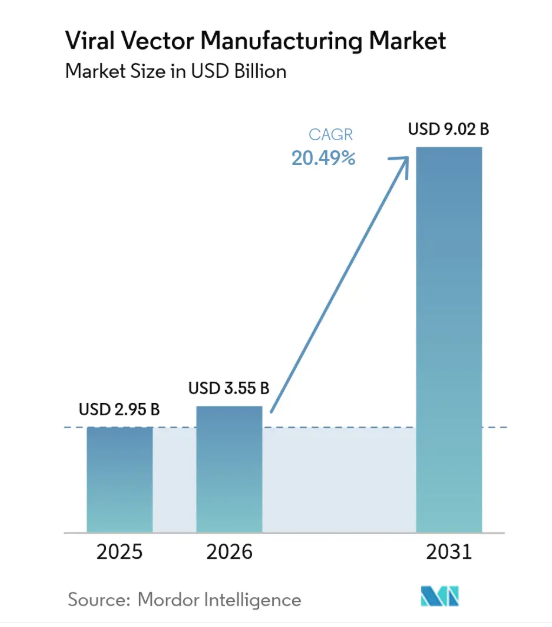
Source- Mordor Intelligence
Latest Viral Vector News-
-

Lonza and Asimov Partner to Advance Lentiviral Vector Manufacturing
-

Minaris Adds Viral Vectors Business Unit to Expand CGT Model
-

Genezen Partners on AAV9 Gene Therapy for Ultra-Rare ARCA2 Disorder
-

Minaris Partners With Asimov to Advance AAV Producer Cell Lines
-

SK pharmteco Supports GEMMABio’s Phase 1/2 Trial of SMA1 Gene Therapy
-
Recipharm Partners With CanVirex to Scale Oncolytic Measles Virus Manufacturing
The Viral Vector Manufacturing Process
Vector Design and Construction
The manufacturing process begins with careful vector design, where therapeutic genes replace pathogenic sequences within the viral genome. This step requires expertise in molecular biology and deep understanding of the target indication to optimise gene expression levels and duration.
Design considerations include:
- Promoter selection for tissue-specific expression
- Packaging constraints based on vector type
- Regulatory sequence optimisation
- Safety modifications to prevent replication
Cell Line Development and Maintenance
Producer cell lines serve as the foundation for viral vector manufacturing. These specialised cell lines, typically derived from human embryonic kidney (HEK293) or other mammalian sources, require careful characterisation and banking procedures to ensure consistent production.
Critical cell line attributes:
- Genetic stability over multiple passages
- Optimal growth characteristics in serum-free media
- Consistent viral vector yield and quality
- Absence of adventitious agents
A notable shift underway across the industry is a move away from transient transfection toward stable, inducible producer cell lines. Researchers are working to reduce reliance on multi plasmid transfection by developing stable cell lines that produce viral vectors under an inducible system, since producer cell lines eliminate the costly and increasingly challenging step of removing plasmid vectors from the production medium at large scale.
Production and Harvest
Large-scale production occurs in controlled bioreactor systems, where producer cells are expanded and induced to generate viral vectors. The production phase typically involves:
- Cell expansion in appropriate culture media
- Transfection or infection to initiate vector production
- Harvest timing optimisation to maximise yield
- Primary recovery through clarification and concentration
Purification and Downstream Processing
Viral vector purification represents one of the most technically challenging aspects of manufacturing. The process must achieve high purity whilst maintaining vector infectivity and stability.
Common purification strategies:
- Ultracentrifugation for research-scale production
- Chromatography-based methods for commercial manufacturing
- Membrane filtration for concentration and buffer exchange
- Tangential flow filtration for scalable processing
Quality Control and Release Testing
Comprehensive analytical testing ensures viral vectors meet stringent safety and efficacy requirements. Quality control encompasses both product characterisation and safety testing.
Essential quality attributes:
- Vector genome titre (copies/mL)
- Infectious titre (functional units)
- Empty-to-full capsid ratio (for AAV)
- Residual host cell proteins and DNA
- Endotoxin levels
- Sterility and mycoplasma testing
Development Phase Manufacturing Considerations
Manufacturing requirements evolve significantly across development phases. Early-stage programmes from pre-clinical through Phase II focus primarily on process development, small-scale production capability, and analytical method establishment. The emphasis remains on rapid proof-of-concept activities and generating preliminary safety data with relatively modest manufacturing demands.
Late-stage development undergoes a fundamental shift toward commercial readiness. Phase III programmes require robust process performance qualification, comprehensive technology transfer planning, and detailed regulatory filing preparation. Supply chain establishment becomes critical, alongside continued process verification and commercial manufacturing capability validation.
Manufacturing Strategy: In House vs. CDMO vs. Hybrid
In House Manufacturing Benefits
Pharmaceutical companies increasingly evaluate building internal viral vector capabilities to maintain control over their gene therapy programs. Internal manufacturing offers several strategic advantages:
Operational control:
- Complete oversight of production timelines
- Proprietary process development
- Direct quality management
- Intellectual property protection
Economic considerations:
- Potentially lower cost of goods at commercial scale
- Reduced dependency on external capacity
- Long term cost predictability
CDMO Advantages
Outsourcing to specialized CDMOs provides immediate access to established infrastructure and expertise, particularly valuable for smaller biotechnology companies or early stage programs.
Strategic benefits:
- Rapid program initiation
- Access to regulatory expertise
- Reduced capital investment requirements
- Scalable capacity options
Practical considerations:
- CDMO booking timelines often extend 18+ months
- Technology transfer complexities
- Potentially higher variable costs
- Shared capacity constraints
Comparison Table: In House vs. CDMO vs. Hybrid
| Factor | In House | CDMO | Hybrid |
|---|---|---|---|
| Capital investment | High | Low | Moderate |
| Time to first production | Slower (build and validate facility) | Faster, but subject to booking lead times of 18+ months | Varies by split |
| IP and process control | Full control | Shared with partner | Partial control |
| Best suited for | Large, well funded programs with long term commercial volume | Early stage or smaller biotechs needing speed and flexibility | Companies de risking supply while building internal capability |
| Supply chain resilience | Highest (self controlled) | Dependent on the CDMO’s own capacity and geography | Improved via dual sourcing |
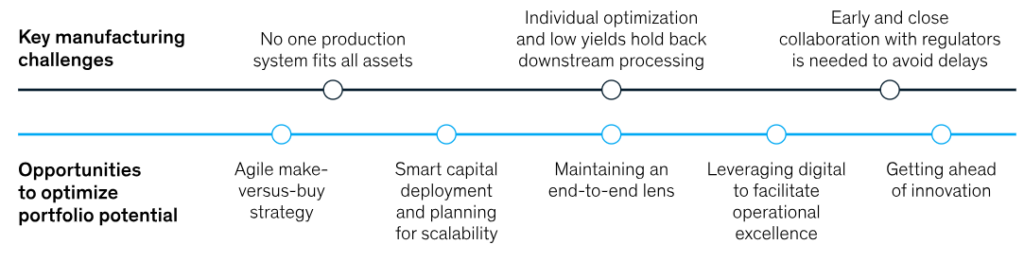
Source- McKinsey
Scalability Challenges and Solutions
Traditional Manufacturing Limitations
Conventional viral vector production methods face inherent scalability constraints that can impede commercial success:
- Adherent cell culture limitations in large-scale bioreactors
- Downstream processing bottlenecks in purification
- Quality control testing throughput constraints
- Regulatory compliance across multiple manufacturing scales
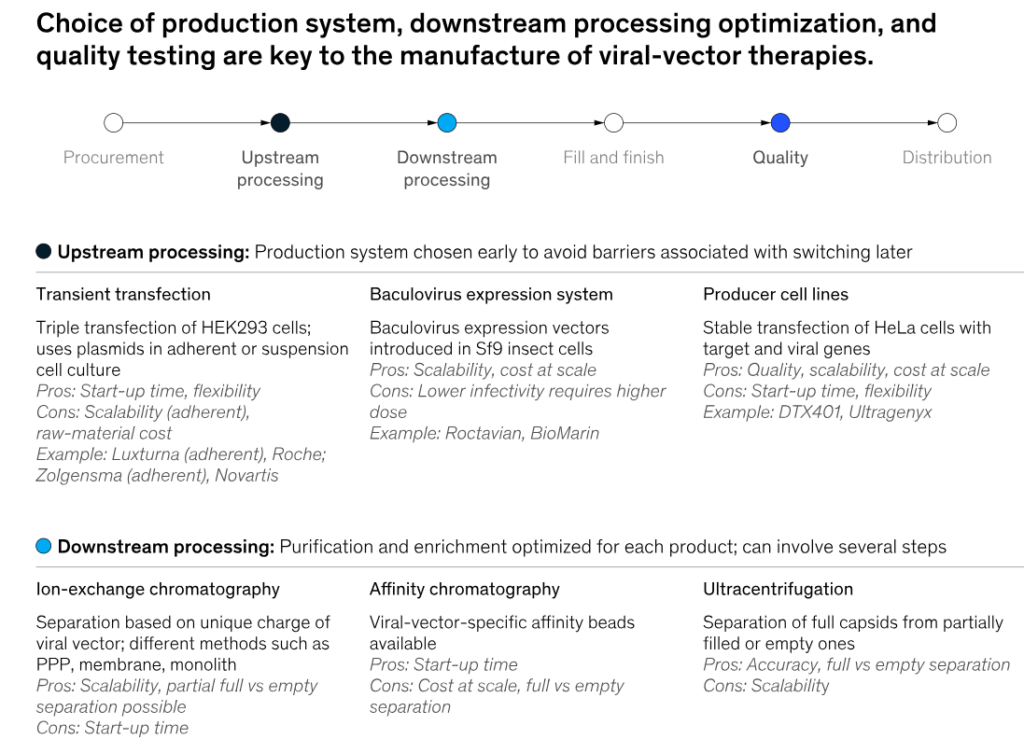

Source- McKinsey
Innovative Scalability Solutions
The industry has developed several approaches to address scalability challenges:
Process intensification:
- High-density cell culture systems
- Continuous manufacturing approaches
- Integrated upstream-downstream processing
Technology platforms:
- Suspension-adapted cell lines
- Single-use bioreactor systems
- Platform-based purification methods
Capacity, Cost, and Supply Chain Risk in 2026
Two forces are actively reshaping viral vector sourcing decisions in 2026, and both deserve a place in any manufacturing strategy conversation:
The Capacity-Utilization Gap
CDMOs have invested heavily in new viral vector capacity over the past two years. More than $8 billion in green field and brown field capacity projects were announced by major CDMOs during 2024 to 2025, led by Fujifilm Diosynth and Lonza. But announced capacity and used capacity are not the same thing: many new suites still run below 50% utilization because they were designed for early phase work rather than sustained commercial output. For sponsors evaluating CDMO partners, this is a useful reality check; headline capacity announcements do not guarantee available slots or favorable pricing.
Cost remains a defining constraint at the product level. AAV production still spans around three weeks and costs roughly $50,000 per construct, with empty capsids inflating volumes and complicating titer calculations. That manufacturing cost pressure shows up downstream in commercial pricing, with Casgevy listing at $2.2 million and Hemgenix at $3.5 million per patient.
The BIOSECURE Act
On December 18, 2025, the BIOSECURE Act was signed into law as part of the FY2026 National Defense Authorization Act, restricting U.S. executive agencies, federal contractors, and recipients of certain federal grants and loans from procuring or using biotechnology equipment or services from designated “biotechnology companies of concern.” The restrictions will not take effect immediately, but the law starts a regulatory process that requires advance planning for affected organizations.
The scale of exposure is significant. With 79% of biopharma companies historically relying on Chinese CDMOs and an estimated $10 billion to $20 billion in annual contracts at stake, companies across the life sciences value chain are reassessing supply chain strategy, and CDMO rates are expected to rise 5 to 10% annually as capacity tightens. For viral vector programs specifically, this is accelerating interest in non Chinese CDMO capacity and reinforcing the dual sourcing trend already underway for supply chain resilience.
Regulatory Considerations
Good Manufacturing Practice (GMP) Requirements
Viral vector manufacturing must comply with stringent GMP requirements throughout development and commercialisation. Key regulatory considerations include:
- Facility design with appropriate containment levels
- Personnel training and qualification programmes
- Cleaning validation for multi-product facilities
- Change control procedures for process modifications
International Regulatory Harmonisation
Regulatory requirements vary across global markets, requiring careful planning for international development programmes:
- European Medicines Agency (EMA) guidelines for gene therapy medicinal products
- FDA guidance on chemistry, manufacturing, and controls
- International Council for Harmonisation (ICH) quality guidelines
- Regional-specific requirements for emerging markets
Supply Chain and Storage Management
Viral vector manufacturing depends on specialised raw materials requiring careful supply chain orchestration. Plasmid DNA, often produced in-house to ensure quality and supply security, represents a critical component for transient transfection processes. Cell culture media and supplements must meet serum-free, chemically defined specifications, with lot-to-lot variability potentially impacting production consistency.
Ultra-low temperature storage requirements create unique logistical challenges throughout the supply chain. Viral vectors typically require storage at -80°C or below, necessitating robust cold chain logistics for distribution. Formulation development efforts focus on improving stability profiles, whilst specialised packaging systems maintain temperature integrity during transport. Storage stability studies determine shelf life parameters and guide commercial supply strategies.
Leading Viral Vector CDMOs and Manufacturers
The viral vector manufacturing landscape includes a mix of large, multi-modality contract development and manufacturing organizations and specialist providers focused exclusively on viral vector platforms. Leading players active in this space include:
- Lonza
- Oxford Biomedica (OXB)
- Charles River Laboratories
- AGC Biologics
- Sigma-Aldrich (MilliporeSigma)
- ProBioGen
- Minaris
- VectorBuilder
- Andelyn Biosciences
- Thermo Fisher Scientific
- Catalent
- FUJIFILM Diosynth Biotechnologies
- WuXi AppTec
- Merck KGaA
- Takara Bio
- Samsung Biologics
- Curia Global
- GenScript ProBio
- Aldevron
- Yposkesi (Sanofi)
- Genezen
- FinVector
- Creative Biogene
- VGXI
- Sartorius
- Cytiva
- SK pharmteco
- Vector BioMed
AI and Digital Twins in Viral Vector Manufacturing
Artificial intelligence has moved from experimental to operational in viral vector manufacturing over the past 18 months, touching both vector design and process control:
Capsid and Vector Design
Machine-learning frameworks such as CAP-PLM now predict AAV capsid fitness with high accuracy, allowing developers to narrow experimental libraries and cut discovery cycles. Better-designed capsids can halve vector dose requirements, easing cost pressure and freeing fermenter capacity (Mordor Intelligence). Similarly, models such as Fit4Function are reshaping capsid design for tropism, manufacturability, and translation to non-human primate models (Viral Vectors Summit 2026).
Process Optimization
In upstream manufacturing, ML models analyze real-time bioreactor data to optimize transfection efficiency and predict viral yields; downstream, AI-driven chromatography modeling predicts optimal elution conditions and reduces trial-and-error experimental runs (Persistence Market Research). Digital twins and multivariate data analysis increasingly enable real-time process monitoring and early anomaly detection, improving batch consistency and supporting regulatory compliance — with AI-enabled platforms expected to shorten development cycles by more than 50% by 2030 (Viral Vectors Summit 2026).
What This Means for Manufacturing Strategy
Technology differentiation is becoming a genuine competitive factor among CDMOs: operators without AI-enabled design and process-control tools risk competing on price rather than value-added science, while those that have integrated these platforms are shaving months off development timelines (Mordor Intelligence). Sponsors selecting a manufacturing partner should now ask specifically about AI/ML tooling in both process development and in-process analytics, not just historical batch success rates.
Future Outlook and Innovation Trends
Emerging Technologies
Several technological innovations promise to transform viral vector manufacturing:
Next-generation production systems:
- Continuous manufacturing platforms
- Cell-free production systems
- Synthetic biology approaches
Enhanced purification methods:
- Affinity chromatography improvements
- Novel membrane technologies
- Integrated downstream processing
Market Evolution
The viral vector manufacturing landscape continues evolving rapidly:
- Capacity expansion driven by increasing demand
- Standardisation efforts across the industry
- Regulatory pathway maturation for gene therapies
- Cost reduction initiatives through process improvements
- Supply chain diversification driven by the BIOSECURE Act
Frequently Asked Questions
What is a viral vector?
A viral vector is a modified virus engineered to deliver genetic material, such as a therapeutic gene, into a patient’s cells. Scientists remove the illness causing portion of the virus so it cannot cause disease, then use its natural ability to enter cells to deliver corrective genetic material instead.
What is viral vector manufacturing in the pharmaceutical industry?
Viral vector manufacturing is the process of producing genetically modified viruses that serve as delivery vehicles for therapeutic genes. These vectors are essential for gene therapy treatments and advanced vaccine development, requiring specialized production facilities and stringent quality controls.
What are the four main types of viral vectors used in pharma?
The primary viral vectors are adeno associated virus (AAV) vectors, adenoviral vectors, lentiviral vectors, and retroviral vectors. Each type offers distinct characteristics regarding safety profile, packaging capacity, and integration behavior, making them suitable for different therapeutic applications.
How are viral vectors prepared for pharmaceutical use?
Viral vector preparation involves vector design and construction, producer cell line development, large scale production in bioreactors, comprehensive purification through chromatography and filtration, and rigorous quality control testing to ensure safety, purity, and potency.
What are the main challenges in viral vector manufacturing?
Key challenges include scalability from laboratory to commercial production, maintaining product quality and consistency, managing complex supply chains for specialized raw materials, ensuring regulatory compliance across global markets, navigating geopolitical supply chain risk such as the BIOSECURE Act, and addressing high manufacturing costs.
Should pharmaceutical companies manufacture viral vectors in house or outsource?
The decision depends on factors including company size, product portfolio, development stage, and strategic objectives. In house manufacturing offers greater control and potentially lower long term costs, while outsourcing provides immediate access to expertise and established infrastructure with reduced capital investment, though CDMO booking timelines often extend 18+ months, so early engagement matters.
What quality controls are essential for viral vector manufacturing?
Critical quality controls include vector genome titer determination, infectious titer measurement, empty to full capsid ratio assessment, residual impurity testing (host cell proteins and DNA), endotoxin testing, sterility verification, and comprehensive identity and purity analysis.
How long does viral vector manufacturing take from start to finish?
Production timelines vary based on vector type, scale, and manufacturing partner. AAV production alone typically spans around three weeks per batch. Some CDMOs now offer accelerated platforms; for example, Charles River’s Lentivation platform targets under seven months to GMP for lentiviral vector programs, compared to longer traditional workflows.
What regulatory approvals are needed for viral vector manufacturing?
Viral vector manufacturing requires compliance with Good Manufacturing Practice (GMP) regulations, facility licensing from relevant health authorities, and product specific approvals as part of gene therapy marketing authorizations. Requirements vary by region and intended use.
How is the BIOSECURE Act affecting viral vector manufacturing sourcing decisions?
Signed into law in December 2025, the BIOSECURE Act restricts U.S. federal agencies and contractors from using biotechnology equipment or services from designated “biotechnology companies of concern.” With a large share of biopharma companies historically relying on Chinese CDMOs, sponsors are increasingly evaluating non Chinese manufacturing partners and dual sourcing strategies to manage this exposure.