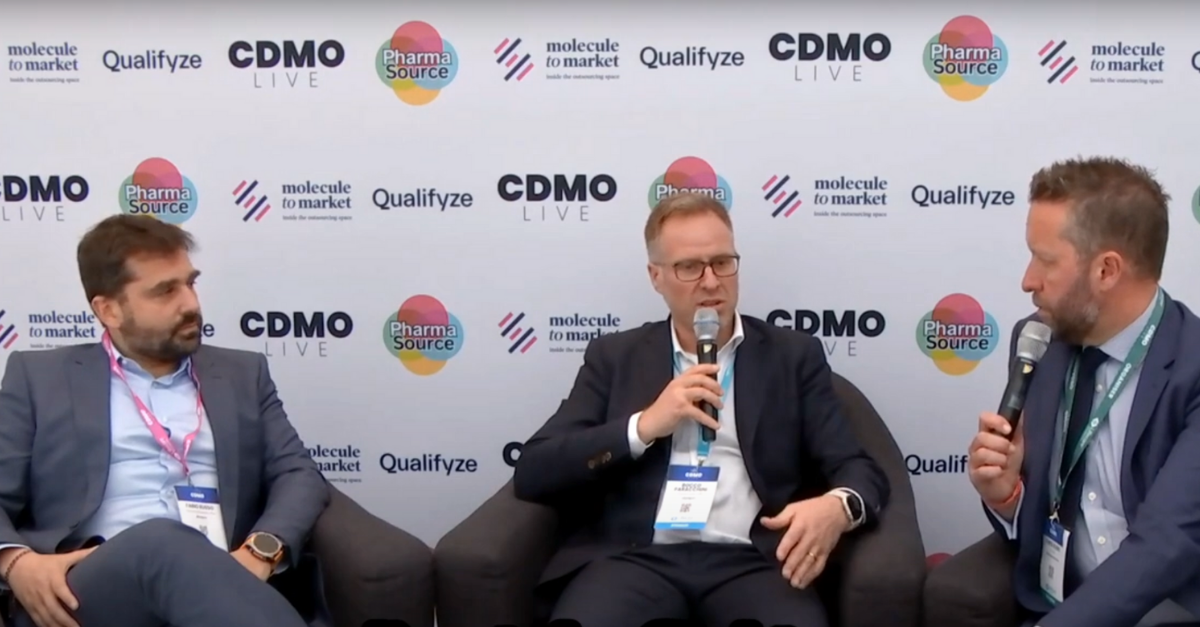
Multi-partner relationships are the new reality. “The relationship between CDMO’s and clients is actually more than just two parties. So it doesn’t necessarily take two to tango, but maybe three or four,” explains Rocco Paracchini from Alfasigma’s Morpho CDMO division, highlighting how modern pharmaceutical outsourcing has evolved beyond traditional sponsor-CDMO partnerships.
Rocco Paracchini, Director of Alfasigma’s CDMO business unit, Morpho, and Fabio Russo, Chief Procurement Officer at Alfasigma, bring extensive expertise in pharmaceutical manufacturing and contract development. Together, they oversee Alfasigma’s expanding CDMO operations and strategic partnerships across the pharmaceutical supply chain.
Speaking at CDMO Live 2025 in Rotterdam, Rocco and Fabio shared insights on navigating supply chain uncertainty, building effective partnerships, and avoiding common outsourcing mistakes. Their perspectives offer valuable guidance for pharmaceutical companies looking to optimise their CDMO relationships and operational strategies.
Multi-Partner Relationships Are the New Reality
Modern CDMO partnerships have evolved far beyond simple two-party agreements between pharmaceutical sponsors and contract manufacturers. Today’s successful relationships often involve multiple stakeholders working collaboratively.
“There are relationships including excipient and machine suppliers. So it’s not just the pharma and the CDMO,” Rocco explains. This multi-partner approach requires more sophisticated relationship management and coordination across the entire supply chain.
The shift towards complex partnerships means companies must adapt their management strategies to handle multiple relationships simultaneously whilst maintaining clear communication channels and aligned objectives across all parties involved.
Nearshoring Strategy Tackles Supply Chain Uncertainty
Alfasigma has implemented a strategic shift towards nearshoring and onshoring to mitigate growing supply chain risks and uncertainties in global manufacturing.
“One of the elements that we started a while back was to concentrate on nearshoring and onshoring. So we are trying to reduce as much as possible our business in countries where there may be risky situations,” Fabio states.
This approach involves moving production closer to end markets, even though it may come at higher costs. “Increasing nearshoring is one of the biggest levers that we’re trying to explore and implement, even though this could come at the cost of pricing and cost efficiency on the product.”
Setting Clear Expectations Prevents Partnership Failures
The most critical factor in successful CDMO relationships is establishing proper alignment from the project’s inception, according to both executives.
“Mistakes are typically made when there’s no good alignment from day one. So if there are too many things taken for granted from both ends on a buyers and on a seller side,” Rocco warns.
Poor initial alignment becomes increasingly difficult to correct once partnerships are operational: “When the relationship takes off, it’s not easy to redirect the flight course in the right direction. So it’s important to invest a bit more time and effort in making sure that there is good alignment.”
The key is implementing “objective methodologies to avoid finger pointing and more about working constructively to come up with improvement in the relationship itself.”
Avoiding Short-Term Thinking and Cost-Only Focus
Two major mistakes plague pharmaceutical outsourcing decisions: excessive focus on immediate cost savings and insufficient patience for proper implementation.
“Going for the short-term game, which is typically cost-focused, and the second element which is connected is a lack of patience. People feel the urgency of getting everything done immediately at time zero, but that doesn’t always happen.” Fabio explains.
Successful partnerships require time investment and long-term strategic thinking rather than purely transactional relationships focused on immediate cost benefits.
Three Pillars for Successful CDMO Integration
For innovative companies establishing their own CDMO operations, Alfasigma has identified three essential pillars for success.
Strategic Clarity: “Being clear on your strategy and your intentions and your positioning. It’s clearly different, a business of CDMO embedded into a pharmaceutical company than CDMO per se,” Rocco emphasises.
Operational Distinction: Companies must establish proper procedures that distinguish between captive production and externally oriented operations. “We have decided to set a number of SOPs and procedures that will help us changing hats.”
Information Security: “It’s definitely necessary to set firewalls that clearly protect the interest of the pharmaceutical companies, the customers, and the interest and IP of the mother company itself.”
This separation ensures neither business compromises the other whilst maintaining the ability for mutual improvement and learning.