“If you feel the rules are changing every five minutes, that’s not going to help you — because this is a long-term industry.”
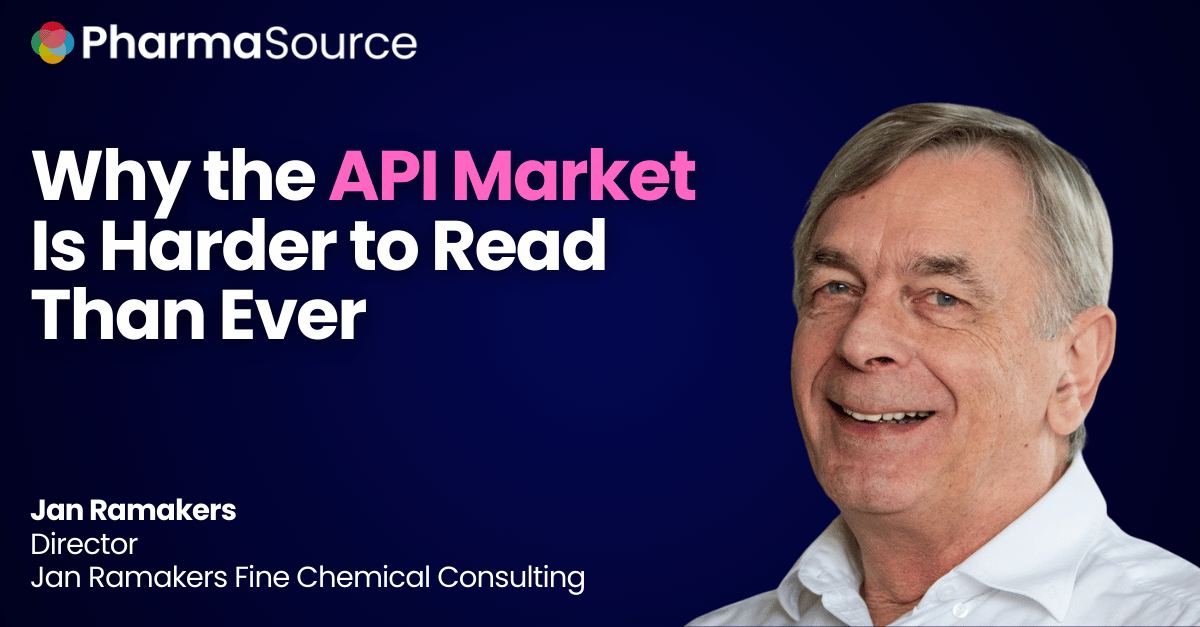
Jan Ramakers is an independent consultant with over two decades of experience tracking the fine chemicals and pharmaceutical ingredients market. A chemist by training, Jan has worked across pharma, agrochemicals, and the financial sector, spanning market intelligence, competitor analysis, and M&A due diligence.
In this PharmaSource podcast episode, Jan explains why the API outsourcing market is at an inflection point shaped by geopolitical uncertainty, supply chain fragility, and the evolving race among CDMOs to differentiate. Drawing on career-long pattern recognition, he outlines what is actually happening on the ground versus what the industry often gets wrong.
The API Market in 2025
“Chaos” is the word Jan uses to describe the current state of the API market. Chaos has a distinction from the word “disruption” – disruption implies an orderly transition; what the market is experiencing right now is something more volatile.
The sources of turbulence are multiple and colliding simultaneously. Shifting U.S. regulatory attitudes toward pharma and vaccines, a trade war generating tariff uncertainty, and pharmaceutical companies making high-profile pledges to invest in U.S. manufacturing – pledges Jan views with measured skepticism.
“Whether that’s going to happen, yes or no, remains to be seen,” he says. “There’s a lot of uncertainty about pricing, about the whole thing.”
This uncertainty is particularly damaging for an industry defined by its long lead times. Regulatory submissions, manufacturing transfers, and plant investments all operate on multi-year timelines. When the external environment shifts faster than internal processes can adapt, companies are left navigating without a reliable map.
Small Molecules Are Not Going Away, And Neither Is Outsourcing
One of the clearest misconceptions Jan addresses is the idea that biologics are displacing small molecules. The data tells a more nuanced story. Small molecules still account for just over 52% of the drug development pipeline. Biologics command higher per-molecule revenues, partly due to price, but in volume terms, small molecules remain dominant.
The biological pipeline is also maturing in ways that affect the competitive landscape. As more biologics lose patent protection, biosimilars are entering the market. Unlike small-molecule generics, which can trigger price drops of 70–80%, biosimilars retain more of their value — because they are not structurally identical to the original, and because manufacturing complexity limits the number of viable competitors.
“They tend not to lose that much of their value,” Jan explains. “Sometimes biosimilars actually outperform the original biological — those are called biobetters.”
For CDMOs, small molecule capabilities remain commercially essential, and the outsourcing rate across both modalities continues to grow. The accessible market for CDMOs is expanding faster than the broader pharma market, driven by increasing technical complexity that makes specialization, rather than in-house manufacturing, the pragmatic choice for most pharma companies.
Reshoring: Real, But Slow
Supply chain reshoring is happening. But Jan is careful to separate the signal from the noise. The movement began well before Trump’s tariffs, rooted in operational frustrations with distant suppliers, communication difficulties, and the logistical vulnerabilities exposed by COVID-19.
“Companies and governments realized that if something like this happens, we’ve got a problem,” Jan says. “Maybe we should produce essential drugs closer to home, for security of supply.”
Regulatory frameworks are reinforcing this direction. The EU Critical Medicines Act focuses attention on essential drugs that Brussels wants manufactured within European borders. Similar pressures exist in North America. But the regulatory intent does not translate into overnight change.
The mechanics of a manufacturing transfer are slow and costly. Adjusting registered suppliers requires regulatory submissions, plant upgrades, validation trials, and contract renegotiation. Jan estimates the process can take up to a year or more, per product.
In terms of the current geographic distribution, Jan estimates approximately 37–38% of CDMO manufacturing sites are in Europe, with the remainder split between China, India, and North America. India, notably, is undergoing its own form of reshoring: historically dependent on Chinese APIs, the country is now building domestic manufacturing capacity with government support.
High Potency APIs and ADCs: Specialization as Competitive Strategy
A decade ago, high-potency API (HPAPI) capability was a genuine differentiator for CDMOs. Today, that capability is widespread enough that it no longer stands alone as a competitive edge. The market has moved on.
What differentiates leading CDMOs now is the combination of HPAPI expertise with adjacent capabilities — particularly in antibody-drug conjugate (ADC) chemistry. ADCs require highly potent payloads to be linked to biological antibodies via specialized linker molecules. These linkers must be stable in transit through the body, then break precisely at the target site. It is a technically demanding niche, and companies that have built expertise in linker chemistry occupy a defensible position.
“It’s high potency APIs plus something else — something specific — that now sets you apart,” Jan observes.
The ADC supply chain as a whole is not yet keeping pace with pipeline demand. CDMOs rooted in small molecule chemistry face a meaningful capability gap when moving into ADCs, which require biological expertise, different operational teams, and different development approaches. Jan sees acquisition, rather than organic build-out, as the faster route for CDMOs seeking to enter this space.
Beyond ADCs, Jan also highlights solid-state chemistry, specifically polymorph and crystalline form screening, as an area of growing CDMO specialization. Regulatory requirements mandate that manufacturers identify and control the most bioavailable form of a solid drug product, making this capability increasingly essential at the development stage.
Sustainability in Chemistry
Pharma companies are deepening their focus on Scope 3 emissions, meaning the environmental footprint of their CDMOs and upstream suppliers. Jan tracks this trend closely, and his read is pragmatic.
Most CDMOs are addressing Scope 1 and 2, renewable energy sourcing, electrifying fleets, and reducing direct emissions with relative ease. Scope 3 is harder. Changing the chemistry itself – the reactions, the solvents, the synthesis routes – runs into regulatory constraints. A drug product’s manufacturing process is locked into its regulatory filing; changing a synthesis route requires revalidation and resubmission.
“For existing products, you’re not going to change a route just to make it greener,” Jan explains. Solvent recycling, where solvents are reclaimed and redirected into non-GMP applications, represents one practical intermediate step. Fermentation-based synthesis, long used for complex chiral chemistry, is gaining renewed attention for its sustainability credentials, though Jan notes it is not universally more sustainable than its marketing implies.
Green chemistry in pharma manufacturing is a long-term transition, not a near-term transformation. CDMOs that are investing now, in both technology and narrative, are positioning ahead of where pharma company procurement criteria will land.
The Talent Gap: Analytical and Business Development Roles Feel It Most
An aging workforce and demographic headwinds are creating talent shortages across the chemical industry. Jan identifies two functions where the pressure is most acute at CDMOs: analytical services and business development.
Analytical departments, which provide the evidentiary backbone for GMP compliance, batch release, and regulatory submissions, require deep specialized knowledge that takes years to develop. Business development in pharma is equally specialized: unlike many sectors, effective BD requires the ability to discuss chemistry fluently with technical counterparts.
“If you’re doing business development in the pharma industry, you need to be able to talk chemistry — or at least understand what your partner is talking about,” Jan notes. “That makes it more specialized than BD in most other industries.”
The broader challenge is one of perception. The chemical industry has not historically been effective at attracting young talent, hampered by associations with industrial pollution and heavy infrastructure.
What the Industry Consistently Gets Wrong
Jan has spent long enough in this market to observe recurring patterns of misjudgment. The most common being overestimating the universality of a particular technology or capability.
Two decades ago, Jan explains, it was chiral chemistry — heralded as essential for every CDMO. More recently, continuous manufacturing has attracted similar levels of hype. Jan’s view is that continuous manufacturing is a valuable tool for the right processes, but it is not a universal solution. Some synthesis steps are simply better suited to batch processing, and forcing continuous manufacturing where it does not fit adds cost and complexity.
“Make sure you don’t focus on one technology at the expense of everything else,” he advises. “People get too carried away with the possibilities and forget that it’s not the single solution for every problem.”
A second recurring misconception is profitability assumptions. Investors and new entrants frequently overestimate the margin profile of pharma-related chemical manufacturing. The regulatory burden, quality requirements, and long development timelines compress returns in ways that are not obvious from the outside.
His method for maintaining signal clarity amid industry noise is to triangulate across multiple viewpoints, strip away the hype, anchor to historical precedent, and trust pattern recognition built over decades. “
“It’s a bit gut feeling, I guess — which I’ve developed over the years,” he admits.
The API Market in 2030: More of the Same, But Larger
Jan’s five-year outlook is grounded in pipeline mathematics. Given that small molecules still account for 52% of the development pipeline today, and that attrition rates are broadly similar for small molecules and biologics, the commercial split between the two modalities is unlikely to shift dramatically by 2030.
What will change: the outsourcing rate. As drug molecules become more technically complex and manufacturing more specialized, the strategic logic of outsourcing to expert CDMOs becomes harder to resist, even for large pharma companies with in-house manufacturing infrastructure.
“Outsourcing is not at 100%, but it is growing, and that will keep on growing,” Jan predicts. “The CDMO market is growing at a higher rate than the general pharma market.”