- AstraZeneca and Bristol Myers Squibb have held merger talks in recent months that would create a combined company worth nearly $400 billion, according to the Financial Times on Sunday 3rd August evening
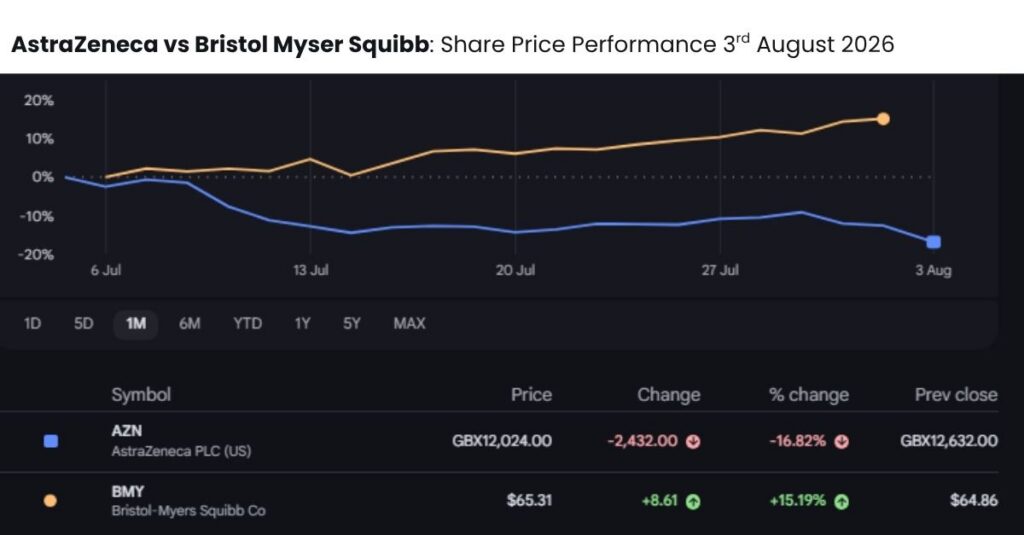
- AstraZeneca’s shares initially by 7% on Monday, the steepest decline on the FTSE 100, while Bristol Myers rose around 6% in premarket trading
AstraZeneca has held discussions with Bristol Myers Squibb about a merger that would combine Britain’s biggest drugmaker with its New Jersey-based rival into a roughly $400 billion group. Within 24 hours, analysts, investors, and industry experts have largely concluded the deal would be a mistake. Here’s what’s actually confirmed, and what industry leaders and megamerger veterans are saying about it.
Coming into Monday 3rd August, AstraZeneca carried a market cap of $264 billion and Bristol Myers roughly $133 billion, according to CNBC. Reuters noted a combined entity would rank fourth globally by market capitalization and first by revenue. Fierce Pharma pointed out that the late-2010s wave of megadeals (Takeda-Shire, AbbVie-Allergan, BMS-Celgene) topped out around the $60 billion-plus range, making this potential combination several times larger than anything the industry has attempted.
AstraZeneca’s London-listed shares fell as much as 7% Monday, hitting a low of £116.46 in early trading per the Guardian, and were still down around 6% by late morning — the steepest decline on the FTSE 100, according to Reuters. Bristol Myers moved the opposite way, rising roughly 6% in US premarket trading, per CNBC.
The market’s verdict has been swift and skeptical. Reuters reported AstraZeneca shareholders including Union Investment and JM Finn questioned the strategic need, with Union’s Markus Manns saying a combination “does not make strategic or financial sense” and warning it would disrupt a well-run company with a full pipeline. Jefferies analysts wrote Monday that they were “a bit perplexed” given the strength of AstraZeneca’s growth and innovation profile, adding that if there is one company that doesn’t need financial engineering, it’s AZ. AstraZeneca is targeting $80 billion in annual sales by 2030, up from about $59 billion last year.
The rationale, such as it is, centers on the US. Bristol Myers sourced 69% of revenue from the US market last quarter, per CNBC, versus 42% of AstraZeneca’s first-half 2026 sales. AstraZeneca completed a direct NYSE listing in June, is investing $50 billion in US research and manufacturing by 2030, and has cultivated close ties with the Trump administration, Reuters and the Guardian reported. Fierce Pharma’s counterargument: AstraZeneca doesn’t have a US void to fill, and the deal would create “an operationally overlapping monster in the same market” rather than unlocking new growth.
The two companies market the only two commercial anti-CTLA-4 agents (Yervoy and Imjudo), and their checkpoint inhibitors Opdivo and Imfinzi target some of the same indications, Fierce Pharma noted, while AstraZeneca’s phase 3 CAR-T candidate, AZD0120, could threaten BMS’s Abecma in multiple myeloma. UBS analysts, cited by Proactive Investors, flagged duplication across solid tumors, blood cancers, and cardiovascular medicine, predicting a deep competition review and probable divestitures. Timing is another objection: Jefferies calculated Bristol’s portfolio would add roughly $30 billion of exclusivity losses led by Eliquis and Opdivo arriving before AstraZeneca’s own post-2030 patent cliff.
Jefferies noted, per Proactive Investors, that AstraZeneca would be a British acquirer of a major American pharma champion at a moment when Washington is preoccupied with domestic manufacturing. UBS even wondered aloud whether the reports might actually relate to a narrower partnership on a single product or franchise rather than a full merger.
Industry Leader Commentary
John Carroll, founding editor at Endpoints News, published a pointed satirical description of the deal on LinkedIn — framing it as a plan that “would eviscerate a sizable chunk of drug R&D, create chaos in 2 huge pipelines,” disrupt lives and cost many jobs, while a few people got very rich.
John LaMattina, previous guest on PharmaSource, senior partner at PureTech Health and a former Pfizer R&D president, replied with a concrete estimate:
“I have lived through two of these and I agree. Both R&D organizations will be in turmoil for at least 18 months. Look at their current clinical timelines and add a year.” He added that headhunters would approach both organizations in droves, offering employees certainty in an uncertain period.
That tracks with what UBS told clients. Per Proactive Investors, the bank noted big pharma mergers have historically damaged research productivity because staff focus on job security during integration rather than the science.
Tom Sanford, a retired senior corporate communications leader, offered a first-hand version: he was at Pfizer during the Warner-Lambert and Pharmacia acquisitions, and while Pfizer “certainly got bigger,” he isn’t sure it got much better.
AstraZeneca and BMS market the only two commercial anti-CTLA-4 agents, Yervoy and Imjudo, and their PD-(L)1 antibodies Opdivo and Imfinzi target overlapping indications. AstraZeneca’s dual-targeting CAR-T candidate AZD0120 just entered phase 3 in multiple myeloma, where it could threaten BMS’s Abecma, while BMS’s EGFRxHER3 ADC izalontamab brengitecan competes with AstraZeneca’s Datroway in breast and lung cancer.
UBS flagged duplication across solid tumors, blood cancers, and cardiovascular medicine, predicting a deep competition review and probable divestitures, per Proactive Investors.
Manoj K., senior partner at IBM Consulting, argued in a LinkedIn analysis that, “the complementarity is real: AstraZeneca’s ADC platforms alongside BMS’s immuno-oncology backbone could enable combination regimens neither optimizes alone.” However,
“the overlap driving synergy is also the antitrust problem. The FTC, European Commission and UK regulators will scrutinize lung cancer, hematology and checkpoint inhibitors for head-to-head competition, and may demand divestitures.”
James Nyssen, global head of life sciences outsourcing at Hays, pointed to a precedent for how that resolves — the forced $13.4 billion Otezla divestiture that came out of BMS-Celgene, which he called a realistic template here.
Sumant Ramachandra, a CEO and board director, offered a strategic read in the comments on Carroll’s post: the combination pulls forward AstraZeneca’s 2030 ambition, buys US commercial infrastructure for a dense launch schedule, and shifts revenue mix away from China where volume-based procurement is compressing price. He added that a larger US footprint would help fulfill the $50 billion commitment and could reduce tariff exposure, while conceding that management conviction would have to be very strong to absorb the risk, and that cheaper routes to the same goals presumably exist.
Peter Benton, a biotech advisor, made the ecosystem argument that displaced employees would go start new biotechs and that a diminished pipeline gives startups fresh shots on goal. Christopher Cooper pushed back, arguing UK biotech isn’t big enough to absorb even a fraction of the losses from a company AZ’s size, with UK scientists still recovering from last year’s redundancies.
Nyssen also cautioned against the tidy narrative in either direction, noting the R&D evidence is split: one analysis of 2001-2011 mergers found productivity improved afterward, a European study found patenting fell, and a third found mergers raise the odds a given program gets killed while survivors move faster.
Salil Kallianpur, founder and MD of Arks Knowledge Consulting, characterized the talks as “a patent cliff bailout, not a growth story,” noting BMS’s Opdivo and Eliquis face exclusivity loss by 2028 and Revlimid has already gone generic.
His key point: when a company with AstraZeneca’s execution record starts treating scale-through-M&A as necessary rather than optional, that says something about how seriously the industry now takes the cliff. If frontrunners are consolidating defensively, he argued, the sourcing and licensing environment for the next three years shifts — pipeline access, deal terms, and partner appetite all move.
Ekaterina Chadina, a business unit director at Ipsen, made a similar directional point: whether this particular deal moves forward or not, large-scale consolidation reshapes licensing and business development priorities, investment decisions across therapeutic areas, and organizational structures.
Whether or not a deal is ultimately agreed, the talks themselves reveal an industry increasingly willing to contemplate unprecedented consolidation as patent cliffs, US policy and the race for pipeline scale converge.