“How do you embed decision-making in the supply chain? It’s in how you manage suppliers. Who manages suppliers? Procurement.”
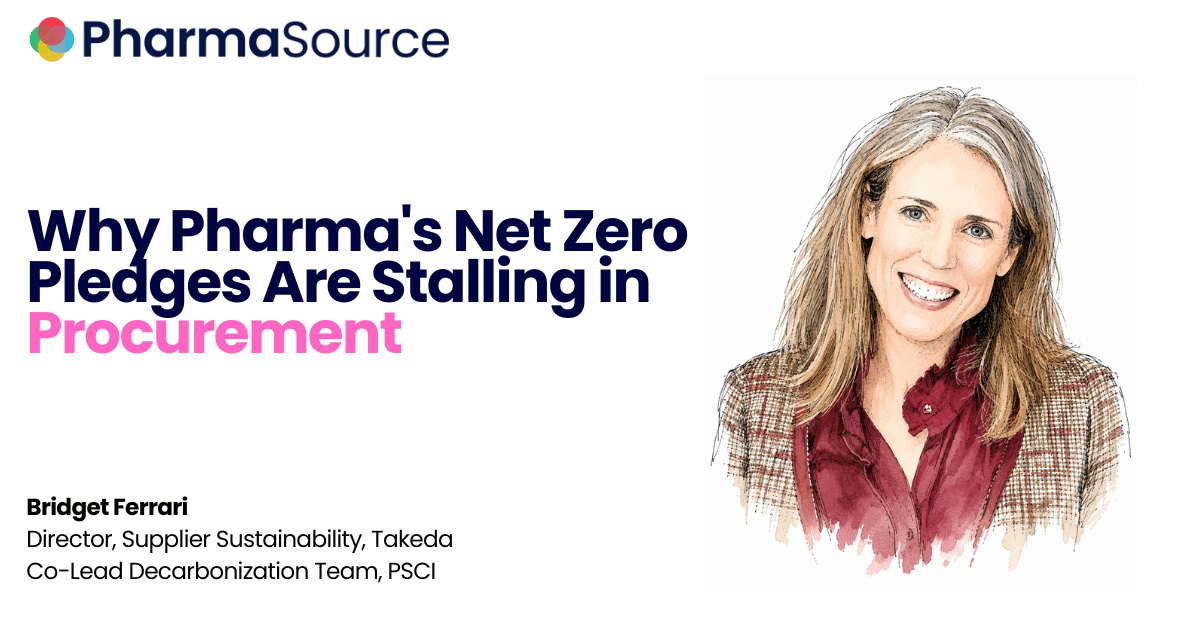
Bridget Ferrari is Director, Supplier Sustainability at Takeda and co-lead of the Decarbonization Team at the Pharmaceutical Supply Chain Initiative (PSCI), which she helped launch in 2022 and has co-led since its inception. The team has grown into one of PSCI’s most active and productive working groups. She joins the “Operationalizing Decarbonization: How to Close the Pharma-CDMO Gap” panel at CDMO Live Americas, October 20-21 in Boston.
Most pharma companies have net zero commitments. Far fewer are on track to meet them, and the category managers who actually place business with CDMOs are rarely given the tools to change that. Ahead of her CDMO Live Americas panel on October 21, Bridget spoke to PharmaSource about how to tell genuine supplier sustainability from marketing, why the industry’s progress numbers may be optimistic, and what “operationalizing” decarbonization actually requires.
The Greenwashing Test: Decisions, Not Declarations
Every CDMO deck now has an ESG slide. Bridget’s test for separating substance from marketing is simple: has ESG changed a decision?
“If they’re actually using it in their decision-making criteria, whether it’s sourcing decisions, or where to set up a new facility, how to bring in employees, if they can demonstrate decision-making related to their values, that’s a big differentiator,” she says.
Disclosure alone proves little. “You can say you’ve done X number of due diligence reviews. For modern slavery, for example, you can have an accessible phone number for employees to call and report abuses. But does it actually change anything? Nobody’s going to say we have child labor in our supply chain. However, if you’re doing the due diligence upfront, are you making different decisions? Has it changed the way you operate or the way that you do business?”
Her advice for buyers evaluating suppliers and for CDMOs preparing for customer questions is to probe for consequences, not counts: what did the company do differently as a result of what it found?
Bridget’s instinct for these questions predates her sustainability career. As a category manager early in her career, she kept asking whether suppliers in developing markets were paying fair wages and operating ethically. “Nobody cared,” she recalls. It wasn’t until she was asked to build a supply chain sustainability program that the pieces connected. “It’s like I saw color for the first time. This was the answer to the questions that I had, and I realized that I just fell in love with my career.”
The Net Zero Gap May be Wider than Reported
The PSCI and Accenture Decarbonization Playbook reports that only 20% of life sciences companies are on track to achieve net zero by 2050. Bridget suspects even that figure flatters the industry.
“I think globally only about 10% of companies are on track to meet their commitments.” She’s careful to frame this as informed instinct rather than data: “I don’t have numbers to back that up. That’s just based on what I’m seeing across organizations that I work with.”
To make that case internally, Bridget created a simple but effective slide listing PSCI member pharmaceutical companies alongside their public net-zero commitments. The one-page overview shows that companies including Takeda, BMS, Pfizer and Novartis have all made comparable carbon-reduction pledges. She originally developed it for category teams whose suppliers often insisted, “We’re not hearing about this from other customers.” The visual served as a reminder that while requests may arrive at different times, the strategic direction across the industry is remarkably consistent.
“This is a clear indication that there’s a market demand and market driver,” she says. “This is business continuity and sales.”
The Business Case Exists, Pricing is the Problem
Asked whether there is a business case for decarbonization, Bridget doesn’t hedge: “Absolutely. It’s not just the patient health piece of it. It’s the access and resiliency, longevity of supply, the materials themselves, but also mitigating disruption.”
Nature-based raw materials face real supply threats, and weather events already disrupt pharmaceutical logistics. “Disruption to the supply chain disrupts revenue,” she says. “If you’re not looking at it from the environmental and sustainability side, you’re looking at it from the revenue side and the shareholder side.”
So why doesn’t the business case land in more boardrooms? “The challenge is putting a value to it. The numbers are still subjective, and there are still too many variables for CFOs to be confident in the numbers they’re using.”
She argues pharma has an additional hook other industries lack. “You can manufacture all the life-saving medications in the world, but if the patient doesn’t have access to healthy air, healthy water, clean facilities, it doesn’t really matter.”
Procurement: The Under-Supported Function that Decides Everything
PSCI’s three-year plan was built on feedback from suppliers, members, healthcare entities and patient organizations. PSCI members represent roughly 70% of pharmaceutical revenue, she notes, and the plan concentrates on making carbon data exchange easy, meeting suppliers where they are on the maturity curve (whether early-stage or managing “boatloads of LCAs”) and, critically, equipping procurement.
“Procurement has been the untapped, under-supported area,” she says. “They don’t need to become climate experts, decarbonization experts, but they need to understand the salient points relative to their category.” PSCI is building what she describes as a one-stop resource for category teams to access resources to help inform their decarbonization conversations with suppliers.
Her analogy for what operationalization means comes from home. “I have teenagers, and they’re starting to drive. You don’t just have them watch a webinar that explains the basics and then hand them the keys. And when they do start driving, we don’t say, okay, you’re in Boston, now drive to Chicago, get yourself there. We don’t say you have seven gallons of gas. They have a dashboard, and they make decisions in context.”
“That’s how you operationalize sustainability and decarbonization. It’s not: here’s an LCA, go make a decision. It’s how is that embedded into the entire decision-making with what they’re doing and managing with that supplier.”
Hear the full discussion at “Operationalizing Decarbonization: How to Close the Pharma-CDMO Gap,” in association with PSCI, at CDMO Live Americas 2026, October 20-21, Boston Sheraton.