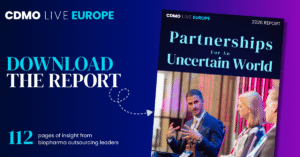
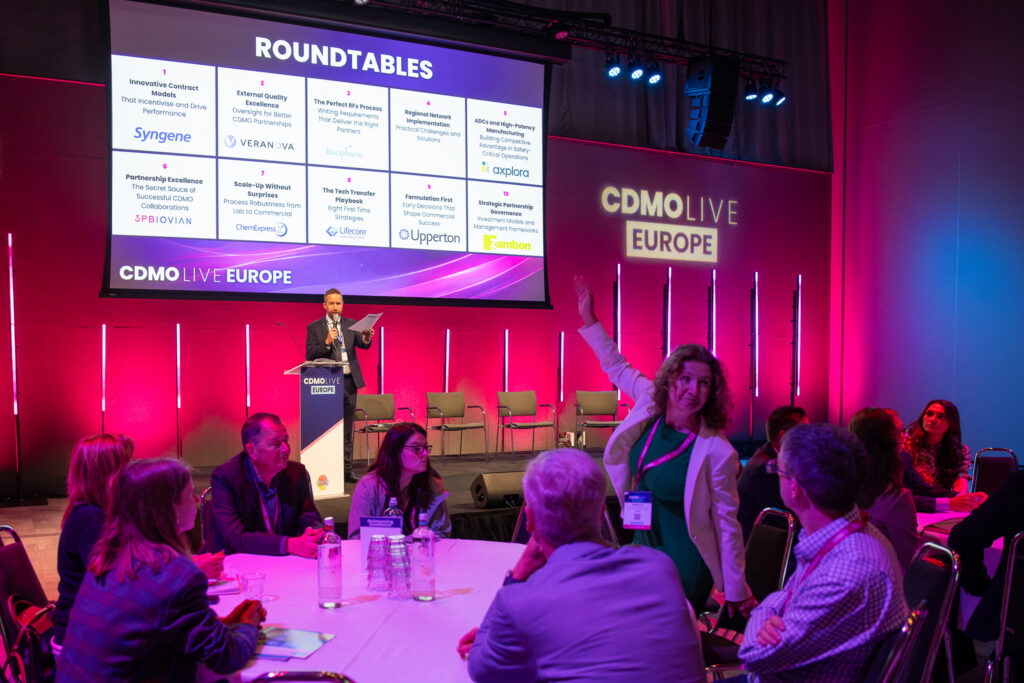
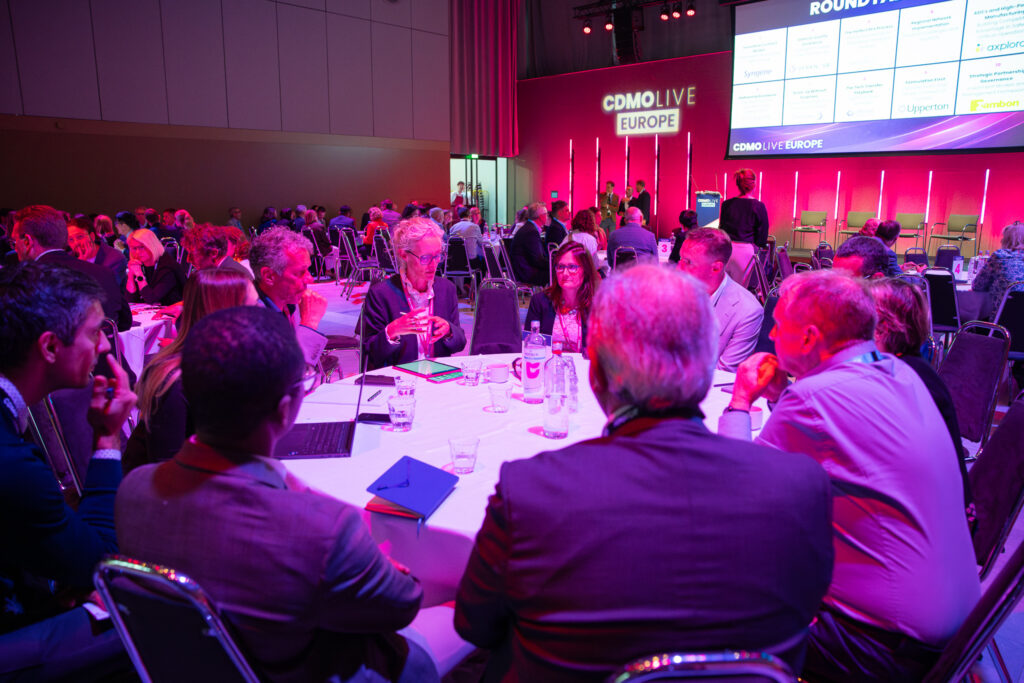
CDMO Live Europe 2026’s Outsourcing Excellence program ran nineteen roundtables, each bringing together pharma and biotech outsourcing leaders and CDMOs to discuss a specific topic in external manufacturing.
The summaries below cover the key points and quotes from each session, spanning RFx design, contract models, regionalization, quality oversight, tech transfer, and supply chain resilience.
The Perfect RFx Process: Writing Requirements That Deliver the Right Partners
Sponsored by Recipharm | Hosted by Dr. Uwe Hanenberg
A poorly constructed RFx doesn’t just waste time. It attracts mismatched partners, produces proposals that can’t be meaningfully compared, and sets up relationships for failure before they’ve begun.
The frustration is mutual. CDMOs face constant revision cycles caused by missing material and process information and no visibility on decision criteria. Buyers receive proposals that don’t match their request, can’t be compared across suppliers, and deliver surprises after signing. Many failed collaborations don’t fail in execution; they fail in the RFx process itself.
The fix isn’t just more detail, it’s the right structure. Key deliverables, including timeline, target price, and CapEx expectations, should be specified upfront, decision criteria included, and a term sheet incorporated from the outset rather than introduced later as a negotiating variable. Where complexity warrants it, a two-step approach can help:
- A lower-granularity ballpark request to identify the most suitable partners
- A detailed quote process with the shortlist
The group landed on one particularly pointed insight: the process needs a built-in mechanism to kill weak opportunities early. As Hanenberg put it, “very often we proceed with RFQs which are dead tosses, and that should be stoppable.”
Innovative Contract Models That Incentivize and Drive Performance
Sponsored by Syngene | Hosted by Mattias Nyström
Traditional fee-for-service contracts often create a misalignment of interests between sponsors and CDMOs, where one party bears most of the risk and neither is particularly incentivized to go beyond the minimum. This session examined whether performance-based and outcome-linked contract structures can change that dynamic, and what it actually takes to make them work in practice.
Performance-based models are gaining traction but remain far from standard. Those who advocate for them point to clear benefits: greater CDMO commitment, sharper focus on outcomes, and stronger accountability on both sides. But designing them well requires care. As Nyström noted, it is “very important how you set your metrics up to encourage sound behaviors and not just trying to boost the KPIs,” with the emphasis on “clarity and simplicity.” The mutuality point was also sharp: a CDMO penalized for late delivery should also be able to earn a bonus for early delivery, but sponsors need to ask honestly whether they are actually set up to benefit from that early delivery.
The group also explored whether soft performance dimensions, such as customer experience, could be built into contracts, though the challenge of measuring these objectively was acknowledged. A further thread examined whether CDMOs might accept lower upfront fees in exchange for royalties or milestone payments, in effect taking a stake in the program’s success.
Regional Network Implementation: Practical Challenges and Solutions
Co-hosted with Frank Binder, Supply Chain Consultant
Building regional manufacturing networks has moved from a strategic nice-to-have to an operational priority, driven by geopolitical pressure, pricing dynamics, and the hard lessons of COVID, particularly around essential medicines. This session focused on the practical realities of making regionalization work.
API regionalization emerged as particularly challenging. Full regionalization is often impossible, global vendors remain unavoidable at certain stages, and sponsors need to verify that nominally separate sources are not in fact served by the same manufacturing site through different distribution channels.
Historically grown networks tend to be large and complex, meaning any regionalization effort brings significant volumes of tech transfer, which the group described pointedly as “problem transfer” given the cost and timeline implications. Regional capability gaps further complicate the picture: what can be manufactured in one region may not be possible in another, requiring a careful balance between resilience and what’s feasible.
Partnership Excellence: The Secret Sauce of Successful CDMO Collaborations
Sponsored by 3P Biovian | Hosted by Timothy Gomez
Selecting the right CDMO is one thing. Making the relationship work is another. Successful outsourcing partnerships depend on more than technical fit; they require trust, communication, and a shared sense of ownership over the program. This session explored what genuinely differentiates high-performing partnerships from the rest.
The number one theme was transparency. As Gomez summarized it, “when things broke down, it was not only about pricing transparency, but also transparency of the capabilities that a CDMO has.” Sponsors would prefer CDMOs to be “completely honest about their capabilities from the beginning, because no CDMO is perfect,” talking openly about weaknesses as well as strengths, rather than claiming they can do everything. Nobody likes surprises, and surprises are what led to the partnership failures discussed at the table.
Beyond transparency, delegates discussed the importance of soft skills and how difficult they are to assess before a collaboration begins. Once a partner is shortlisted, what determines success is whether the CDMO “is engaged and wants to participate in the drug development. It’s not just about providing the services and giving an end product.” Sponsors want partners who problem-solve proactively and help get the product to the finish line. That sense of shared commitment was described as especially important now, with tighter financing meaning many companies have “one shot to do the activities in order to get to the end game.”
External Quality Excellence: Oversight for Better CDMO Partnerships
Sponsored by Veranova | Hosted by Ingrid Lux
Maintaining quality standards when manufacturing happens outside your own walls is one of the more complex challenges in external manufacturing. The risk of quality drift, inconsistent oversight, and an adversarial dynamic with CDMOs is real, and the cost of getting it wrong is high. This session looked at how to build quality oversight models that are genuinely effective without becoming a drag on speed.
Lux opened with a Nietzsche quote to frame the discussion: “Smooth ice is paradise for those who dance with expertise.” She identified two key “unknowns” representing the hidden risks in quality oversight: the culture of the outsourcing relationship, and the evolving landscape of digitalization and AI in quality systems. The message was clear: quality functions need to understand both deeply before they can perform with real expertise. CDMOs and sponsors alike need to approach oversight as a collaborative discipline, not an inspection regime.
Strategic Partnership Governance: Investment Models and Management Frameworks
Sponsored by Zambon | Hosted by Kieran Falvey
As CDMO relationships become more strategic, standard supply contracts are increasingly ill-suited to managing them. Capacity reservations, co-investment in equipment, and even equity arrangements are becoming more common, but they require governance frameworks that most organizations haven’t fully developed. This session examined when and how to structure these more complex arrangements.
The group worked through five core questions:
- When to move beyond a standard contract. New modalities, the desire to limit tech transfer optionality, and the need for co-invest in specialist equipment were the clearest triggers.
- Governance. The consensus was to define it pragmatically and early, keeping it as simple as possible, and anchoring it in quality KPIs alongside what one delegate called a “gut feel KPI,” an intangible but real sense of whether a relationship is on track.
- Exit strategies. Communicating the exit strategy early was seen as essential. One specific challenge flagged: CDMO teams tend to disengage once a contract end date is known, making the final phase harder to manage.
- IP at exit. Ownership of IP, particularly when relationships have soured, was flagged as an area requiring careful planning upfront.
- The human element. The session closed with simple but sincere advice: “be nice, be good,” maintain a connection between CEOs, and remember that governance “really comes down to relationships, communication, and people management.”
The Outsourced Manufacturing Organization: Structure, Skills, and Success
Sponsored by SGS | Hosted by Paul Broomhead & Enrica Tomasutti
When manufacturing is entirely external, the internal team effectively becomes a virtual factory, coordinating across organizational and geographic boundaries without any of the direct operational control that comes with on-site production. Building that team well, with the right skills and governance, is critical to making external manufacturing work.
This session explored what good looks like in practice. The discussion centered on cross-functional team design, with delegates agreeing that matched-level expertise matters: having “an equal expert on my side and the CDMO, so that the conversation can be smooth and at the same expertise level.” On governance, the preference was strongly for resolving issues bilaterally, with escalation to cross-functional forums as the exception, not the default. The best teams combine proactive problem-sensing, clarity on when to act, and the courage to make decisions quickly.
Proper partner onboarding was highlighted as an often-underinvested step, including sending subject matter experts to CDMO sites to embed process knowledge. On whether CDMOs genuinely feel like an extension of the sponsor organization, the first table saw limited hands raised, but the second produced several strong examples of long-term partnerships where, as one delegate put it, “yes, we do feel part of the organization. We sometimes even sit together to prepare a top-to-top meeting.”
Broomhead’s closing point was direct: “CDMOs and external manufacturing sponsors need to talk a lot more, a lot more frequently, and maybe set a mandate of the expectations.”

Maximizing Every Euro: Smart CMC Strategies for Emerging Biotechs
Sponsored by Flamma | Hosted by Fabrice Cornille
For early-stage biotechs with constrained resources, CMC decisions carry outsized consequences. As Cornille framed it, many of the biggest delays, cost overruns, and frustrations in early-stage biotech “don’t come from science, they come from CMC execution and partner selection.” This session focused on how resource-limited companies can make smarter decisions to protect both timeline and capital.
The group’s central focus was CDMO selection. The point was made plainly: “the choice of CDMO won’t just impact your process, but will impact your timeline, your burn rate, and your probability of success. It’s nothing to do with saving money.” Key criteria discussed included:
- Know-how alignment. A CDMO that genuinely understands the specific modality and development stage brings experience the sponsor may lack.
- Geography. Despite higher costs, there was a clear preference for local or regional partners, citing flexibility, ease of site visits, and cultural alignment as meaningful advantages that show up in program execution.
Fast-Track to Market: Cutting Timelines Without Cutting Corners
Sponsored by Prasfarma | Hosted by Nicolas Chornet
Speed to market is a competitive and sometimes clinical imperative, but compressing timelines creates risk if not managed carefully. The challenge is finding the genuine acceleration opportunities without compromising quality or regulatory standing. This session shared lessons from those who have navigated that balance.
Several levers were identified:
- Parallel activity planning. Moving away from sequential handoffs and running workstreams simultaneously wherever possible, in development and tech transfer alike.
- Team composition. A fully integrated team, with regulatory representation from the outset, was seen as critical to avoiding the late-stage bottlenecks that regulatory surprises create.
- Contract negotiation. An unexpected but widely recognized pain point. “Sometimes it takes six months to a year to sign the contract, and maybe that’s an area we could put as a topic for next year.” Letters of intent and analogous mechanisms were discussed as ways to start work before full contracts are in place, with potential lessons from other industries.
- Knowing when to stop optimizing. Having someone with commercial accountability in the project team, who can make a clear-eyed call on whether further process optimization is actually justified, given budget and timeline implications.
The Tech Transfer Playbook: Right First Time Strategies
Sponsored by Lifecore Biomedical | Hosted by Ryan Swanson
Failed tech transfers are one of the most avoidable sources of delay and cost in pharmaceutical development, yet they remain common. The consequences run from wasted batches and lost time to damaged relationships and regulatory setbacks. This session shared strategies for designing tech transfer protocols that work first time.
Four themes dominated:
- Transparency and expectations. Setting clear expectations from the outset between sponsor and CDMO, and establishing escalation pathways so that when communication breaks down, there is a defined route back to alignment.
- Knowledge transfer. Particular attention was paid to capturing tribal knowledge, “the kind that isn’t well documented in tech transfer documentation.” Delegates shared approaches for drawing this out deliberately, rather than hoping it travels with the process.
- Analytical readiness. Getting methods set up correctly and providing the right reference materials to allow comparability to be properly assessed.
- AI. The group’s consensus was measured: current applications are best suited to “virtual assistant type activities,” and there was no strong appetite for pushing deeper at this stage.
Formulation First: Early Decisions That Shape Commercial Success
Sponsored by Upperton | Hosted by Carole Delauney
Formulation decisions made early in development have consequences that ripple through every subsequent stage, influencing manufacturing feasibility, CDMO options, cost of goods, and ultimately patient access. Yet in practice, drug substance and drug product development are frequently disconnected, with formulation considered too late. This session examined how to break that pattern.
The group was candid: “Industry acts in silo when it comes to drug substance to drug product process, and this is how it is.” One CDMO may develop the drug substance, another handles drug product, and scale-up sits elsewhere. The takeaways were practical rather than aspirational:
- CDMOs should conduct thorough technical due diligence with prospective clients early, building in assumptions and flagging risks around analytics, excipient choices, and bioavailability before they become problems.
- Leadership teams, including investors, need to be educated that reformulation is sometimes necessary and should be planned for, not treated as a failure.
The Clinical-to-Commercial Handoff: Getting It Right First Time
Sponsored by Aarti Pharmalabs | Hosted by Mike Frodsham
The transition from clinical to commercial manufacturing is one of the highest-risk moments in a drug’s development, a point where knowledge is lost, teams change, and assumptions that were never written down get left behind. This session examined the structures and disciplines that make handoffs work.
Three themes dominated:
- Knowledge management. “The impact of people and changing personnel within a program can have a significant impact on that knowledge transfer process. It may sound obvious, but I think everybody has felt the pain of that.” When key people move on, undocumented process knowledge goes with them.
- Process lock decision-making. Experienced project teams and robust statistical justification were both identified as critical to building genuine confidence before committing to lock down a process.
- Risk documentation. FMEA analysis was broadly used and well-regarded across the group.
A significant point emerged around contracts: transfer agreements need to be flexible enough to accommodate out-of-scope work. As Frodsham put it, “even with the best planning, we’ve all been there and had problems,” and contractual rigidity at that point creates its own difficulties.
Digital Manufacturing Networks: Creating a Seamless Quality and Manufacturing Network
Sponsored by Boehringer Ingelheim | Hosted by Stefan Haider
Real-time visibility, predictive quality, and seamless data flow across CDMO networks remain largely aspirational for most organizations. The gap between the promise of digital connectivity and the operational reality is significant, shaped by differences in digital maturity, a lack of shared standards, and the human challenges of managing large-scale change. This session examined what is actually working in practice and where the real barriers lie.
The two table conversations went in notably different directions. The first focused on technical realities:
- Digital maturity remains mismatched between companies, and sometimes between departments within the same company.
- The absence of common standards makes data sharing across diverse CDMO systems genuinely difficult, though standards are slowly beginning to emerge.
- IoT and real-time monitoring capabilities are improving, creating better visibility of what is happening on the shop floor.
The second table took a more cultural lens, with strong consensus that digital transformation is fundamentally a change management challenge. “If you’re not getting the people with you, you cannot really make this transition.” Both conversations converged on the need for greater standardization as a prerequisite for progress.
Continuous Manufacturing: Making the Switch From Batch to Flow
Sponsored by P.I. Health Sciences | Hosted by Alessio Piccoli
Continuous manufacturing has been discussed as the future of pharmaceutical production for years, promising tighter quality control, reduced footprint, and greater efficiency. Yet adoption remains slower than its advocates anticipated. This session brought together practitioners to examine the transition honestly: the real drivers, the real barriers, and what the next decade might look like.
The group acknowledged the genuine advantages, including safety, efficiency, speed, and quality consistency, but spent more time on why the switch is harder than it appears. As the table host summarized: “It is not only a matter of technology evolution, but a cultural evolution. We need an important change in mindset.”
For companies in Europe, particularly, the upfront capital investment is a significant hurdle, and recovering it over a realistic timeframe is not straightforward for existing products. The group’s view was that continuous manufacturing is most viable for new chemical entities with significant unmet medical need, where “the cost of this technology will be reverted on the patients” and the investment case is clearest.
ADCs and High-Potency Manufacturing: Building Competitive Advantage in Safety-Critical Operations
Sponsored by Axplora | Hosted by Yann Bethuel
Highly potent compounds, from ADCs to HPAPIs and radiopharmaceuticals, sit at one of the most demanding intersections in pharmaceutical manufacturing, where safety, quality, and speed all have to coexist. This session explored how to translate those constraints into competitive advantage through smarter decisions and stronger partnerships.
As Bethuel framed it, “challenges are real, but so are the opportunities for those who are doing it right.” The discussion centered on what it really means to have the right capabilities. Facility design and containment are necessary but not sufficient. Equally important is investment in operator training: “you can have the best SOPs, but if you don’t follow the SOPs, then this is useless.” Operators should be treated as assets. Beyond internal capabilities, the group stressed the importance of process design itself as a safety tool, with a well-designed process able to significantly reduce operator exposure to highly potent material.
Scale-Up Without Surprises: Process Robustness from Lab to Commercial
Sponsored by ChemExpress | Hosted by Tangqing Li
The gap between lab success and commercial-scale manufacturing is where many promising therapies run into serious trouble. Processes that work at small scale don’t always behave the same way at pilot or commercial scale, and the consequences of finding that out late are costly. This session focused on building process robustness that genuinely translates across scales.
The discussion covered scale-up challenges across different development phases: earlier stages calling for fit-for-purpose process development, later stages increasingly using quality-by-design approaches to identify critical parameters and define ranges that support robust scale-up. The group landed on a wry but accurate conclusion, captured well by Li: “It will be a surprise if there’s no surprise during the development phase.” The goal isn’t to eliminate uncertainty, but to design processes and development protocols that surface and resolve it early.
Capacity Planning for Launch: Securing Manufacturing Slots in a Constrained Market
Sponsored by Novartis | Hosted by Markus Stemp & Marusa Bozic
For products approaching commercial launch, manufacturing capacity isn’t a given. In high-demand modalities and therapeutic areas, slots are genuinely scarce, and late-stage planning failures have derailed otherwise successful programs. Securing the right capacity at the right time requires forward planning, creative deal structures, and a clear view of risk tolerance. This session examined how to approach that challenge.
The group focused on two linked priorities: flexibility and expertise in CMO selection, with both expected as a baseline at commercial scale. On deal structuring, delegates discussed milestone-based approaches, using early-phase agreements to establish the relationship and validate the partnership without committing to full commercial terms upfront. As Stemp described it, the approach is to “apply a milestone setup covered by an early phase agreement to not spend a lot of time negotiating a full-blown CMO contract,” then transition to a funnel model for commercial manufacturing that manages risk for both sides before formalizing in a full MSA.
Regulatory Readiness: CMC Packages That Pass First Time
Sponsored by Onyx Scientific | Hosted by Julian Northen & Marta Kijanka
CMC deficiencies remain one of the most common causes of regulatory delay, and many are avoidable. Building packages that withstand agency scrutiny requires more than good science; it requires integration, planning, and a clear understanding of what reviewers are looking for. This session drew on shared experience across small molecules, oligonucleotides, and antibodies.
Integration was the dominant theme: “not working in siloed groups, whether in bigger pharma or small CDMOs and biotechs, that integration is critical.” The group had a lot of discussion about stability data and unexpected analytical results, with the consensus that “what feels like a CMC trip hazard is simply part of the narrative to the regulator,” provided teams are properly integrated and have the right expertise around the table.
On regulators, the session offered a measured view: “they’re not always the big bad.” Engaging proactively, particularly when digging out of an unforeseen issue, is often more productive than avoiding the conversation. Phase-appropriate planning was reinforced as essential: “tell the right story to the right people,” and don’t simply repurpose documents designed for a different stage or region.
Supply Resilience: How to Navigate Global Supply Chain Uncertainty
Co-hosted with Rx-360 | Sponsored by Asymchem | Hosted by Ryan Kelly
Supply chain disruption has shifted from an occasional risk to a persistent operating condition. Geopolitical instability, tariff volatility, the lingering implications of the pandemic, and upcoming legislation such as the BioSecure Act are all reshaping how pharmaceutical supply chains need to be designed and managed. This session focused on practical mitigation strategies.
Collaboration was the consistent thread: “you need to keep your partners updated and work to identify win-win situations.” Specific tactics discussed included:
- Safety stock where possible
- Reformulation where viable
- Use of intermediaries to extend dating
- Dual and alternative sourcing
- Extending order lead times from, for example, six to nine months
- Rerouting products through different markets to navigate tariff exposure, though this works differently case by case
On the regulatory side, health authorities were seen as needing to become more proactive partners in supply resilience rather than purely reactive ones. As Kelly summarized: “There’s a need for them to be more proactive, instead of just reactive,” with early engagement recommended when product availability is at risk.
We will be running Outsourcing Excellence Roundtables at CDMO Live Americas 2026, taking place in Boston, October 20th-21st. Download the agenda or book your ticket now.