At Nordic Life Science Days (NLSDays), Microsoft and Cegeka explored how pharmaceutical companies can adopt AI-powered automation while maintaining regulatory compliance. The workshop covered practical applications of AI agents already in production, compliance-ready ERP implementation strategies, and the business case for digital transformation in highly regulated manufacturing environments.
The Pharma Compliance Challenge
The pharmaceutical industry faces challenges that make digital transformation particularly complex: extensive regulatory requirements (FDA, EMA, GXP), global operations across multiple jurisdictions, and the need for complete traceability throughout the product lifecycle. Traditional ERP systems have struggled to balance compliance requirements with operational agility.
Cegeka’s presentation of the Ixor case study illustrated these pain points. The medtech startup, which developed a new apnea treatment device, needed to transition from an R&D-focused organization to a sales-driven operation while maintaining FDA compliance across four countries. The solution required pre-configured, industry-specific business processes that could scale globally while guaranteeing continuous regulatory compliance.
Augmenting Teams with AI
Microsoft’s Gaurav Roy, Head of Product — AI, Analytics & ERP Solutions, introduced the concept of “frontier firms” — organizations that use AI agents to expand their workforce and redesign workflows. According to Microsoft’s Work Trend Index research, 53% of business leaders are prioritizing productivity increases through workforce augmentation with AI.
Frontier firms achieve transformation through three evolutionary phases:
- Phase One: Humans augmented with AI-powered assistance
- Phase Two: Teams where digital workers collaborate alongside humans
- Phase Three: Autonomous agent groups executing tasks with human oversight only when needed
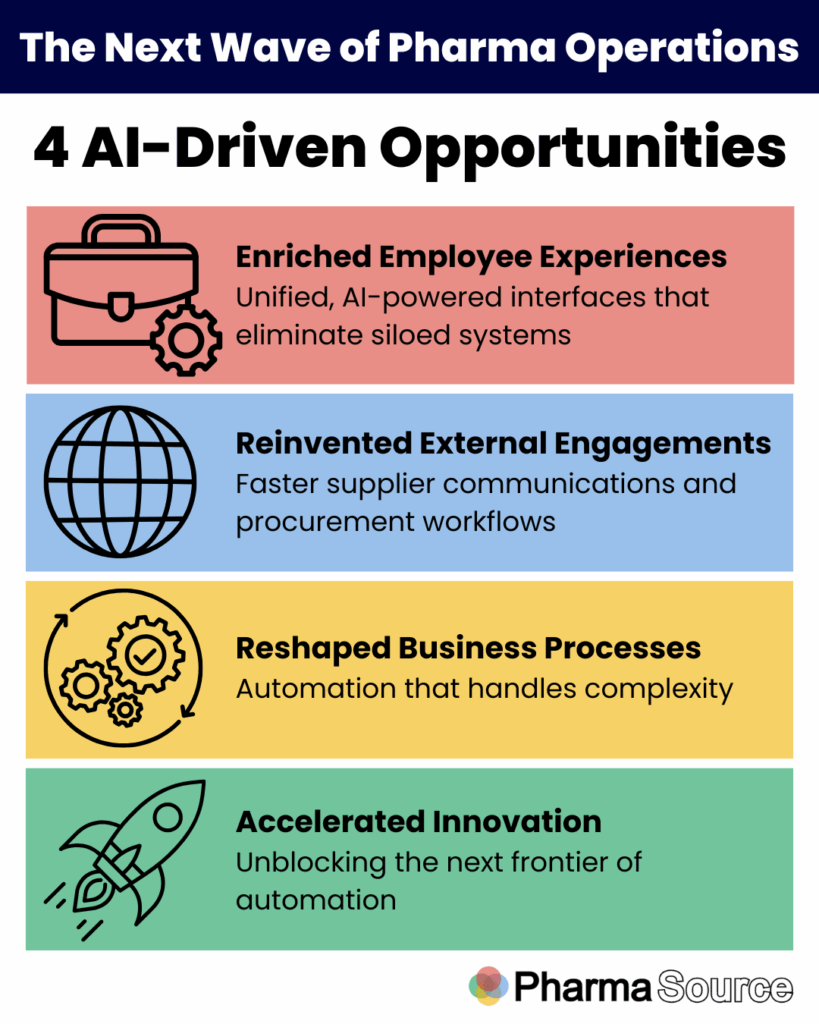
This evolution offers four key opportunities for pharmaceutical operations:
- Enriched employee experiences through unified, AI-powered interfaces that eliminate siloed systems
- Reinvented external engagements with faster supplier communications and procurement workflows
- Reshaped business processes that can handle complex scenarios previously requiring manual review (such as policy document verification)
- Accelerated innovation by unblocking scenarios that couldn’t be automated with deterministic workflows
AI Agents Already in Production
Microsoft Dynamics has deployed six first-party agents currently working in customer environments:
- Time logging agents that automatically track project time across multiple applications
- Expense agents that streamline financial workflows
- Approval agents that streamline approval workflows across departments
- Supplier communication agents that extract entities from emails and update procurement systems
- Scheduling operations agents for manufacturing optimization
- Accounting facilitation agents for financial processes
These agents operate through Model Context Protocol (MCP) servers that span the entire Dynamics ecosystem, including partner verticals like Cegeka’s pharmaceutical solutions. This architecture enables agents to access and reason across multiple applications, creating a unified intelligence layer.
Implementation Challenges in Regulated Environments
The presenters emphasized that successful AI implementation in regulated industries requires avoiding common pitfalls:
Misaligned use cases: Organizations must select scenarios where AI genuinely adds value rather than retrofitting AI into existing solutions. Microsoft advocates a “model-first” approach — understanding current AI model capabilities before designing solutions, rather than the traditional “code-first” approach.
Hybrid solutions required: Not every problem should be solved with generative AI. Traditional programming works better for certain tasks, and many real-world scenarios require combining both approaches. For example, a system might use traditional code for precise calculations, data validation, or deterministic workflows, while using generative AI for tasks like interpreting unstructured documents or summarizing communications.
Continuous quality monitoring: Unlike traditional software that produces identical results every time, AI agents generate different responses for similar situations. This requires ongoing monitoring to ensure outputs remain accurate and appropriate, rather than one-time testing during development.
Significant team resources required: Building production-ready AI agents is complex work that requires large, specialized teams. Microsoft’s agent development teams have 30-40 people each, not just a few developers. Companies should plan accordingly and not underestimate the expertise and effort needed.
Maintaining Compliance in an Agentic World
For pharmaceutical manufacturers, maintaining validated systems while adopting new technology is paramount. Cegeka addresses this by building compliance into the foundation rather than treating it as an add-on:
- Pre-configured, verified business process libraries covering over 600 industry-specific processes documented to sub-process level
- GAMP5-aligned implementation methodology ensuring validation deliverables meet regulatory standards
- Continuous compliance guarantees even as underlying systems are updated with new AI capabilities
- Industry-specialized teams recruited from pharma backgrounds who understand GXP requirements
This foundation allows pharmaceutical companies to adopt AI agents while maintaining their validated state — a requirement that has historically slowed technology adoption in life sciences.