As clinical development timelines compress and therapeutic complexity rises, pharmaceutical sponsors must secure manufacturing partnerships that adapt to uncertainty without draining budgets. How to structure CDMO contracts that deliver both flexibility and cost efficiency has become a strategic imperative and can determine whether programs advance or stall.
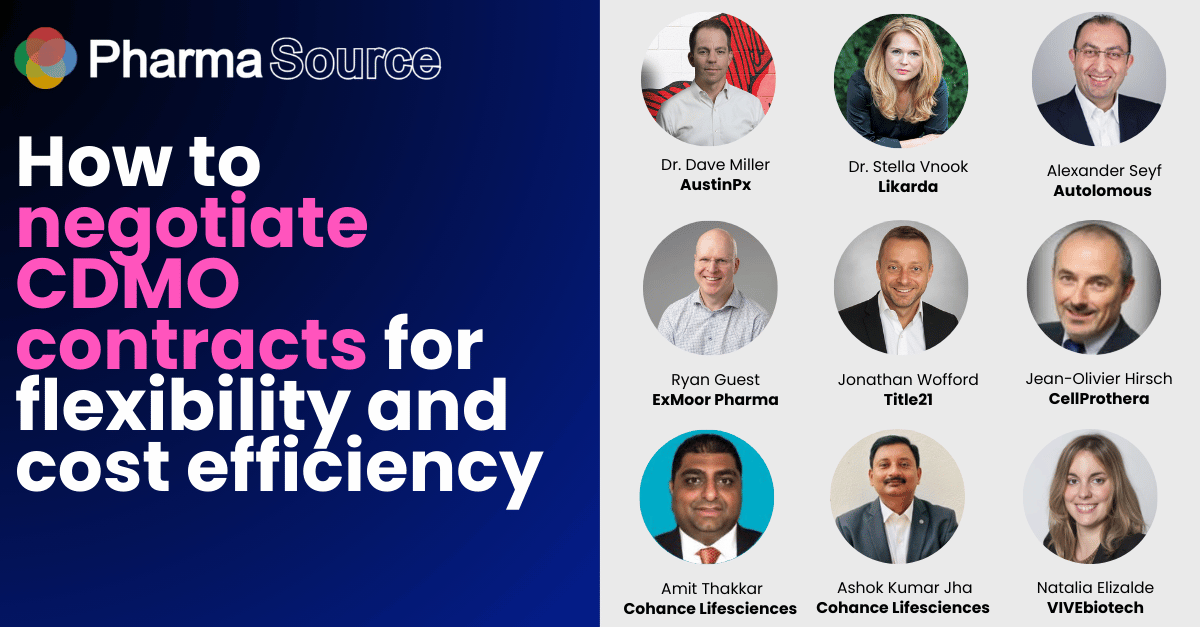
Nine industry leaders across the contract development and manufacturing landscape shared their insights on navigating this delicate balance. Their responses encourage a shift from rigid, transactional agreements toward dynamic partnerships built on transparency, modular design, and shared accountability.
Finding Your Position
The starting point for any negotiation is understanding where your program falls on the flexibility-cost continuum. Dave Miller, Chief Scientific Officer at AustinPx, explains, “On one end, you maximize flexibility, which usually involves full-time employee (FTE) contracts where the client more or less has their own lab at the CDMO. That said, this is also the most expensive option.”
At the opposite end, milestone-dependent contracts are more rigid but more cost-efficient. “The scope of work is spelled out in detail, which experiments are you running, how many, how much they’ll cost, and you’re bound by that plan,” Miller explains.
The optimal approach often blends elements of both. Amit Thakkar and Ashok Kumar Jha from Cohance Lifesciences Limited outline the two main frameworks. “A fee-for-service (FFS) approach is a fixed overall cost for the project, with the key deliverables being the manufacturing of the product. Full-Time Equivalent (FTE) models can be fixed or flexible.”
They note that flexible FTE models offer particular advantages: “This allows for the flexibility to spread out payments as well as allow for an increase or decrease in budget. The flexible FTE model also generally allows for termination of the project with only payment required for the work completed.”
Modular and Milestone-Based Strategies
Multiple experts advocate for breaking contracts into smaller, adjustable components. Ryan Guest, Senior CMC Translation Consultant at eXmoor Pharma, recommends structuring “contracts with modular work packages (e.g., process & analytical development, tech transfer, GMP manufacturing) that can be activated or paused based on clinical progress.”
This modular approach pairs naturally with milestone-based payments. Natalia Elizalde, Chief Business Development Officer at VIVEbiotech, emphasizes the importance of this strategy for early-stage programs. “One effective way for sponsors to achieve both flexibility and cost efficiency is to structure contracts around go/no-go milestones, particularly in the early stages where uncertainty is highest.”
Jean-Olivier Hirsch, COO at Cellprothera, takes this further by proposing tiered capacity models. “Instead of rigid commitments, sponsors should negotiate tiered capacity models, establishing a guaranteed baseline for the CDMO, while retaining scalable options that can be activated as programs progress.”
Digital Transparency
A recurring theme across responses is the transformative role of digital tools in enabling flexible, cost-efficient partnerships. Jonathan Wofford, Chief Commercial Officer at Title21, a software provider, argues that “digital visibility can help alleviate much of that tension” between cost, speed, and flexibility.
“Sponsors should look for contracts that include access to live production and quality data through digital dashboards,” Wofford advises. “This kind of transparency helps both sides act on the same information, avoid surprises, and adjust quickly if batch sizes or timelines change.”
Alexander Seyf, CEO and co-founder of Autolomous, a manufacturing software platform, emphasizes how technology fundamentally reshapes contract structure. “Software platforms enable a new model of partnership by providing real-time visibility into every aspect of the manufacturing process. This live data enables a more dynamic relationship, allowing capacity to be managed adaptively and costs to be directly tied to performance.”
This data-driven approach, Seyf notes, “allows for flexible terms and performance-based clauses in contracts, moving away from rigid agreements.”
Pricing Transparency and Cost Management
Beyond contract structure, leaders stress the importance of transparent pricing mechanisms. Dr. Stella Vnook, CEO of Likarda, challenges sponsors to look beyond simple price negotiations. “The real leverage comes from designing contracts around shared accountability and scalability.”
Hirsch from Cellprothera advocates for explicit cost protections: “Each material or product reference must be the subject of a clear positioning in terms of purchase, and the CDMO’s purchase prices may not be higher than the customer’s price, excluding logistics management and quality control costs.”
Guest from eXmoor Pharma recommends pursuing “open-book pricing to understand cost drivers (labor, materials, overhead)” and benchmarking “CDMO quotes against industry standards or use third-party consultants to validate pricing.”
Volume-based pricing also emerges as a key efficiency driver. Thakkar and Jha outline creative solutions. “Tiered pricing based on volumes, with binding forecasts, allows the CDMO to optimize the economies-of-scale made possible through the use of larger assets and operations planning.”
Risk-Sharing and Strategic Alignment
Several contributors highlight risk-sharing models as a path to mutual benefit. Guest notes that sponsors can “explore risk-sharing models where CDMOs invest in development in exchange for future commercial manufacturing rights or royalties.”
Vnook from Likarda emphasizes early collaboration: “At Likarda, we emphasize engaging CDMOs early in formulation and delivery discussions, so manufacturing processes reflect real-world constraints from day one. By embedding terms that reward adaptive capacity and risk-sharing, sponsors avoid the rigidity that often drives up cost downstream.”
Thakkar and Jha provide examples of incentive structures, including sharing “cost reduction benefits in raw and key starting materials achieved through long-term binding forecasts, supplier changes, and process improvement” and “incentivizing the CDMO to meet a shorter timeline or achieve higher yields.”
Governance: The Foundation of Partnership
Multiple leaders stress that contract terms alone cannot ensure success—robust governance structures are essential. Thakkar and Jha recommend establishing “a governance model, such as a Steering Committee, that addresses the complexity of the relationship, frequency of meetings, and escalation pathways for any issues.”
They outline a three-tier approach: operational teams managing day-to-day functions, managerial teams handling longer-term planning and escalation, and executive teams conducting annual strategic reviews.
“Establishing key performance indicators (KPIs) sets mutual expectations for the relationship at the Steering Committee level,” they note, with metrics including on-time delivery, deviations, technical capability, and cost competitiveness.
Building Strategic Partnerships
The overarching message from industry leaders is that the most successful CDMO relationships transcend traditional vendor-client dynamics. Thakkar and Jha articulate this, “An aligned understanding of each parties’ motivations will shape the relationship from transactional to strategic and mutually beneficial.”
This strategic mindset manifests in various ways, including joint problem-solving, shared facility investments, technology transfer flexibility, and continuous improvement cultures. As Vnook notes, “The most successful contracts focus not just on unit cost, but on speed-to-clinic, regulatory robustness, and contingency planning.”