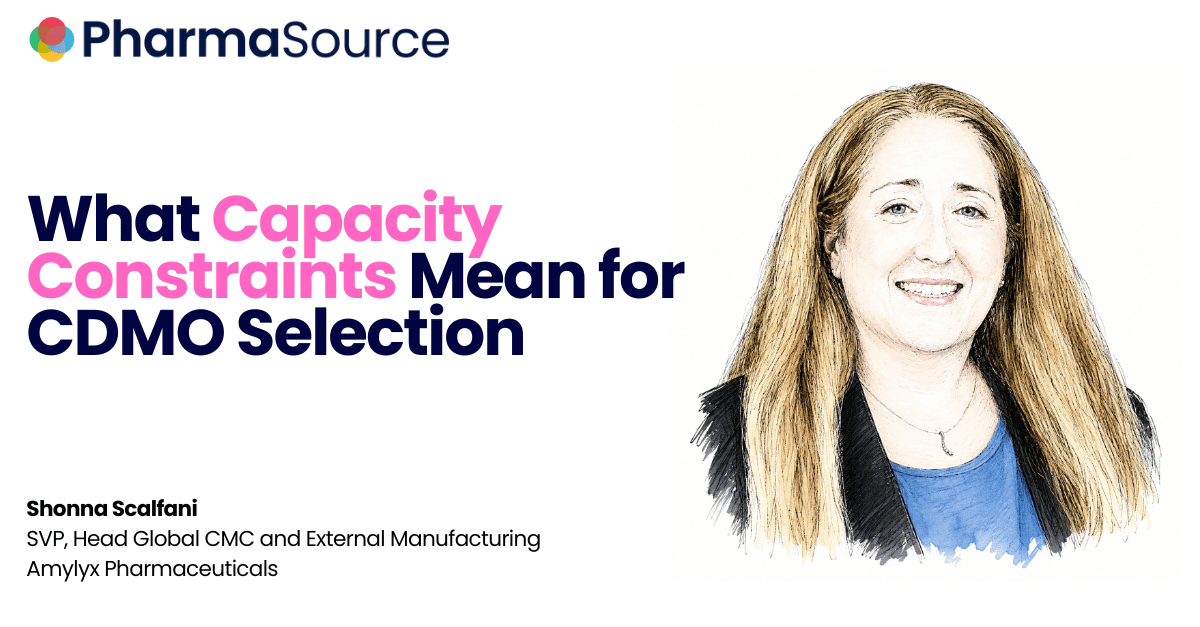
“The best CDMO on paper may not be the best partner for your organization,” says Shonna Scalfani.
Shonna Scalfani is SVP, Head of Global CMC and External Manufacturing at Amylyx Pharmaceuticals, where she has led supply strategy from the company’s early days through late-stage development and preparation for commercialization. Before Amylyx, she built her CMC and external manufacturing background at Shire, Biogen, and Takeda, including the global launch of Takhzyro.
Sterile, peptide, and oligo manufacturing all face capacity constraints right now, and CDMOs are responding in different ways — from vertical integration to new entrants to process innovation. Shonna explains what’s actually driving those shifts and what she looks for in a CDMO partner that a standard RFP won’t tell you.
A Sterile Capacity Shortage Is Reshaping the CDMO Map
“We are seeing a significant influx of new entrants responding to a clear shortage of high-volume, high-quality sterile manufacturing CDMOs, particularly in the United States,” Shonna says. Existing CDMOs are responding by expanding their own footprint: “Many CDMOs are pursuing greater vertical integration by adding sterile drug product capabilities to offer a more end-to-end solution. That model brings both advantages and tradeoffs.”
For a smaller biotech, the appeal is consolidation. “From a sponsor perspective, the ability to build a more strategic relationship across the supply chain is an attractive option, especially for a smaller biotech looking to gain influence and minimize operational complexity.” But she draws a different line for harder programs: “For more technically challenging or early-stage development programs, speed, flexibility, and deep technical expertise remain key drivers in CDMO selection. While the one-stop-shop model can be compelling, it is not universally the best fit.”
Peptide and Oligo Capacity Is Catching Up to Demand, Unevenly
“Anyone operating in the peptide space right now knows there is an overall mismatch of capacity driven by the rapid growth of GLP-1 demand,” Shonna says. Capital is moving, just not fast enough: “We are seeing tremendous capital investments globally to meet this need, but much of that capacity will take time to come online. The industry is also innovating to drive higher yields from existing infrastructure, but of course these new approaches have challenges.”
Oligonucleotides face a similar capacity gap without the same investment pull behind them. “We see a similar need for innovation in the oligo space but without the demand pressure driven by GLP-1s. I believe the oligo CDMOs are taking learnings from the traditional stepwise peptide synthesis processes and looking at how to enable oligo scale-up without a proportional capital investment and solvent use.”
What an RFP Can’t Tell You About a CDMO
Shonna’s evaluation criteria have shifted over the course of her career. “Earlier in my career, I evaluated CDMO partners primarily through objective criteria such as location, scale, cost, and regulatory history. Those factors remain important and still form the foundation of a rigorous selection process. What has changed over time is the weight I now place on the less tangible aspects of the relationship.”
“The best CDMO on paper may not be the best partner for your organization. In many respects, selecting a CDMO is a matchmaking exercise,” she says. At Amylyx, that match is measured against the company’s stated values: “Our core values — be audacious, be curious, be authentic, be engaged, and be accountable — shape how we operate and what we expect from our CDMO partners. We place a high value on CDMOs that share our sense of urgency in serving communities with significant unmet medical need. The strongest partners are those that see themselves not simply as service providers, but as true extensions of our organization, where our success is shared, and execution is approached with the same commitment and purpose.”
None of that is visible in a written proposal. “When evaluating a potential CDMO, I pay close attention to their company values and how the organization presents itself. CDMOs that seem aligned make the short list, but the real assessment happens on site.” Her questions once she’s there are specific: “Are they living their values? Do operations appear to be in a state of control? Are frontline teams empowered? Is the structure appropriately designed to support decision-making and execution? Are they creative, solutions-oriented thought partners? These factors, rarely evident through the RFP process alone, ultimately determine whether a CDMO can become a strong long-term partner.”
Designing Supply Chains for Single-Sourced, Development-Stage Assets
“When you build a supply chain for a development-stage asset, you must design for the realities of drug development,” Shonna says. “That starts with selecting suppliers who can support the base forecast while also offering capacity to support upside potential,” with agreements “structured with enough flexibility to manage downside scenarios.”
Without a second source to fall back on, inventory does the work redundancy would normally do. “Ahead of launch, most assets will be single-sourced and need to use inventory, both work-in-process and finished goods, as a critical lever for preserving flexibility and supporting readiness. Early CMC work to support extended shelf life, where possible, can further strengthen the supply model.” Taken together, she says, those choices create “a supply model that is resilient, scalable, and able to support the realities of development-stage programs.”
What Should Sponsors Ask Before Choosing a CDMO?
- A vertically integrated, one-stop-shop CDMO isn’t automatically the better choice. It can suit a smaller biotech that wants fewer relationships to manage, but for technically demanding or early-stage programs, specialist speed and depth often matter more than consolidation.
- Peptide and oligo manufacturing capacity will stay tight for a while. New capital investment is flowing into the space, but most of it will take time to come online, so sourcing timelines should account for that lag rather than assume near-term relief.
- An RFP alone can’t tell you whether a CDMO is a strong partner. It screens for objective criteria like cost, location, and regulatory history, but values, operational discipline, and team dynamics only become clear on a site visit.
- A CDMO site visit should answer specific questions: Are they living their stated values? Is the operation in a state of control? Are frontline teams empowered to make decisions?
- Supply agreements for single-sourced, pre-commercial assets should be built for flexibility in both directions, with enough capacity to support upside potential and enough contractual flexibility to manage downside scenarios.
- Inventory is a deliberate flexibility tool, not a fallback. When dual sourcing isn’t yet possible, work-in-process and finished goods inventory, plus early shelf-life extension work, are the levers that preserve readiness ahead of launch.