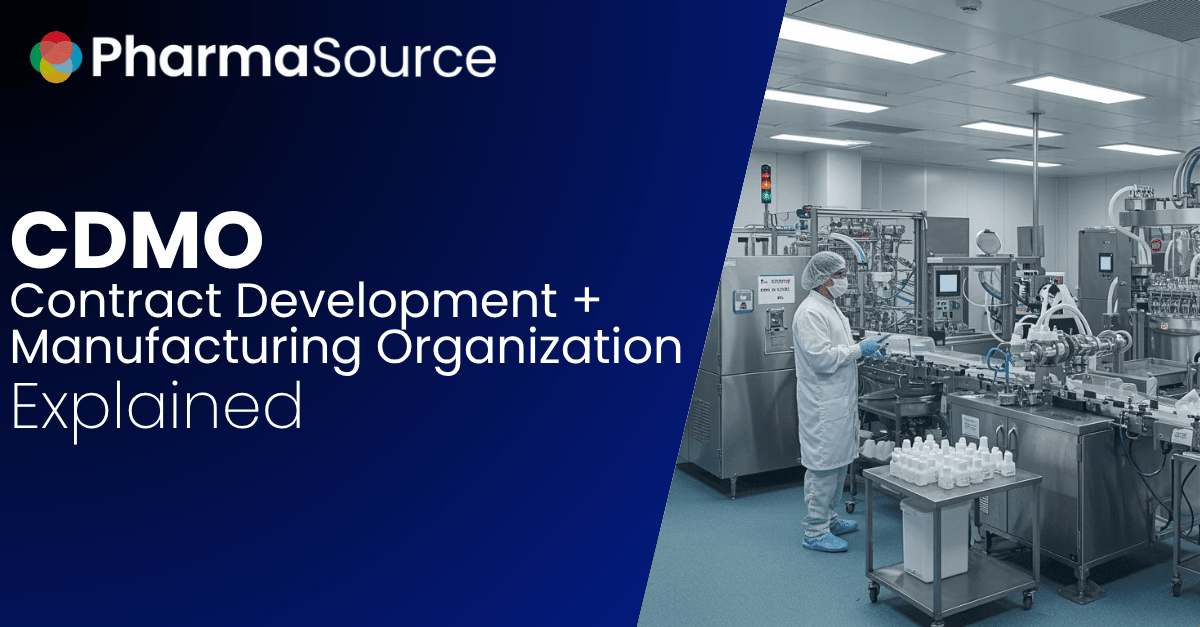
Drug development no longer ends in the laboratory. Increasingly, the path from promising molecule to commercial medicine runs through a Contract Development and Manufacturing Organization (CDMO). As pharmaceutical and biotech companies outsource more of their development and manufacturing activities, CDMOs have become a critical part of the global pharma supply chain.
From early stage drug development and formulation to clinical manufacturing, commercial production, and technology transfer, CDMOs support companies across almost every stage of the product lifecycle. But the market is becoming increasingly complex. Rising demand for manufacturing capacity, the growth of biologics, cell and gene therapies, and other complex modalities, combined with supply chain pressures and changing regulations, are reshaping how pharma companies evaluate and select their outsourcing partners.What Is a CDMO?
A Contract Development and Manufacturing Organization (CDMO) is a service provider in the pharmaceutical industry that offers comprehensive services spanning drug development through manufacturing. In essence, a CDMO is a one-stop shop for pharmaceutical and biotech companies, allowing them to outsource a significant portion of their operations rather than build costly in-house infrastructure.
The term breaks down simply: “Contract” refers to the contractual agreement between the pharma company (the sponsor) and the service provider. “Development and Manufacturing” refers to the wide range of services CDMOs provide, everything from pre-formulation, formulation development, and stability studies, to method development, pre-clinical and Phase I clinical trial materials, late-stage clinical trial materials, formal stability testing, scale-up, registration batches, and full commercial production.
The Global CDMO Market in 2026
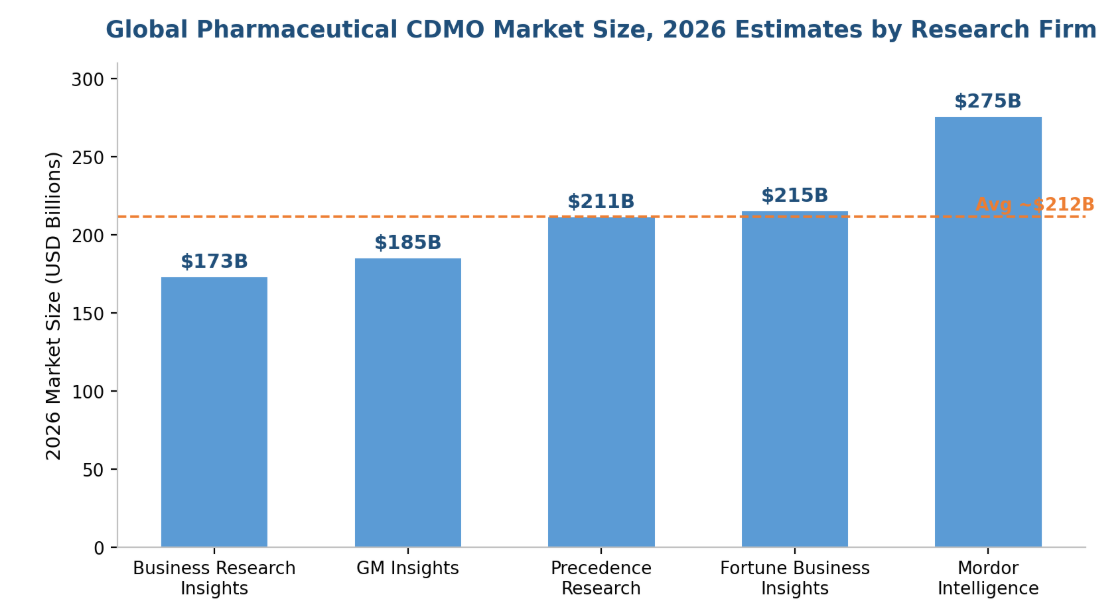
The global pharmaceutical CDMO market size is valued at USD 197.40 billion in 2025 and is predicted to increase from USD 211 billion in 2026 to approximately USD 392.67 billion by 2035, expanding at a CAGR of 7.12% from 2026 to 2035. (Source: Precedence Research)
Estimates vary by research firm and market definition. The chart below shows how five major analyst firms currently size the 2026 global CDMO market, ranging from roughly $173 billion to $275 billion, with a rough consensus around $210–215 billion.
This growth trajectory reflects a fundamental transformation in pharmaceutical manufacturing, where outsourcing has evolved from a cost-optimization strategy into a strategic imperative for accessing specialized expertise, cutting-edge technologies, and flexible production capacity.
The Five Dimensions of a Modern CDMO
The CDMO of today looks very different from the “factory for hire” model of the 1990s and early 2000s. According to Contract Pharma’s analysis of the modern CDMO, today’s leading organizations distinguish themselves across five dimensions:
- Integrated development and manufacturing: Sponsors can pursue early development, tech transfer, scale-up, validation, and clinical and commercial production under a single coherent umbrella, reducing handoffs and preserving institutional knowledge between stages.
- Digital maturity: Electronic batch records, real-time analytics, and cloud-based visibility have shifted from optional enhancements to baseline sponsor expectations (see PharmaSource’s own survey data below).
- Platform capability: Modality-agnostic platforms, reusable mRNA templates, viral-vector production lines, and continuous-manufacturing systems let CDMOs pivot across dosage forms rather than acting as single-purpose factories.
- Regulatory depth: CMC documentation, submissions, and global registrations have become a central part of the CDMO service portfolio rather than a sponsor-only function.
- Supply-chain stewardship: Mature CDMOs qualify raw-material suppliers, manage procurement, and coordinate global logistics, acting as an operational shock absorber for sponsors.
What Does a CDMO Do? The Drug Development Lifecycle
A CDMO sits at the intersection of pharmaceutical science, engineering, regulatory expertise, and commercial manufacturing. Its core function is to accelerate a drug sponsor’s path from molecule to market by providing the development and production capabilities that most companies — particularly small and mid-sized biotechs — cannot economically build and sustain in-house.
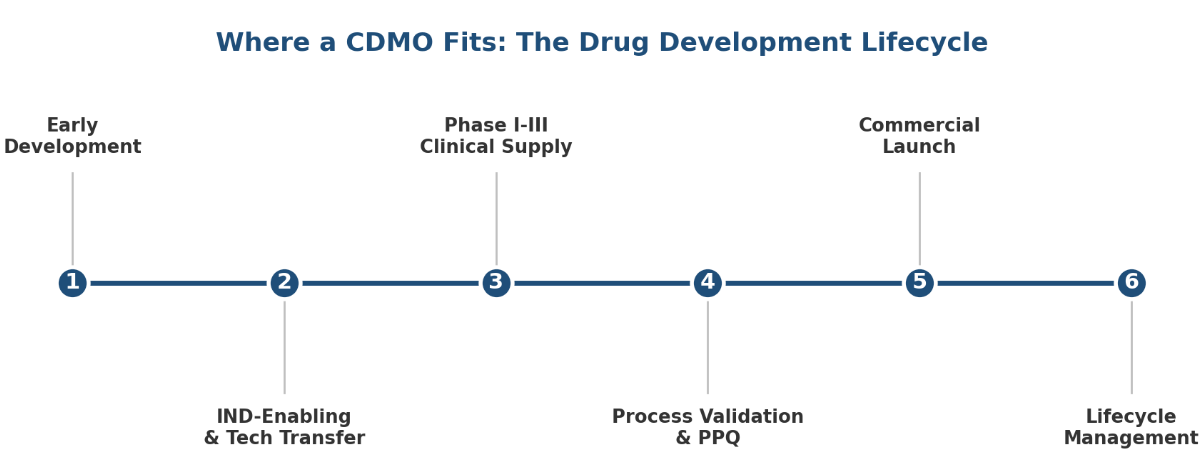
- Early development: Feasibility batches, formulation refinement, and establishment of analytical methods.
- IND-enabling and tech transfer: Scalable process development and transfer of methods into GMP environments ahead of an IND filing.
- Phase I-III clinical supply: GMP production of clinical trial materials, including packaging, labeling, and global distribution support.
- Process validation and PPQ: Locking in process validation and overseeing process performance qualification (PPQ) ahead of commercial launch.
- Commercial launch: Delivery of validated supply at commercial scale, with packaging, serialization, and global distribution.
- Lifecycle management: Ongoing support for line extensions, bridging batches, reformulations, and post-approval changes.
CDMOs offer services across this lifecycle including API development and synthesis, drug product formulation development, analytical development and validation, process scale-up, clinical supply manufacturing, sterile fill-finish, secondary packaging and serialization, and regulatory affairs and CMC support for IND, NDA, and BLA filings.
The CDMO sector continues to grow and diversify, with an ever-increasing range of companies to choose from:
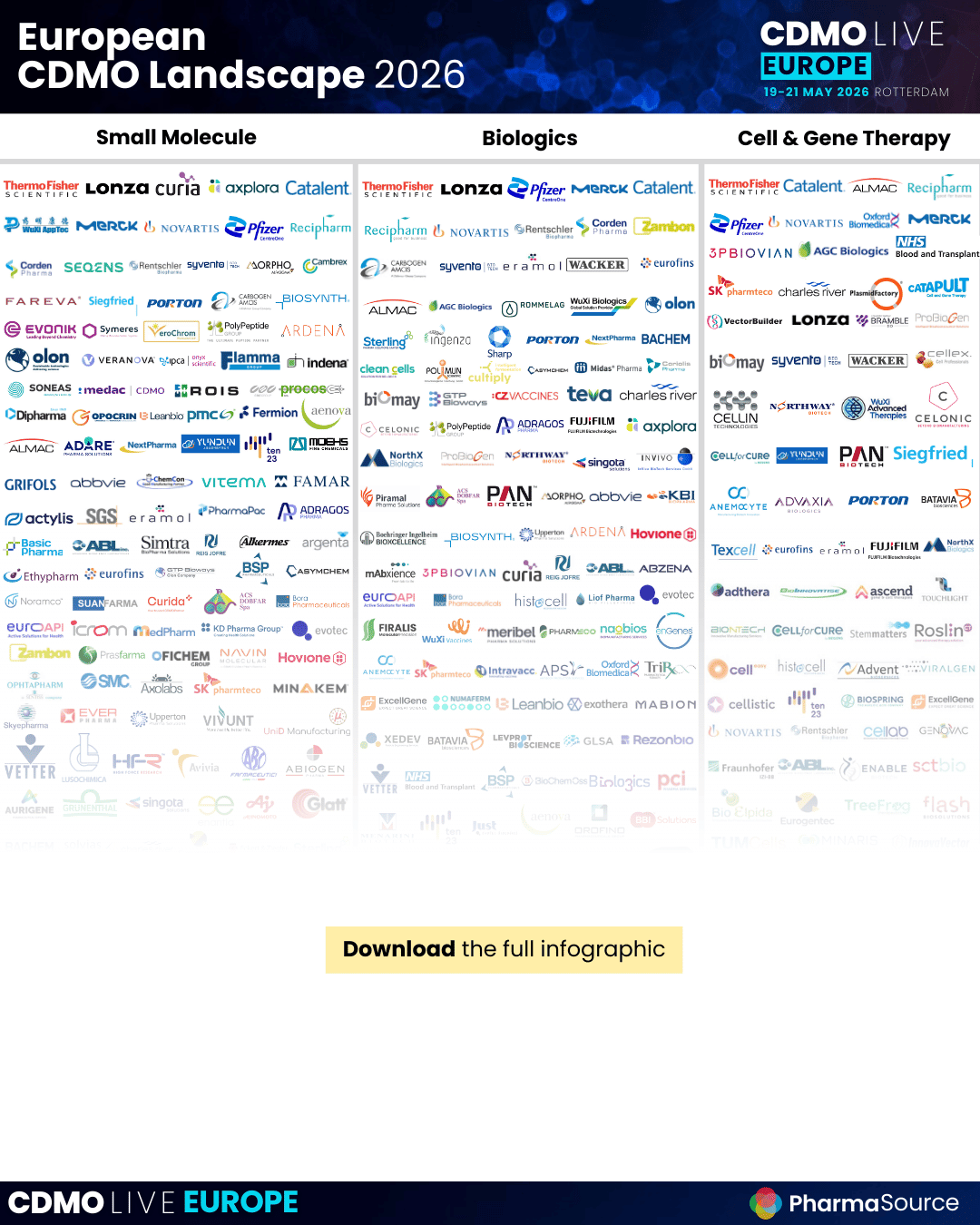
Download the full infographic here.
CDMO vs. CMO vs. CRO: What’s the Difference?
|
Organization |
Core Focus |
Typical Scope |
|---|---|---|
|
CRO (Contract Research Organization) |
Research services |
Early-stage R&D, pre-clinical studies, clinical trial management, regulatory affairs |
|
CMO (Contract Manufacturing Organization) |
Manufacturing only |
Large-scale production using the sponsor’s existing formulation and process |
|
CDMO (Contract Development and Manufacturing Organization) |
Development + manufacturing |
End-to-end support from early formulation through commercial-scale production and packaging |
In short: a CRO helps you prove a drug works; a CMO helps you make it at scale once the process is fixed; a CDMO does both — developing the formulation and process, then scaling it into commercial manufacturing under one roof.

Read CDMOs vs CROs vs CMOs: Understanding Key Services at Each Stage of Drug Development
Why Pharma Companies Use CDMOs
Developing a new drug is complex, time-consuming, and expensive. Here are the key reasons pharma and biotech companies choose to partner with CDMOs:
- Speed to market: CDMOs have the expertise and ready infrastructure to expedite development, helping sponsors reach patients faster.
- Cost savings: Outsourcing avoids the high capital expenditure of building dedicated manufacturing facilities.
- Scalability: CDMOs offer flexible capacity, letting sponsors scale production up or down based on demand.
- Focus on core competencies: Outsourcing complex development and manufacturing frees internal teams to focus on discovery and commercialization.
- Regulatory compliance: Experienced CDMOs navigate FDA, EMA, PMDA, and other global regulatory frameworks daily.
- Access to advanced technologies: Many CDMOs offer specialized equipment and platforms that would be uneconomical to build in-house.
The BIOSECURE Act and CDMO Reshoring in 2026
This is the single biggest structural shift in the CDMO landscape heading into the second half of 2026, and any sponsor evaluating outsourcing partners needs to understand it.
The BIOSECURE Act became US law on December 18, 2025, as part of the FY2026 National Defense Authorization Act (NDAA). It prohibits US federal agencies from contracting with companies that use biotechnology equipment or services from designated “biotechnology companies of concern” — a category expected to include several major China-based CDMOs and genomics firms.
Why it matters beyond federal contracts: with 79% of biopharma companies relying on at least one Chinese CDMO relationship, and an estimated $10–20 billion in annual contracts potentially in play, the ripple effects extend well past companies with direct federal funding. Commercial partners are already re-evaluating supply chains pre-emptively.
- Timeline: The official OMB “companies of concern” designation list is expected around late 2026; federal enforcement is not anticipated before late 2028.
- Commercial impact today: CDMO rates are expected to rise 5–10% annually as sponsors pre-emptively re-source capacity ahead of the designation list.
- Who benefits: US, EU, and Indian CDMOs all stand to gain share, provided they have qualified, near-term capacity.
The practical takeaway for sponsors: switching CDMOs is not instant. It typically requires facility and process requalification and regulatory filings, which can take 12–24 months. Companies with China-linked CDMO relationships are advised to begin dual-sourcing now rather than waiting for the formal designation list.
Regulatory & Policy Headwinds Reshaping US CDMOs in 2026
Beyond the BIOSECURE Act, several other 2026 policy developments are directly affecting how sponsors and CDMOs plan capacity and contracts.
FDA Staffing Cuts and Review Timelines
FDA staff reductions through 2025, driven by Department of Government Efficiency (DOGE) initiatives and early retirements, removed institutional knowledge from the review process, according to Gil Roth, President of the Pharma and Biopharma Outsourcing Association (PBOA), speaking on PharmaSource’s podcast. “A lot of people were fired. The commissioner keeps talking about hiring 450 people, but a lot of people who left had institutional knowledge,” Roth said. Drug reviews have held up so far in 2026, but FDA has extended some review timelines by roughly three months beyond standard PDUFA goal dates, and complete response letters have become more frequent for issues that could previously have been resolved through reviewer discussions.
Tariffs and Most Favored Nation Pricing
US tariff policy on manufacturing equipment has created cost increases of up to 50% for some CDMOs, per PBOA commentary on PharmaSource’s podcast, while Most Favored Nation (MFN) drug pricing deals are simultaneously compressing sponsor margins, creating a genuine squeeze between rising input costs and pricing pressure.
AI and Digital Maturity in CDMOs: What the Data Shows
Digital maturity has become one of the clearest differentiators between CDMOs. PharmaSource’s own survey of 50+ global CDMOs, conducted in partnership with MasterControl, found that 60% of CDMOs operate at preliminary digital maturity levels even as 92% report that sponsors are now raising digital requirements during contract negotiations.
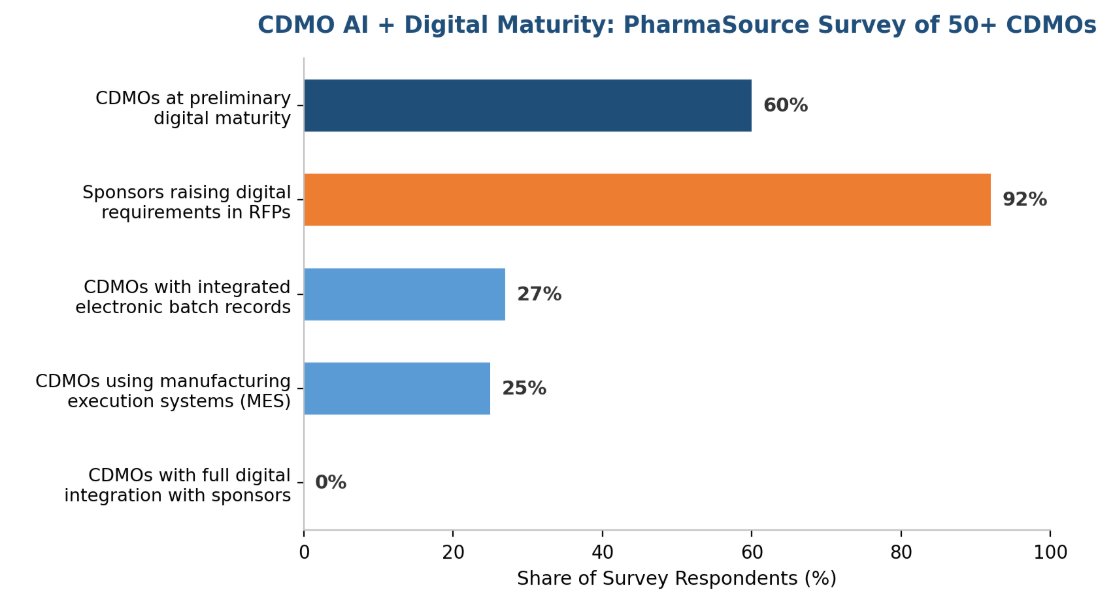
The gap is structural, not just cultural: only 27% of CDMOs surveyed have integrated electronic batch records, and just 25% use manufacturing execution systems. Notably, zero CDMOs reported full digital integration with sponsor systems, even though the large majority of sponsors now expect it. PharmaSource’s report frames the practical guidance simply: build the digital foundation before pursuing AI, fix processes before digitizing them, and deploy resources with focused pilots rather than broad, diffuse investments.
This finding is corroborated by external research: Deloitte’s Life Sciences Manufacturing Index found that digitally mature CDMOs experience significantly fewer documentation-related deviations and faster batch-release cycles.
Regulatory and Pharmacovigilance Outsourcing Trends
It isn’t just manufacturing that sponsors are outsourcing. According to IQVIA research on regulatory outsourcing, 54% of biotech and pharma companies now outsource regulatory activities, rising to 62% among emerging biopharma firms, and 67% outsource pharmacovigilance altogether. For CDMOs with mature regulatory infrastructure, CMC documentation and global registration support have become a central, differentiating part of the service portfolio rather than an optional add-on.
Supply-chain resilience remains a work in progress across the sector: an Accenture analysis of supply-chain performance in life sciences found that supply-chain maturity averages just 34% across the industry, though companies investing in digitally enabled, integrated supply chains see materially shorter lead times and improved resilience.
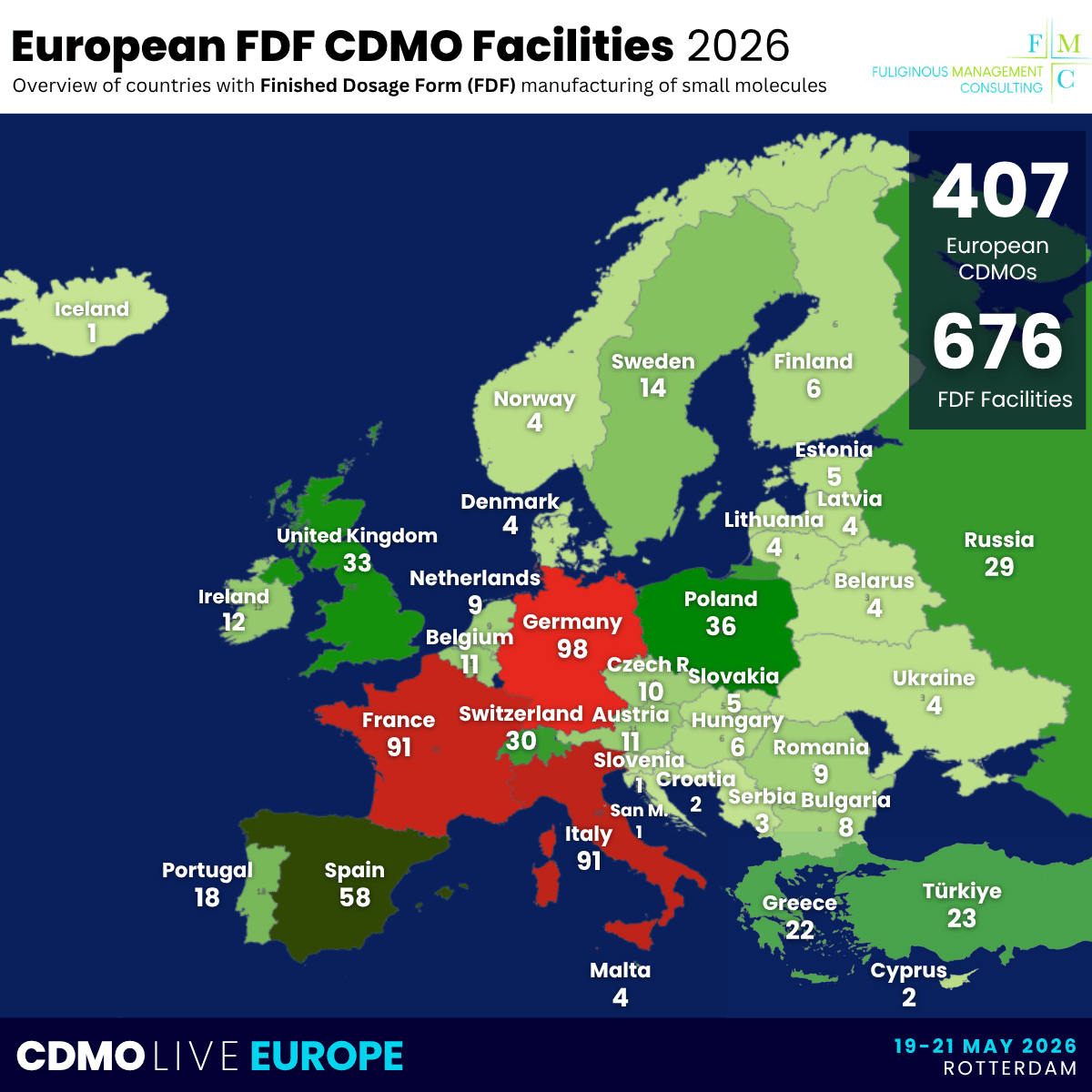
- Read our ranking of 675 FDF CDMO manufacturing sites across Europe, which reveals the countries with the most facilities in operation.
How to choose the right CDMO for your business
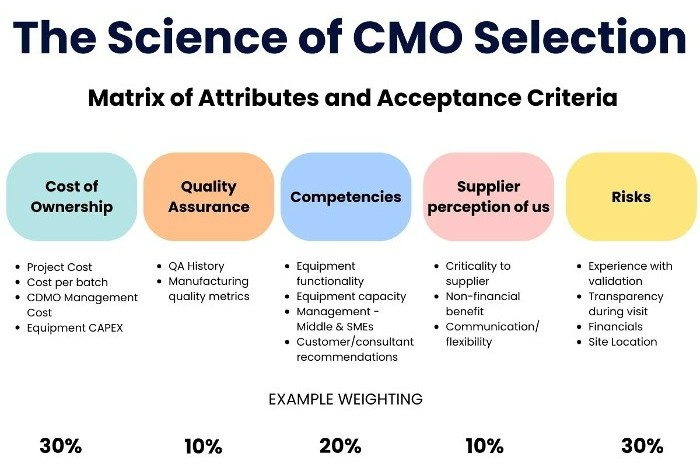
Selecting the right CDMO is a critical decision that can significantly impact the success of a company’s drug development and manufacturing process. A CDMO partnership is typically a long-term strategic relationship, so fit — in size, culture, and specialization — matters as much as price.
- Industry credibility: Look for a strong track record, client references, and relevant regulatory inspection history.
- End-to-end support: Confirm the CDMO covers every stage you need, from pre-formulation through commercial production.
- Proactive risk mitigation: Robust risk-management strategies to anticipate and mitigate potential challenges.
- Project management: A proven record of delivering projects on time and within budget.
- Scalability: Ability to scale production quickly and efficiently as demand grows.
- Trustworthiness and transparency: Open communication and a demonstrated commitment to client needs.
- Geopolitical resilience: Given BIOSECURE Act dynamics, assess whether the CDMO’s supply chain and ownership structure could expose your program to future compliance risk.
- Digital maturity: AI-enabled process development and digital twin capabilities are increasingly a marker of a forward-looking partner.
In this video, David Caron SVP CMC at Ayala Pharmaceuticals explained his framework for selecting a Contract Manufacturing partner:
What Does It Cost to Work with a CDMO?
CDMO pricing varies enormously by modality, scale, and service scope, so there’s no single industry-standard rate card — but a few factors consistently drive cost:
- Modality complexity: Biologics, ADCs, and cell & gene therapies cost substantially more to develop and manufacture than small-molecule oral solid doses.
- Capacity scarcity: Constrained segments — GLP-1 peptides, sterile fill-finish, viral vectors — command premium pricing due to limited qualified capacity.
- Batch scale and campaign length: Clinical-scale batches typically carry higher per-unit costs than commercial-scale runs.
Market-wide pricing pressure: CDMO rates are projected to rise 5–10% annually through 2026–2028 as BIOSECURE-driven re-sourcing tightens available capacity, and tariff-driven equipment cost increases are adding further pressure (see Regulatory & Policy Headwinds above).
Sponsors should request detailed, phase-specific quotes early and build in contingency for rate increases on multi-year commercial agreements, particularly in capacity-constrained modalities.
The Future of CDMOs in the Pharma Industry
Several trends will continue to shape the CDMO sector through the rest of this decade:
- Technological capability as a differentiator: Sponsor-integrated digital systems and AI-enabled process development are becoming key selection criteria.
- Specialization over generalization: Specialized CDMOs offering deep expertise in specific modalities, including peptides, ADCs, and cell and gene therapy, are gaining share over generalists.
- Geopolitical realignment: The BIOSECURE Act, tariffs, and reshoring incentives are accelerating a structural shift of manufacturing capacity toward the US, EU, and India.
- Policy volatility as a planning constraint: FDA staffing, tariff policy, and drug-pricing reform mean sponsors and CDMOs alike are prioritizing contract and capital-planning flexibility over rigid long-term forecasting.