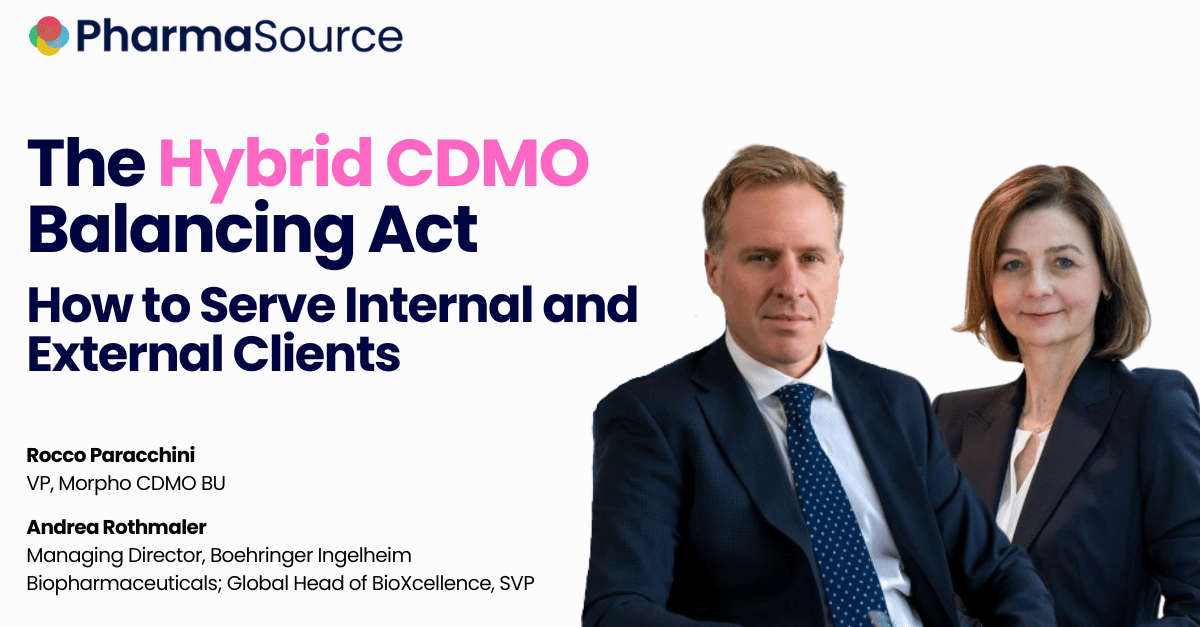
A growing number of pharmaceutical manufacturers are operating a dual mandate: running contract development and manufacturing services for external clients while simultaneously supplying their own commercial and pipeline products. For these hybrid CDMOs, every decision—from capacity allocation and pricing to IP protection and investment—must serve two sets of masters at once.
PharmaSource asked leaders from two organizations operating this model to share how they navigate the structural, operational, and strategic polarities it creates. The perspectives of Rocco Paracchini, representing Morpho—the CDMO arm of Italian pharmaceutical company Alfasigma, integrating solid oral, sterile, and API manufacturing capabilities across five European and U.S. sites—and Andrea Rothmaler, Managing Director of Boehringer Ingelheim Biopharmaceuticals and Global Head of BioXcellence, a leading global biopharmaceutical contract manufacturer specializing in mammalian cell culture and microbial fermentation, reveal both the promise and the challenges of this model.
Capacity Allocation Is a Dynamic Task
One of the most common questions put to hybrid CDMOs is: how much capacity do you reserve for internal versus external work? Both organizations reject the premise that a fixed percentage is the right answer.
Morpho takes a data-driven planning approach, integrating all forecasted volumes—captive and third-party—into a Rough-Cut Capacity Planning (RCCP) model. As Rocco explains, the answer lies in actively managing the variables that define capacity itself:
“We do not pre-allocate a fixed percentage of capacity to internal versus external needs. Instead, we integrate all forecasted volumes—captive and CDMO—into our RCCP model. RCCP allows us to simulate different production scenarios, identify bottlenecks, and adjust levers such as campaign length, shift patterns, or equipment loading.”
Rocco Paracchini, VP, Morpho CDMO BU
BioXcellence takes a similarly governance-driven approach. Andrea notes that the foundation is structural clarity rather than fixed quotas, not even naming products, but conducting this exercise in an anonymized way:
“Operating a complementary business model requires careful balancing of internal programs and external client commitments. We rely on clear, established governance structures and decision-making procedures to ensure the timely and balanced allocation of capacity. Forecasting mechanisms embedded in our supply agreements provide our partners with a high degree of planning reliability.”
Andrea Rothmaler, Managing Director, Boehringer Ingelheim Biopharmaceuticals; Global Head of BioXcellence, SVP
A diversified customer and project portfolio is a deliberate hedge, allowing short- to mid-term adjustments when internal pipeline priorities shift, or when a major external program accelerates.
Production Mix as a Stabilizer
Both leaders acknowledge that polarities exist in the hybrid model, but both also argue that the model’s structure can reduce, not increase, scheduling conflict.
Morpho draws a distinction between Make-to-Stock (MTS) logic, which governs captive products with stable, long-range demand patterns, and the Make-to-Order (MTO) or Make-to-Forecast (MTF) models that external clients typically follow. Rocco argues this coexistence creates a natural buffer:
“The coexistence of MTS and MTO actually creates buffering and smoothing effects in the production schedule. Internal volumes provide a stable baseline load, while external volumes can be flexibly slotted into available windows.”
Rocco Paracchini, VP, Morpho CDMO BU
BioXcellence is candid that the complementary model comes along with topics and risks to be carefully considered. Andrea’s team identifies four primary friction points, and has demonstrated managing them, drawing mitigation solutions based on experience successfully operating this model:
- Increasing dynamic around capacity allocation and rising demand for operational flexibility
- Strict requirements to protect confidential information in both directions
- Potential strategic conflicts between internal pipeline priorities and external client portfolios
- Technology strategy and investment decisions that must serve both agendas
Mastering these points requires structured Sales and Operations Planning (S&OP) processes, transparent governance, and scenario-based planning—elements both organizations cite as non-negotiable infrastructure.
Pricing and Profitability
When the same facility, staff, and equipment serve both a parent company’s products and paying external clients, transfer pricing and cost allocation become critical. Both organizations maintain a clear separation between the economics of captive production and external contract work.
Morpho operates as a distinct legal and financial entity within Alfasigma—with its own P&L, cost structure, and pricing methodology. Rocco is explicit that the two sides of the business must not cross-subsidize each other:
“We do not perform a direct comparison between captive profitability and third-party manufacturing, because the two operate under fundamentally different economic logics. Morpho’s costing model uses a differentiated fixed-cost allocation mechanism.”
Rocco Paracchini, VP, Morpho CDMO BU
BioXcellence operates as an autonomous organization within Boehringer Ingelheim with separate leadership representation and its own legal entity, the Boehringer Ingelheim Biopharmaceuticals GmbH. It frames the contract manufacturing business as an independent revenue stream with strategic financial weight. Andrea points to industry-wide cost pressure and patient’s access to medicines as a driver of internal discipline:
“Cost sensitivity is a clear trend in the industry, and we apply the same rigor internally to ensure sustainable and competitive operations—for example, through active management of manufacturing costs (COGS). We apply the same stringent quality system and operational excellence standards for both internal and external programs, and those two allow us to carefully manage COGs”
Andrea Rothmaler, Managing Director, Boehringer Ingelheim Biopharmaceuticals; Global Head of BioXcellence, SVP
IP Protection
When a CDMO operates inside a pharmaceutical company, intellectual property protection takes on a different dimension than in a standalone CDMO. External clients may operate in the same therapeutic areas as the parent company’s own pipeline—making robust information firewalls essential.
Both organizations have built layered protection frameworks. Morpho’s approach combines procedural, technical, and structural controls:
- Dedicated CDMO teams with segregated reporting lines
- Firewalled digital environments and systems
- SOP-driven information-handling protocols specifying what can be shared, with whom, and under what conditions
- Physical segregation where appropriate
- Contractual safeguards, including NDAs and confidentiality clauses tailored to the hybrid model
BioXcellence adds a formal governance layer through its active Corporate IP Protection (cIPP) Council, supported by Legal with cross-functional representation. Its framework also includes formal IPP checks beginning at the acquisition phase—before a new client relationship is even established—to identify and escalate potential IP or strategic conflicts to executive decision bodies when necessary.
Andrea emphasizes that technical controls are only as effective as the training and monitoring that surrounds them. Mandatory, role-specific cIPP training with regular refreshers and routine audits keeps compliance current rather than theoretical.
“Maintaining trust and compliance is non-negotiable, and our governance model is designed to uphold that standard.”
Rocco Paracchini, VP, Morpho CDMO BU
Lessons from the Field: What Makes the Model Work
Both organizations are candid that the hybrid model is not a default outcome of being a pharma company with spare capacity—it requires deliberate design and continuous management. The lessons they have drawn are consistent across several dimensions.
Rocco identifies three operational principles for Morpho:
- Campaign optimization and changeover minimization: the more harmonized the operational backbone, the easier it is to switch between internal and external products without losing efficiency
- Strategic alignment: CDMO activities must complement, not compete with, the parent company’s core portfolio, which means selecting external projects that match existing technological capabilities and equipment platforms
- Governance and planning discipline: a structured S&OP process and scenario-based planning are the connective tissue that holds both sides of the business together
BioXcellence adds several dimensions that speak to organizational culture and stakeholder management. Andrea’s list of critical success factors includes:
- Early transparency and a strong understanding of the needs and expectations of both internal and external stakeholders
- A collaborative and solution-oriented mindset that recognizes mutual value in combining internal manufacturing with CDMO activities
- Clear alignment, structured procedures, and consistent decision-making
- A diversified CDMO customer and product portfolio, and a global network of interchangeable capacities to buffer market fluctuations and geopolitical uncertainty
- Continuous investment in internal capabilities and capacity to maintain operational excellence