The United States has spent eighteen months trying to bring pharmaceutical manufacturing home through tariffs, pricing agreements, and investment incentives. Billions have been announced, cranes are rising across the country, and yet the industry’s dependence on overseas supply remains remarkably intact.
Since early 2025, tariffs have been announced, delayed, reintroduced and redesigned. But the measures extend well beyond tariffs. They include faster FDA engagement for domestic manufacturing, incentives for companies investing in US capacity, Most Favored Nation (MFN) pricing agreements, strategic API stockpiling and new congressional proposals examining foreign ownership of pharmaceutical assets.
“There are a lot of valid concerns, but also a lot of noise and clutter. Administrations come and go. In pharma we need a much longer view — building resilience that will stand the test of time.” – Pharma Excecutive at the Boston ExM Think Tank, hosted by PharmaSource.
The reshoring agenda now combines four separate policy levers.
Trade policy uses Section 232 tariffs to encourage domestic manufacturing.
Industrial policy supports investment through Executive Order 14293 and associated manufacturing initiatives.
Regulatory policy seeks to reduce development timelines through FDA’s PreCheck program.
Supply-chain resilience has become a policy objective through measures such as the Strategic Active Pharmaceutical Ingredients Reserve.
But the policy levers do not necessarily all pull in the same direction.
Speaking to PharmaSource, Marta E. Wosińska, Senior Fellow at the Brookings Institution’s Center on Health Policy, explains that reshoring is only one of several objectives being pursued simultaneously. Drug pricing, tariff negotiations and domestic manufacturing incentives have become intertwined, creating routes for companies to reduce their tariff exposure without necessarily moving production to the United States.
“If you’re already in Ireland, and then you strike a deal, then you’re fine,” Marta said, discussing the interaction between MFN agreements and tariffs. “So I think in certain pockets, you might have an incentive.”
Her broader point is that some reshoring is happening, but headline policy may not actually translate into an incentive to relocate manufacturing.
Gil Roth, President of the Pharma and Biopharma Outsourcing Association (PBOA), told CDMO Live Europe 2026 that his members had argued for regulatory, financial and tax incentives instead:
“We are not for tariffs. We are against tariffs from a CDMO perspective. We gave a number of regulatory, financial, tax code ideas to the Department of Commerce… Another spoiler: they didn’t listen.”
Gil Roth, President, Pharma & Biopharma Outsourcing Association (PBOA)
Both Marta E. Wosińska and Gil Roth will be providing a full update the impact of reshoring at CDMO Live Americas, 20-21 October in Boston.
The Policy Timeline
What does the manufacturing base look like today?
The onshoring push predates the latest tariff announcements. Rosemary Coates, Founder and Executive Director of the Reshoring Institute, says the organization has tracked “slow but steady growth” in US manufacturing since it was established in 2014, with the pandemic pushing supply-chain dependence much higher up the corporate agenda.
“The COVID-19 pandemic kicked reshoring discussions into high gear, and many companies took steps to consider manufacturing here,” she said. But that initial momentum did not translate into an immediate factory-building boom. “Over the past two years, companies became very reluctant to invest in new factories and capabilities because of the unstable economic environment.”
FDA data shows why reshoring remains a long-term challenge.
According to FDA:
- More than half of pharmaceuticals distributed in the United States are manufactured outside the country.
- Around 53% of branded medicines are manufactured overseas.
- Around 69% of generic medicines are manufactured overseas.
- Only 11% of API manufacturers supplying FDA-approved products are located in the United States, compared with 44% in India and 22% in China.
The challenge is particularly acute for generic medicines, where reshoring has to compete against established overseas supply chains in a market built around thin margins.
Charlie Lyon, Vice President of Manufacturing, Procurement & Logistics at the API Innovation Center (APIIC), argues that building domestic capacity or providing one-time incentives alone will not make US generic manufacturing commercially sustainable.
“While reshoring continues to gain attention and momentum, progress is slow, especially regarding generics,” Charlie tells PharmaSource. “US manufacturers must compete with established, lower-cost foreign supply chains, often in markets where margins are already extremely thin.”
In his view, the missing ingredient is not simply domestic capacity but demand for that capacity. That requires manufacturers, customers and government purchasers to create enough long-term certainty for US production to remain commercially viable.
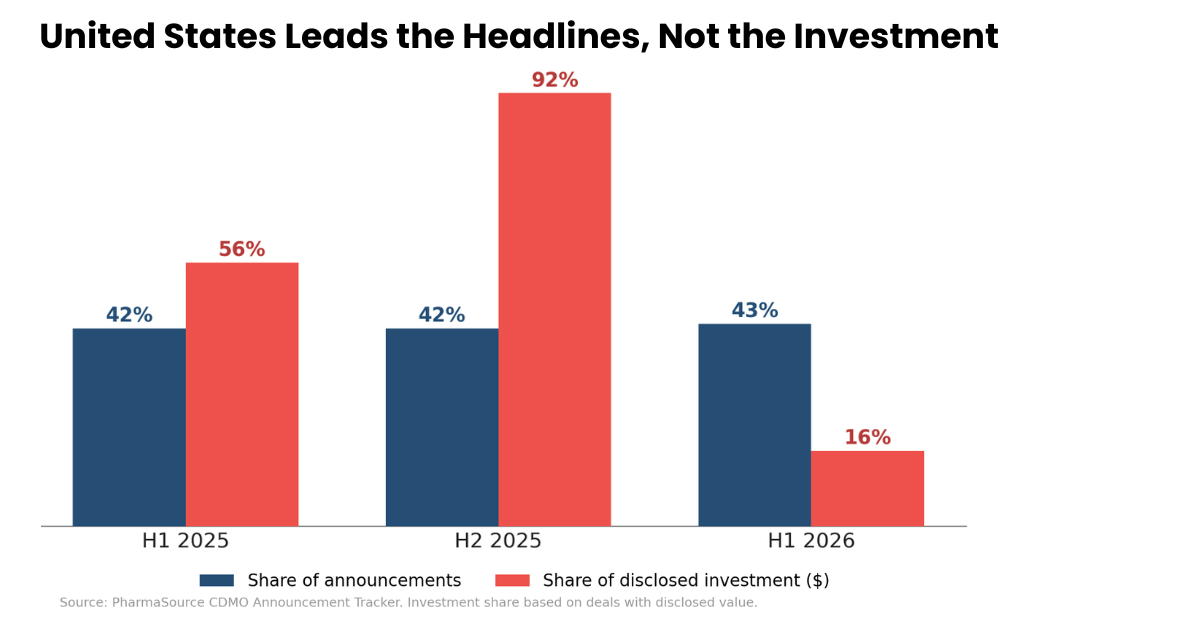
This begs the question: how much new domestic capacity is actually being created? Announced US manufacturing commitments now exceed $480 billion. But CBRE estimated in August 2025 that roughly half of the announced capital expenditure was already planned or already spent. And PharmaSource’s own H1 2026 CDMO data shows disclosed new facility investment fell to $3.9 billion, from roughly $13 billion in each of the two preceding halves, with the largest new plants landing in Italy, Germany and India — while the US share of announcements held steady at 43%.
Gil described how the pledge totals inflated:
“It turned into a numbers game… Companies started making announcements of titanic numbers, but they started including R&D spend, operations, updating facilities — things that were maybe already committed… Everything got lumped in to try to satisfy the big billion figure that needed to be announced.”
Manufacturing Reality
Policy has accelerated quickly, but manufacturing capacity cannot keep pace.
Executives attending External Manufacturing Leaders in Boston described a domestic manufacturing system already operating under significant capacity constraints.
Participants highlighted shortages in sterile fill-finish capacity, limited commercial ADC manufacturing capability, long technology-transfer timelines, and workforce shortages. Several noted that US facilities remain significantly more constrained than political discussion often assumes.
One executive summarized the challenge:
“There’s no capacity available. It makes it really hard to build resiliency. We’re booking 18 months ahead of time and it’s still hard to steer.”
Another described antibody-drug conjugate manufacturing as particularly constrained:
“The capacity in the US for ADCs is completely tied up. You can count on two or three fingers the ‘seasoned’ commercial partners capable of drug substance and highly potent fill-finish.”
The cost gap appears to explain why the dependence persists. As one Boston participant put it: “China is 20% cheaper than the US or EU, and 10% cheaper than India.”
Construction timelines are the other constraint no policy can waive. Fujifilm’s Holly Springs site in North Carolina — announced in January 2021 and opened in September 2025 — took roughly five years and $3.2 billion from announcement to first commercial output, and is considered a fast build.
Gil warned that if the pledged construction does materialize, it will hit shared bottlenecks in equipment, FDA review, and people:
“If everybody with thirty, forty, fifty billion dollar investments is spending that money at the same time, someone’s gonna come up short… We saw this with serialization back in 2015 and 2016.”
“If you actually built all this stuff, there is not enough workforce in the US to handle it all.”
He also raised the risk that some announced plants become stranded assets — “these facilities may get built and never used” — citing the Recipharm CEO’s prediction, in an interview with Endpoints, that within ten years 75% of these sites will be up for sale. Gil’s own view: “I think it’ll be shorter than ten years.”
Beyond Reshoring
Ryan Kelly, Senior Director of Supply Chain Security & Brand Protection at Rx-360, argues that manufacturing location alone is an incomplete measure of resilience.
“Reshoring is underway, but investment is concentrated in complex, higher-value capabilities such as biologics, sterile injectables, cell and gene therapies, radioligand therapies, and specialized API production.”
He notes that the United States remains dependent on imported APIs, key starting materials and other critical inputs, particularly for essential generic medicines.
Ryan argues that: “The real measure of reshoring is not announced investment. It is qualified capacity, reduced concentration, and improved continuity for patients.”
He also cautions that ownership and manufacturing location should not be viewed as interchangeable. “Foreign ownership is not automatically a vulnerability, and domestic manufacturing is not automatically resilient.”
That distinction becomes even more important when resilience is measured beyond the location of the final manufacturing step.
Marta explains that policymakers first need to define what reshoring is intended to achieve. A policy designed to create American manufacturing jobs may look very different from one intended to reduce strategic dependence on China.
“If you’re trying to onshore to lower your China exposure, then you need to realize that it’s actually not the API that China makes, but the key starting materials and some of the intermediates,” she said.
Simply moving API production to the United States, therefore, does not necessarily remove the underlying dependency. “Unless you solve the upstream, you didn’t solve the problem.”
Furthermore, much of the new US capacity is being built by foreign-owned companies. Gil noted that non-US CDMOs including Rovi, Samsung Biologics, Vetter, Celltrion, and Bora have bought or built US footprints over the past year, partly as a tariff hedge. Foreign capital is creating the domestic capacity the policy is designed to encourage.
Ryan warns that blunt instruments could backfire:
“Broad restrictions or tariffs could discourage investment, increase costs, and push lower-margin products from the market.”
Instead, he recommends companies map their complete supply chains, including APIs, starting materials, manufacturing, logistics, inventory and downstream distribution, to understand where critical dependencies remain.
Charlie similarly argues that companies need to look beyond finished drugs and APIs to key starting materials, precursors and other critical inputs. But he also points to procurement as a policy lever.
The federal government is one of the largest purchasers of medicines in the country, and Charlie argues that longer-term purchasing commitments could provide predictable demand; something factory incentives alone cannot.
For critical generic medicines in particular, that demand certainty could determine whether domestic production is economically sustainable once the initial incentives have disappeared.
The API Innovation Center (APIIC) believe that capacity for generics already exists, but that it is sitting idle across US facilities operating at 50% or below and needs to be “Activated”.
Speaking to the PharmaSource podcast, APIIC’s Charles Lyon explains how they work with existing US capacity, leverage advanced manufacturing technology, and de-risks participation for CDMOs and API manufacturers through a public-private funding model.
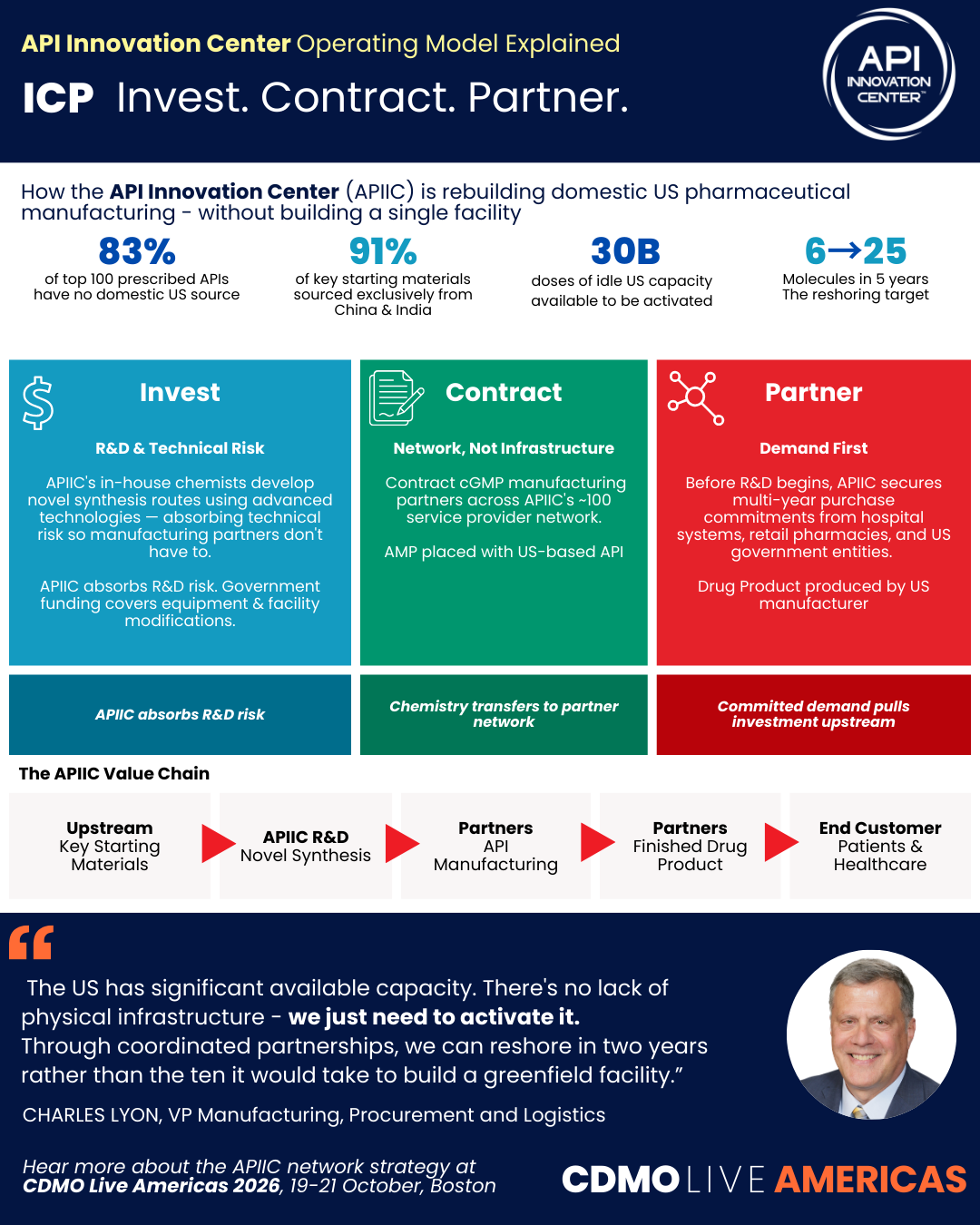
Read the full interview with Charles Lyon, VP Manufacturing, Procurement and Logics – another speaker highlight at CDMO Live Americas 2026.
Looking ahead
Since 2025, the United States has introduced new trade measures, regulatory reforms, manufacturing incentives and legislative proposals aimed at expanding domestic pharmaceutical production and improving supply-chain resilience.
At the same time, industry leaders continue to highlight practical constraints around capacity, workforce, technology transfer and specialist manufacturing capability.
As reshoring moves from policy announcement to implementation, the discussion is shifting to which capabilities matter most, which dependencies actually create risk, and whether there will be sufficient demand to sustain the capacity once it is built.
The investment totals may continue to rise, but the more meaningful measures will be harder to capture in a headline: qualified capacity, diversified upstream supply, commercially sustainable domestic production, and continuity of medicines for patients.