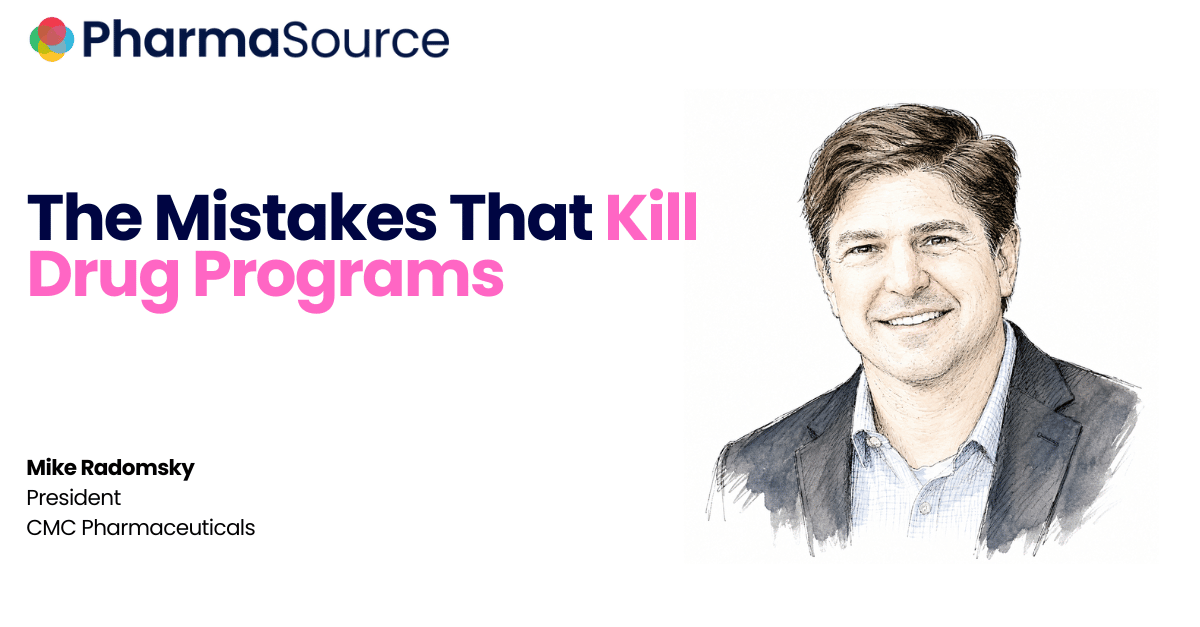
“Cultural fit, customer service, communication, and transparency often matter as much as technical capability,” says Mike Radomsky.
Mike Radomsky, President of CMC Pharmaceuticals, Inc., a drug product consulting and lab services firm serving preclinical through commercial-stage programs, has spent more than 30 years watching the same preventable mistakes derail otherwise promising drug development programs. In a recent interview with PharmaSource, he laid out the patterns he sees most often, the questions sponsors should be asking CDMOs, and why the industry’s push toward U.S.-based manufacturing is finally starting to shift the available options for small sponsors.
The Costliest CMC Mistakes Happen Before Anyone Realizes It
Asked to identify the single most expensive mistake sponsors make in early development, Mike points to a pattern. Early-stage teams consistently underestimate how deeply interconnected CMC decisions are, and the cost compounds quietly until a regulatory submission or manufacturing run makes it impossible to ignore.
The most financially damaging case he has witnessed was a product that made it all the way to market and then couldn’t keep up with demand.
“The biggest financial mistake I’ve seen was when a product’s manufacturing was not scaled sufficiently to meet post-approval demand,” Mike says. “The company had a successful product that was generating income, but supply constraints prevented them from capturing additional sales.”
The most time-damaging case followed a different path. Inadequate development of analytical methods, formulation selection, and the manufacturing process led to repeated batch failures. Batches had to be re-manufactured when the API was in short supply. The cascade delayed IND submission, clinical trials, and ultimately NDA approval.
Mike groups the common failure modes into five categories that sponsors should pressure-test before any submission:
- Misalignment with regulatory expectations — lack of clarity on critical quality attributes, product specifications, or control strategy
- Missing key studies — omitting work needed to justify specifications
- Neglecting the basics — focusing on the novel parts of a program while overlooking straightforward requirements
- Timing errors — addressing issues too late to complete development studies before filing, including multi-year stability studies started too close to submission
- Failure to plan for long-term success — not ensuring surge capacity is in place to meet post-approval commercial demand
Tech Transfer Readiness Is a Judgment Call
One of the most consequential decisions in drug development is the decision to transfer a program to a CDMO. Get it wrong in either direction (transferring too early or waiting too long), and the consequences cascade through timelines and budgets.
Mike describes what genuine readiness requires. “It takes an experienced cross-functional CMC team to make that assessment,” he says. “The team needs confidence in the analytical methods, formulation selection, and manufacturing process, and that all the details are in line with cGMP, FDA, and industry standards.”
That means the process is reproducible, critical parameters are understood, and there are no major unknowns heading into scale-up. Each CMC expert evaluating the program should have decades of hands-on experience in tech transfer, scale-up, and engineering batch production. A checklist can confirm that documents exist. Only experience can assess whether the program is genuinely ready.
CMO Selection Beyond the RFP: What Actually Predicts a Good Partnership
Technical capability is necessary but not sufficient when selecting a CDMO. Mike argues that cultural fit and communication practices are equally predictive of program outcomes and are almost never evaluated rigorously in a standard RFP process.
The baseline questions — does the facility have the right equipment, personnel, and processes to make this product? are the starting point.
“Beyond these technical fundamentals, a good fit with a CMO may be dependent on corporate culture,” Mike says.
He offers a specific set of diagnostic questions that reveal how a CDMO actually operates day to day:
- Does the CDMO hold regularly scheduled meetings and maintain ongoing communication with the customer?
- Is bad news communicated as quickly and efficiently as good news?
- Do you have direct access to technical staff, not just a project manager?
- Are they responsive and proactive to issues both large and small?
- Do they act like a partner or just a vendor?
The distinction between a partner and a vendor shows up not in the proposal, but in how the organization behaves when something goes wrong. Sponsors who evaluate CDMOs only on paper often find out which category they’re dealing with at the worst possible moment.
Reshoring Is Changing the CDMO Landscape for Small Sponsors
The industry’s push toward U.S.-based manufacturing has created a perception problem for smaller sponsors: they assume the domestic CDMO pool is thin, and sometimes select foreign manufacturers not because of capability or cost but because they don’t believe viable U.S. options exist. Mike’s view is that this perception is increasingly outdated.
The shift in attitude among international CDMOs is significant. As recently as ten to fifteen years ago, declining to bid on U.S.-based work was common practice — foreign manufacturers simply couldn’t compete with Asian pricing. That has changed.
“Today, with the push for reshoring and supply chain security, many CDMOs are much more willing, and in some cases eager, to support U.S.-based programs,” Mike says. “It is still more constrained than a global search, but the number of viable options is increasing.”
Why Integration Beats Fragmentation: The Full-Program View
Mike describes what he calls the fundamental problem with fragmented CMC models: decisions get made without full visibility across the entire program.
CMC development is, by nature, highly interconnected. A change in drug substance process can propagate downstream in ways that affect drug product quality, manufacturability, or stability. In a fragmented model, where drug substance and drug product development are siloed, those downstream implications often go unassessed until they surface as problems.
“If a DS engineer makes a change in the DS process without consulting the full development team, this could have a significant impact on downstream DP quality,” Mike says. “Changes and improvements in the process must be justified, and evidence-based and interconnected decisions must be made.”
An integrated approach solves this by bringing the right experts together with the entire program in mind before changes are implemented rather than after problems appear. The result is a different risk profile: issues identified at the design stage are categorically less costly to address than issues identified after a batch failure or a deficiency letter.
“That alignment,” Mike says, “is what ultimately reduces risk and improves the likelihood of success.”
Key Takeaways for Sponsors
The programs that avoid costly CMC failures are not those with unlimited budgets or perfect science. They are the ones who built in the right expertise, the right checkpoints, and the right partner relationships early enough to act on what they found.
For sponsors evaluating their current CMC strategy, Mike’s framework suggests three specific areas to pressure-test:
- Readiness assessment — Is your cross-functional team experienced enough to make a genuine judgment about tech transfer timing, or are you relying on documentation alone?
- CDMO cultural fit — Are you evaluating how potential partners communicate bad news and whether you have access to technical experts, not just project managers?
- Program integration — Are your drug substance and drug product development teams operating with full visibility into each other’s decisions, or are changes being made without full downstream assessment?
The programs that answer those questions early are the ones, in Mike’s experience, that don’t have to answer for them later.