A single missed shipment can stall a clinical trial for weeks which is exactly why clinical trial supply has become one of the most closely watched functions in drug development. As biologics, decentralized trials, and personalized medicine reshape how studies are run, sponsors need supply chains that are faster, more flexible, and more tightly controlled than ever before.
From GMP manufacturing and cold-chain logistics to AI-driven demand forecasting, getting clinical trial supply right determines whether a promising therapy reaches patients on time or doesn’t reach them at all. This guide breaks down what’s driving the market, the CDMOs and technology vendors leading it, and what to look for in a supply partner.
Clinical Trial Supply Market Size and Growth (2026)
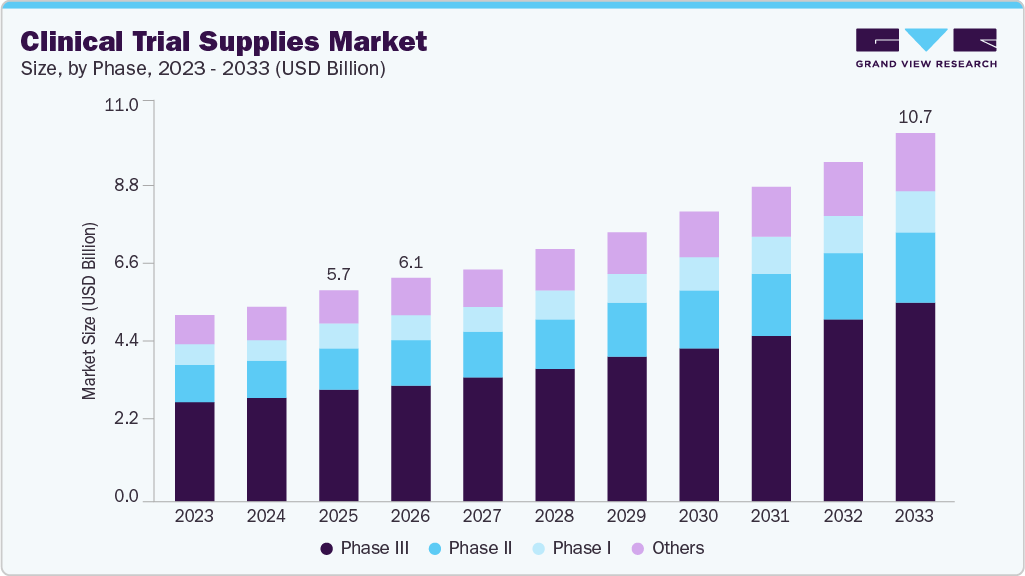
The global clinical trial supplies market size was valued at USD 5.7 billion in 2025 and is projected to grow from USD 6.1 billion in 2026 to USD 10.7 billion by 2033, at a CAGR of 8.4% from 2026 to 2033. This growth is largely fueled by rising R&D investments, the growing burden of chronic diseases, and the continued globalization of clinical trials. Additionally, the expanding focus on biologics and personalized medicine is increasing the need for advanced supply chain solutions, including temperature-controlled logistics and just-in-time delivery models.
(Source- Grandview Research)
What is Clinical Trial Supply?
Clinical trial supply encompasses the end-to-end process of manufacturing, packaging, labeling, storing, and distributing investigational drugs and associated materials to clinical research sites and patients. This highly regulated supply chain ensures that:
- Investigational products maintain quality and integrity throughout their lifecycle
- Trial materials are delivered at the right time, to the right location, in the right condition
- Regulatory compliance is maintained across multiple jurisdictions
- Patient safety and data integrity are protected
Unlike commercial pharmaceutical supply chains, clinical trial supply must accommodate greater uncertainty, frequent protocol changes, and the unique challenges of handling investigational products that may have limited stability data.
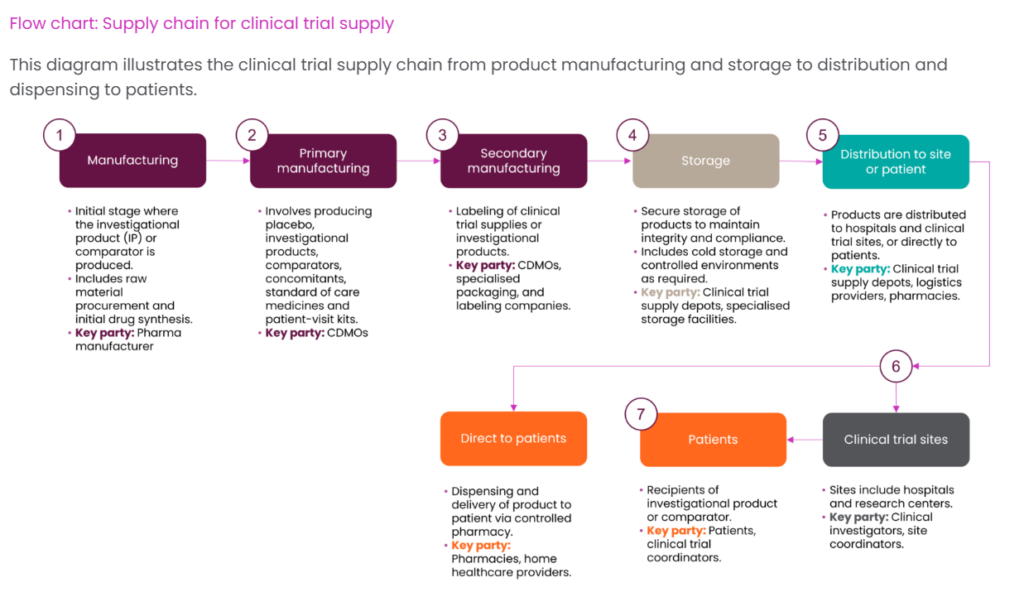
Source- Akesa
Latest Clinical Trial Supply News-
-

Genezen Partners With Galibra Neuroscience on SSADH Deficiency Gene Therapy
-

Andelyn Biosciences Partners With PQP Group
-
4basebio Partners With TriLink on Cell Therapy Manufacturing Program
-

SK pharmteco Supports GEMMABio’s Phase 1/2 Trial of SMA1 Gene Therapy
-

FamiCord AG Signs Manufacturing Agreement With VERIGRAFT for P-TEV
-
Sharp Services Expands Autoinjector and Pen Assembly Capacity
Key Components of the Clinical Trial Supply Chain
Manufacturing and Production
The clinical trial supply chain begins with the production of investigational medicinal products according to Good Manufacturing Practice (GMP) standards. This phase involves:
- Small-batch production: Specialized manufacturing of limited quantities
- Formulation development: Creating appropriate dosage forms for the clinical setting
- Analytical testing: Validating product quality, potency, and purity
- Documentation: Comprehensive batch records and certificates of analysis
Packaging and Labeling
Clinical trial materials require specialized packaging and labeling that:
- Maintains product stability and integrity
- Enables blinding procedures when required
- Complies with region-specific regulatory requirements
- Incorporates randomization codes and unique identifiers
- Provides clear instructions for proper handling and administration
Storage and Distribution
Clinical supplies must be stored and transported under carefully controlled conditions:
- Temperature monitoring: Continuous tracking for temperature-sensitive products
- Environmental controls: Protection from light, humidity, and other environmental factors
- Security measures: Prevention of unauthorized access or tampering
- Global logistics planning: Coordination across international borders and regulatory frameworks
Inventory Management
Effective inventory management ensures adequate supply while minimizing waste:
- Demand forecasting: Predicting site requirements based on enrollment projections
- Expiry tracking: Managing limited shelf-life of investigational products
- Resupply triggers: Automated systems for timely replenishment
- Returns processing: Accounting for unused or expired materials
Strategic Planning in Clinical Trial Supply
Successful clinical trial supply begins with comprehensive strategic planning that accounts for:
Risk Assessment and Mitigation
A robust risk management approach identifies potential disruption points:
- Supply chain vulnerabilities assessment
- Backup sourcing strategies development
- Alternative logistics pathways planning
- Quality deviation response protocols establishment
Demand Forecasting
Accurate forecasting balances availability against waste:
- Enrollment rate projections across sites
- Protocol-specific dosing requirements analysis
- Regional regulatory approval timeline considerations
- Buffer stock calculations based on variability factors
Regulatory Strategy
Navigating complex and varied regulatory landscapes requires:
- Country-specific importation requirements mapping
- Label translation and compliance planning
- Documentation preparation for multiple authorities
- Expiry extension strategies when appropriate
Regulatory Framework for Clinical Trial Supply
Clinical trial supply operates within a comprehensive regulatory framework designed to ensure patient safety and data integrity:
Global Regulatory Standards
Key regulatory guidelines that govern clinical trial supply include:
- Good Manufacturing Practice (GMP): Ensures product quality and consistency
- Good Distribution Practice (GDP): Maintains product integrity during transport
- Good Clinical Practice (GCP): Establishes overall trial conduct standards
- International Council for Harmonisation (ICH) guidelines: Provides harmonized approaches
Regional Regulatory Considerations
Regional variations create complexity in multi-country trials:
- FDA requirements in the United States
- EMA guidelines across European Union member states
- NMPA regulations in China
- PMDA standards in Japan
- Local import license requirements in emerging markets
Current Challenges in Clinical Trial Supply
Clinical trial supply is becoming increasingly complex due to adaptive trial designs, personalized treatments, and decentralized models that demand flexible and patient-centric solutions. Global supply chain disruptions driven by pandemics, geopolitical issues, and raw material shortages have further exposed vulnerabilities. Cold chain requirements for biologics and cell therapies add pressure with strict temperature controls and time-sensitive logistics. Rising costs from shipping, complex manufacturing, security, and regulatory compliance continue to strain trial budgets, making efficient and resilient supply strategies more critical than ever.
AI and Predictive Analytics in Clinical Trial Supply
Artificial intelligence has moved from experimental to essential in clinical supply planning. AI algorithms now analyze historical trial data, patient enrollment trends, and site performance to generate more accurate supply predictions, reducing the risk of overstocking or stockouts and helping sponsors allocate resources more efficiently. Complementing this, IoT-enabled sensors monitor the location, temperature, and condition of investigational products throughout the supply chain, feeding real-time dashboards that give teams end-to-end visibility into inventory levels and shipment status.
Other technology-driven advances reshaping the space include:
- Interactive Response Technology (IRT): automates randomization and supply management
- Blockchain applications: enhance traceability and authenticity verification
- Digital twin technology: simulates supply chain scenarios for optimization
Among IRT/RTSM platforms, Medidata RTSM is a widely adopted enterprise-grade platform for complex global trials, while newer entrants like mIRT are gaining recognition for combining AI-driven capabilities with regulatory and clinical expertise.
Direct-to-Patient and Decentralized Trial Models
Decentralized approaches are gaining significant traction, including home delivery of investigational products, remote temperature monitoring of stored products, telehealth integration with supply logistics, and patient-friendly packaging and administration systems. The rising number of decentralized clinical trials (DCTs) is expected to create significant growth opportunities, as sponsors adopt DCT models to improve patient recruitment and retention while reducing trial timelines.
Sustainable Supply Chain Practices
Environmental considerations are increasingly shaping clinical supply strategy, including reduced packaging waste through innovative design, lower-carbon transportation strategies, energy-efficient storage facilities, and adoption of recyclable and biodegradable materials.
Key Companies in Clinical Trial Supply
- Thermo Fisher Scientific
- Almac Group
- Novo Holdings
- Marken
- PCI Pharma
- Piramal Pharma
- Sharp
- Cencora
- Myonex
- Clinigen
- Inceptua
- Eurofins
- Parexel
- ICON
- IQVIA
- Catalent
- DHL
- Movianto
- UDG Healthcare
- FedEx
- Ceva Logistics
- Clinevo Technologies
- Credevo
- Experic
- Oximio
- Proventa International
How to Choose a Clinical Trial Supply Partner
Selecting the right provider typically follows a structured procurement process. This begins with identifying required items investigational drugs, devices, and consumables followed by issuing requests for proposals or tenders to potential suppliers, with selection based on quality, cost, reliability, and regulatory compliance, before contracts are negotiated and finalized. When evaluating partners, sponsors should assess:
- Global regulatory and importation expertise across target trial countries
- Cold chain and temperature-controlled logistics capabilities
- IRT/RTSM technology integration and real-time visibility tools
- Track record with your specific modality (small molecule, biologic, cell and gene therapy)
- Scalability from Phase I through Phase III and into commercial supply
- Quality systems, audit history, and deviation response protocols
Cost Drivers in Clinical Trial Supply
The high costs associated with clinical trial supplies remain a key constraint on the market, with packaging, labeling, storage, and transportation expenses particularly for temperature-sensitive biologics continuing to rise, compounded by the strict regulatory compliance required across global trials. Overproduction, wastage, and logistical inefficiencies further add to costs, making accurate demand forecasting and flexible supply strategies critical to controlling trial budgets.
Best Practices for Optimizing Clinical Trial Supply
- Integrated Planning: involve supply chain early, align manufacturing with enrollment, and maintain clear site communication
- Smart Technology: use real-time tracking, temperature monitoring, and analytics for end-to-end visibility
- Vendor Management: partner with qualified vendors, define performance metrics, and conduct regular audits
- Contingency Plans: prepare backups for sourcing, distribution, and manufacturing to handle disruptions smoothly
The Role of Outsourcing in Clinical Trial Supply
Many sponsors rely on specialized service providers to manage aspects of their clinical trial supply chain. Strategic outsourcing can provide specialized expertise in complex logistics, geographic reach and local market knowledge, scalable capacity, and cost efficiencies through shared resources.
The outsourcing landscape includes Contract Manufacturing Organizations (CMOs) focused on production, clinical supply services providers specialized in packaging and distribution, integrated CDMOs offering end-to-end services, and specialty logistics providers focused on complex transportation requirements.
Glossary of Key Terms
- IMP (Investigational Medicinal Product): the drug or comparator being tested in a clinical trial
- IRT (Interactive Response Technology): software that automates randomization and drug supply management
- RTSM (Randomization and Trial Supply Management): a term often used interchangeably with IRT
- QP (Qualified Person): the individual responsible for certifying IMP batch release in the EU
- GDP (Good Distribution Practice): standards governing product integrity during transport and storage
Key Considerations for Clinical Trial Supply Success
Successful trial supply starts with early integration into trial design — assessing supply risks, packaging needs, and distribution capabilities during protocol planning. Flexibility is vital, enabling quick adjustments for enrollment changes, amendments, or trial expansions. Strong quality systems ensure compliance through documentation, audits, and deviation controls. End-to-end visibility with real-time tracking and predictive analytics supports proactive decision-making and uninterrupted supply flow.
Conclusion
The clinical trial supply chain is a complex, highly regulated, and increasingly sophisticated ecosystem that directly impacts the success of drug development programs. As trials become more complex and global in scope, excellence in supply chain management has emerged as a competitive advantage that can accelerate timelines, control costs, and ultimately bring new therapies to patients more efficiently. Organizations that invest in strategic planning, technological innovation, and optimization of their clinical trial supply operations — while partnering with the right CDMOs and technology vendors — position themselves to navigate challenges more effectively and deliver more reliable outcomes.
Frequently Asked Questions
What is the difference between clinical supply and commercial supply?
Clinical supply involves smaller production volumes of investigational products under development, with frequent changes, complex logistics for blinded studies, and strict regulatory oversight. Commercial supply focuses on large-scale, standardized production of approved medications with established, predictable demand forecasting.
What are clinical supplies in pharmaceutical manufacturing?
Clinical supplies include all materials needed to conduct clinical trials — primarily investigational medicinal products, but also comparator drugs, placebos, ancillary supplies, and supporting materials such as patient diaries and temperature monitoring devices.
How is the clinical trial supply chain managed?
Management involves strategic planning, manufacturing, packaging, labeling, storage, distribution, and inventory control, coordinated through cross-functional teams spanning clinical operations, manufacturing, logistics, and quality assurance, supported by systems like IRT and temperature monitoring.
What are the main challenges in clinical trial supply?
Key challenges include maintaining product integrity, managing temperature-sensitive products, navigating complex global regulatory requirements, accommodating protocol changes, ensuring blinding integrity, managing limited shelf-life, controlling costs, and adapting to decentralized trial models.
How are technology innovations improving clinical trial supply?
Innovations include blockchain for traceability, IoT sensors for real-time temperature monitoring, AI and machine learning for demand forecasting, cloud-based supply chain management systems, automated inventory management, and direct-to-patient platforms supporting decentralized trials.
Which companies lead the clinical trial supply market?
Thermo Fisher Scientific is widely cited as the clinical trial supplies market leader, with Almac Group, Catalent, Sharp Services, PCI Pharma Services, and Piramal Pharma Solutions also named among the leading providers.