
Process analytical technology (PAT) has moved from a regulatory concept to a manufacturing necessity. In 2026, PAT tools from Raman and NIR spectroscopy to AI-driven chemometric models sit at the center of real-time quality control, continuous manufacturing, and real-time release testing across pharma and biotech.
This guide covers what PAT is, the market size and growth trends, the regulatory landscape (including new 2025–2026 FDA, EMA, and USP developments), the leading PAT tool categories and suppliers, and how procurement teams can build smarter, lower-risk PAT partnerships.
Process Analytical Technology (PAT) has emerged as a transformative force in pharmaceutical manufacturing, fundamentally reshaping how contract development and manufacturing organizations (CDMOs) approach quality control, process optimization, and regulatory compliance. As the pharmaceutical industry continues its evolution toward Quality by Design (QbD) principles and continuous manufacturing, PAT has transitioned from an innovative concept to an essential operational requirement.
What Is Process Analytical Technology (PAT)?
Process Analytical Technology (PAT) refers to a set of tools, techniques, and systems used to monitor, analyze, and control pharmaceutical manufacturing processes in real time. As defined in the FDA’s 2004 guidance, “PAT — A Framework for Innovative Pharmaceutical Development, Manufacturing, and Quality Assurance,” PAT is a system for designing, analyzing, and controlling manufacturing through timely measurements of critical quality and performance attributes of raw and in-process materials and processes, with the goal of ensuring final product quality is built into the process rather than tested after the fact.
It enables manufacturers to make informed decisions, ensure product quality, optimize processes, and meet regulatory requirements. With increasing demand for quality control and assurance in pharmaceutical and biotech industries, PAT has become an indispensable component of the manufacturing process.
PAT Tool Categories
PAT tool category | Representative techniques | Typical application |
|---|---|---|
Spectroscopy-based | Near-infrared (NIR), Raman, Fourier-transform infrared (FTIR), UV-Vis | Chemical composition analysis, impurity identification, in-line metabolite and biomass monitoring |
Chromatography-based | High-performance liquid chromatography (HPLC), gas chromatography (GC), size-exclusion chromatography (SEC) | Separation and purity analysis, downstream purification monitoring |
Particle size analysis | Laser diffraction, focused beam reflectance measurement (FBRM) | Particle size distribution and morphology for formulation and manufacturing optimization |
Physical/electrochemical sensors | pH, conductivity, dissolved oxygen, temperature, capacitance probes | Real-time cell culture and process parameter monitoring |
Chemometric/MVDA software | Partial least squares (PLS), principal component analysis (PCA) | Multivariate process control and predictive modeling |
Other PAT tools include imaging systems, data analytics software, and multivariate data analysis (MVDA) tools that facilitate comprehensive process analysis and optimization.
Inline, Online, and At-Line Measurement — What’s the Difference?
- Inline measurements are taken directly within the process stream in real time, without sampling.
- Online measurements divert a sample from the process, analyze it, and may return it to the process.
- At-line measurements are performed in close proximity to the process with minimal delay.
Each approach offers a different balance of timeliness, accuracy, and practicality depending on the application. On-line/in-line configurations are the fastest-growing segment of the PAT market, driven by the shift toward continuous manufacturing and automated process control.
Process Analytical Technology Market Size and Trends (2026)
Market-research estimates of the global PAT market vary depending on scope — whether the figure covers instruments alone or the full ecosystem of instruments, software, and services. Recent 2026 estimates place the market anywhere from roughly $5.6 billion to $9 billion, with most forecasts projecting continued double-digit or high-single-digit annual growth through the early 2030s. Fortune Business Insights estimates the market at $8.95 billion in 2026, growing to $13.83 billion by 2034 (5.59% CAGR). 360iResearch puts 2026 at $6.24 billion, reaching $13.30 billion by 2032 (13.38% CAGR). MarketsandMarkets projects growth from $5.79 billion in 2026 to $11.49 billion by 2031 (14.7% CAGR), citing rising investment in biopharmaceutical manufacturing capacity as a primary driver.
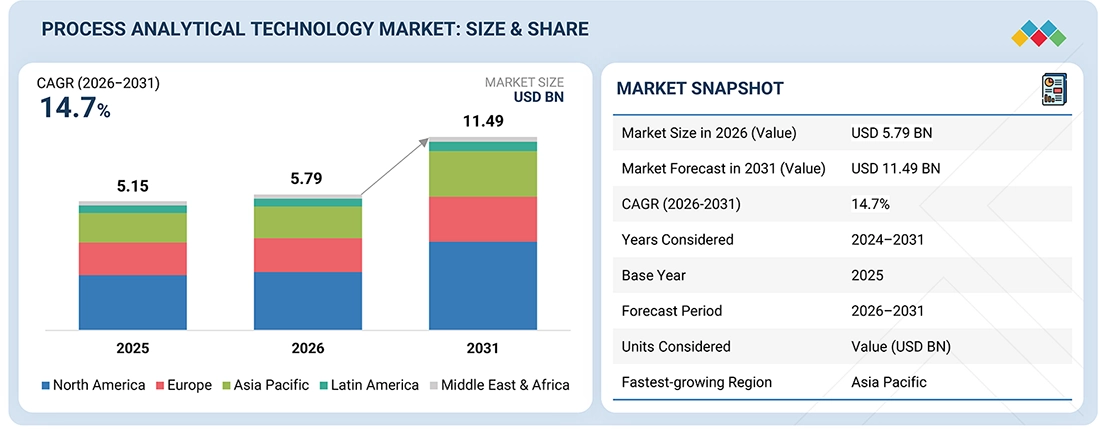
Across sources, on-line/in-line measurement and spectroscopy-based tools consistently represent the largest and fastest-growing segments, and North America remains the largest regional market, with Asia-Pacific growing fastest.
The PAT market is experiencing significant growth due to increasing demands for quality control, regulatory compliance, and process optimization in the pharmaceutical industry. The COVID-19 pandemic accelerated adoption of PAT, with analyzers, sensors, probes, and software increasingly used throughout the product lifecycle to ensure quality and safety while reducing costs — a shift that has continued well beyond the pandemic period as continuous manufacturing and biologics production capacity have expanded.
How to Partner Better with Process Analytical Technology Suppliers
In order to establish better partnerships with PAT suppliers and effectively manage costs without compromising quality, pharmaceutical procurement teams can consider the following strategies:
Understand your business partners’ specific requirements and align with PAT suppliers’ capabilities
Clearly define your organization’s needs and objectives when seeking PAT solutions. Conduct thorough market research to identify suppliers whose capabilities align with your requirements.
Conduct thorough supplier evaluations and due diligence
Evaluate potential suppliers based on their expertise, track record, quality certifications, and references from existing clients. Consider factors such as product quality, after-sales support, and the supplier’s ability to meet regulatory requirements.
Foster long-term relationships with trusted suppliers
Building strong relationships with PAT suppliers can lead to mutual trust, enhanced collaboration, and favorable pricing. Establishing long-term partnerships can also facilitate customization of solutions to meet specific needs.
Collaborate on customization and integration of PAT solutions
Work closely with PAT suppliers to customize solutions that integrate seamlessly with your existing manufacturing processes. Effective collaboration ensures optimal implementation and minimizes disruptions.
Seek cost optimization opportunities through process improvements
Work closely with PAT suppliers to identify areas for process optimization and efficiency gains. Streamlining processes can lead to cost savings and enhanced productivity.
Negotiate favorable service and maintenance agreements
Negotiate comprehensive service and maintenance agreements that cover regular maintenance, calibration, troubleshooting, and prompt technical support. Clarify pricing, response times, and service level agreements to avoid unexpected costs.
Consolidate purchasing and leverage collective buying power
Consolidate purchasing requirements and leverage the collective purchasing power of your organization. Openly discuss cost challenges with PAT suppliers and explore opportunities for mutually beneficial cost optimization.
Conduct comprehensive cost-benefit analyses
Evaluate the overall cost implications of implementing PAT systems, considering not only upfront costs but also long-term benefits in terms of improved quality, process efficiency, and regulatory compliance. Consider the total cost of ownership over the lifetime of the PAT systems, including maintenance, support, and potential upgrades.
Keep abreast of market developments and seek competitive bids
Continuously monitor the PAT market for new entrants, technological advancements, and competitive pricing. Regularly solicit bids from multiple suppliers to ensure you are obtaining the best value for your investment.
Key Benefits of Process Analytical Technology
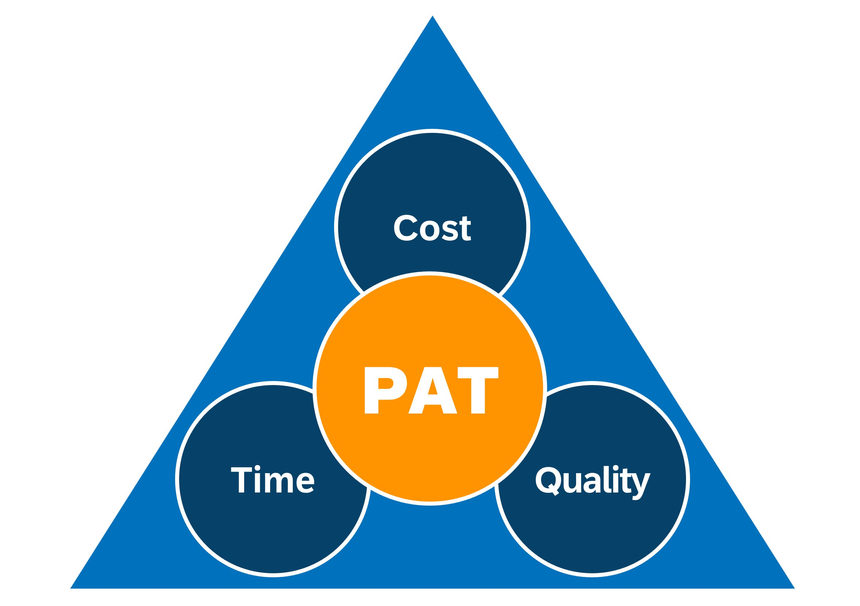
PAT delivers significant quality and commercial advantages across pharmaceutical manufacturing operations:
- Improved product quality and uniformity through real-time monitoring
- Reduced waste, rework, and energy consumption
- Decreased process cycle time and faster development timelines
- Right-first-time manufacturing with higher production asset utilization
- Real-time quality assurance and movement toward real-time product release
- Enables transition from batch to continuous manufacturing
- Reduced raw material, work-in-progress, and finished goods inventories
- Facilitates regulatory acceptance and compliance
Frequently Asked Questions
What is Process Analytical Technology (PAT)?
PAT uses real-time measurements and advanced analytics to monitor and control pharmaceutical manufacturing processes and build quality into products.
What are the main benefits of PAT?
PAT improves product quality, reduces waste and cycle times, strengthens process understanding, and supports real-time quality assurance.
Which analytical techniques are used in PAT?
Common techniques include NIR, Raman, UV-visible spectroscopy, HPLC, GC, mass spectrometry, FBRM, and process sensors.
How does PAT support Quality by Design (QbD)?
PAT provides real-time process data that helps manufacturers understand critical process parameters, define design spaces, and develop effective control strategies.
What challenges do CDMOs face when implementing PAT?
Key challenges include investment costs, system integration, specialized expertise, technology transfer, client requirements, and regulatory documentation.
How should pharmaceutical companies evaluate CDMO PAT capabilities?
Evaluate PAT infrastructure, relevant experience, regulatory track record, quality systems, scalability, technology transfer capabilities, and cost.
What is the difference between inline, online, and at-line measurements?
Inline measurements occur directly within the process, online measurements analyze diverted samples, and at-line measurements are performed near the process with minimal delay.
How does PAT enable real-time release testing (RTRT)?
PAT continuously monitors process and quality data, allowing validated models to support product release based on real-time data.
What role does PAT play in continuous manufacturing?
PAT provides the real-time monitoring and control needed to maintain quality and process stability in continuous manufacturing. ICH Q13 provides harmonized expectations for continuous manufacturing.