Highly Potent Active Pharmaceutical Ingredients (HPAPIs) have emerged as a cornerstone of modern pharmaceutical development, revolutionizing targeted therapy approaches across multiple disease areas.
These exceptionally potent compounds are increasingly explored as strategic solutions for improving treatment efficacy while minimizing dosage requirements. From oncology therapeutics to treatments for central nervous system disorders and diabetes, HPAPIs are fundamentally changing pharmaceutical development by enabling precision medicine approaches.
The HPAPI CDMO Manufacturing Market: Size, Growth & Key Trends
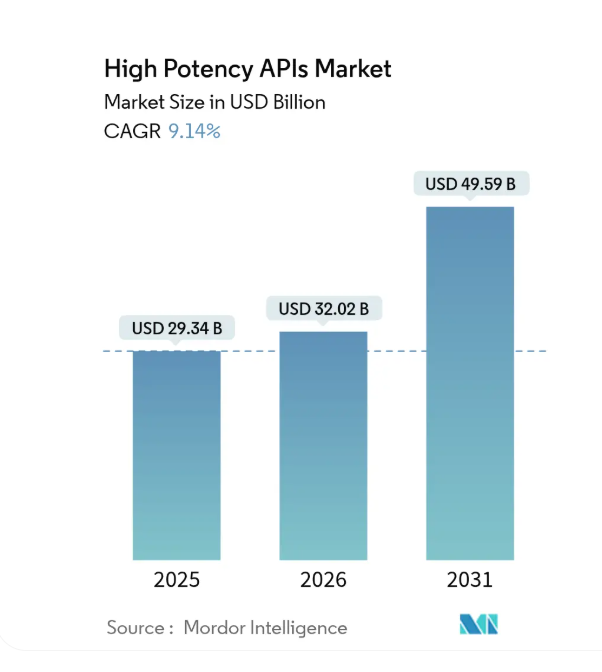
The high potency API (HPAPI) market is projected to grow significantly, reaching USD 32.02 billion in 2026, up from USD 29.34 billion in 2025, and expected to reach USD 49.59 billion by 2031, reflecting a 9.14% CAGR between 2026 and 2031. (Source- Mordor Intelligence)
This growth is driven by the increasing shift toward precision medicine, a higher share of highly potent compounds in drug development pipelines, and continued capacity investments by CDMOs. Supply chain adjustments influenced by the BIOSECURE Act are accelerating reshoring initiatives in North America, while India and other Asia-Pacific hubs are emerging as alternative sourcing destinations.
Oncology remains the leading therapeutic application, though areas such as ophthalmology and metabolic disorders are contributing additional growth opportunities. Across the industry, advanced containment infrastructure, modular facility design, and digital occupational safety systems are becoming key competitive differentiators, raising the barrier to entry for new market participants.
What is Highly Potent API (HPAPI) manufacturing, and why does it matter?
HPAPIs are active pharmaceutical ingredients that produce a significant biological effect at very low doses — typically below 150 micrograms per kilogram of body weight. They are the backbone of modern targeted therapies, particularly in oncology, and their manufacturing demands specialized containment infrastructure, rigorous safety protocols, and deep regulatory expertise that most pharma companies cannot maintain in-house.
Three macro trends are shaping the HPAPI CDMO manufacturing landscape right now. First, the explosion of antibody-drug conjugates (ADCs) — which pair a targeting antibody with a highly cytotoxic payload — is creating sustained demand for ultra-high containment manufacturing capabilities. Second, the broader shift toward precision medicine is concentrating drug pipelines around molecules that are inherently more potent, further expanding the addressable HPAPI manufacturing opportunity. Third, geopolitical pressures — including the U.S. BIOSECURE Act and supply chain reshoring initiatives — are accelerating investment in domestic and European HPAPI manufacturing capacity, driving fresh CDMO buildouts across North America and the EU.
Highly Potent API Services (HPAPI) and the Science Behind the Market
HPAPIs are pharmaceutical compounds characterized by extreme biological activity at very low concentrations. In practice, this means that occupational exposure limits (OELs) are typically set at or below 1 microgram per cubic meter of air — a threshold so low that standard pharmaceutical manufacturing environments are wholly inadequate. The result is a specialized manufacturing discipline that sits at the intersection of advanced chemistry, industrial hygiene, engineering controls, and regulatory compliance.
Latest HPAPI News–
-

Shilpa Medicare Launches Dedicated Complex Small-Molecule CDMO
-

SK pharmteco Opens Expanded Swords Facilities for Small Molecules and HPAPIs
-

Eurofins CDMO Alphora Expands Kilolab and HPAPI Capabilities in Mississauga
-
Polpharma API Selected by Celon Pharma for ADC Payload-Linker Manufacturing
-

Altruist Biologics Receives Trilateral Approval for ADC Manufacturing at Hangzhou Site
-

CDMO World Cup: Comparing Global Contract Manufacturing Powerhouses
How HPAPI Manufacturing Works
The fundamental challenge of HPAPI CDMO manufacturing is isolating the compound from workers and the environment throughout every stage of synthesis, drying, milling, and analysis. This is achieved through a hierarchy of engineered containment systems — from contained gloveboxes and split butterfly valves at smaller scales, to fully pressurized isolator suites and closed-loop processing systems at commercial scale. Containment performance is classified using the Occupational Exposure Band (OEB) framework, which stratifies compounds from OEB1 (least hazardous) through OEB5 and beyond (OEB6, sometimes called “ultra-potent”), with OEB4 and OEB5 representing the core of classic HPAPI territory.
Analytical capability is equally critical. HPAPI CDMOs must operate validated methods capable of detecting and quantifying trace-level residues for equipment cleaning verification — a process that demands specialized analytical infrastructure and a deep understanding of matrix interference at the sub-nanogram level.
Growth Drivers
- Rising Global Cancer Burden: Nearly 20 million new cancer cases in 2022 driving sustained demand for oncology APIs
- Expanding ADC Pipeline: Increasing number of antibody–drug conjugates in Phase I–III trials requiring GMP payload and conjugation manufacturing
- Oncology Patent Expirations: Growth of the generic HPAPI market as branded oncology drugs lose exclusivity
- Regulatory Maturity: Improved regulatory comfort with complex HPAPI submissions and risk-based containment frameworks
- Increased Outsourcing: Lower barriers encouraging more sponsors to outsource HPAPI manufacturing
Key Challenges in HPAPI Development and Manufacturing
Despite their therapeutic advantages, HPAPIs present unique challenges throughout the development and manufacturing process:
Safety and Toxicity Concerns
The primary challenge with HPAPIs stems from their intrinsic hazard potential. Even trace exposure can pose serious health risks to manufacturing personnel. This necessitates:
- Implementation of stringent containment protocols
- Comprehensive personal protective equipment requirements
- Continuous monitoring of exposure levels
- Rigorous occupational health surveillance programs
Classification and Standardization Issues
A significant industry-wide challenge is the lack of universal standardization in HPAPI classification and containment strategies:
- Classification systems vary between companies and regions
- Each HPAPI requires individual comprehensive risk assessment
- Determination of appropriate Operational Exposure Banding (OEB) levels
- Variable regulatory approaches across different markets
Small-Batch Manufacturing Complexities
Due to their high potency, HPAPIs are typically produced in relatively small volumes, which introduces specific challenges:
- Complexities in validation of containment measures
- Challenges in establishing representative sampling protocols
- Higher cost-per-gram compared to traditional APIs
- More complex scale-up processes with heightened safety considerations
Essential Strategies for Safe HPAPI Manufacturing
Successful HPAPI development and manufacturing requires implementing multiple complementary strategies:
Comprehensive Hazard Assessment
Early and thorough hazard evaluation forms the foundation of safe HPAPI handling:
- Accurate potency determination to establish proper exposure limits
- Toxicological profiling to understand specific health risks
- Operational Exposure Banding (OEB) classification to guide safety measures
- Determination of Occupational Exposure Limits (OELs) for workplace safety
Advanced Engineering Controls and Containment Systems
State-of-the-art engineering solutions are essential for HPAPI manufacturing safety:
- Primary containment strategies focused on reactors, filters, and dryers
- Secondary containment systems for operations requiring primary containment access
- Specialized isolators and barriers to minimize exposure potential
- Advanced ventilation systems with HEPA filtration and pressure cascades
Robust Administrative Controls and PPE Protocols
Even with engineering controls, administrative measures remain crucial:
- Comprehensive standard operating procedures specific to each HPAPI
- Extensive personnel training on hazard recognition and safe handling
- Appropriate personal protective equipment selection and use
- Regular emergency response and decontamination drills
Implementing Effective HPAPI Handling Procedures
Handling high-potency APIs (HPAPIs) demands robust procedures focused on containment, validation, and cleaning. Effective strategies begin with clearly defined primary and secondary containment systems, supported by thoughtful facility design and controlled material flow.
Equipment must undergo stringent validation through safety checks, mock runs, and system verification before use. Finally, thorough cleaning and decontamination protocols—with validated residue limits and personnel safeguards—are essential to ensure safety and compliance.
Collaborative Approaches to HPAPI Development
A multi-disciplinary approach significantly enhances HPAPI manufacturing success:
- Quality-by-Design (QbD) implementation across the development pipeline
- Seamless coordination between research, development, and manufacturing teams
- Early engagement with safety, industrial hygiene, and regulatory experts
- Cross-functional training to ensure comprehensive hazard awareness
Future Trends in HPAPI Development
The HPAPI landscape continues to evolve rapidly, with several emerging trends:
Advanced Drug Delivery Systems
Next-generation delivery technologies are increasingly paired with HPAPIs:
- Nanoparticle formulations for targeted delivery
- Liposomal and micellar systems enhancing bioavailability while reducing exposure risks
- Controlled-release technologies allowing lower peak concentrations
Biological HPAPIs and Conjugates
The boundaries between traditional HPAPIs and biologics are blurring:
- Antibody-Drug Conjugates (ADCs) leveraging antibody specificity for targeted delivery
- Peptide-based HPAPIs offering improved selectivity profiles
- Oligonucleotide therapeutics with highly specific mechanisms of action
Technological Integration in Manufacturing
Digital transformation is enhancing HPAPI manufacturing capabilities:
- Artificial intelligence applications for process optimization
- Machine learning models improving quality control
- Advanced analytics for continuous monitoring and predictive safety
- Automation technologies reducing operator exposure
Evolving Regulatory Frameworks
Regulations governing HPAPI manufacturing continue to develop:
- Harmonization efforts across different regulatory jurisdictions
- Risk-based approaches to containment requirements
- Enhanced employee safety guidelines specific to HPAPI handling
- Environmental impact considerations for waste management
Criteria for Selecting the Right HPAPI CDMO Partner
Selecting the right highly potent API CDMO requires evaluating partners across a range of specialized dimensions. The following criteria are particularly important in this area:
- Containment certification and OEB capability. Confirm independently verified containment performance to the relevant OEB level — ideally through third-party surrogate testing data. A CDMO claiming OEB5 capability should be able to demonstrate it with documented SMEPAC results.
- Regulatory track record and GMP compliance history. Review FDA, EMA, and other applicable inspection outcomes. For oncology API CDMO programs destined for the U.S. or EU markets, a clean inspection history at the relevant site — not just at the corporate level — is essential.
- Analytical capabilities at trace levels. Verify that the CDMO operates validated analytical methods capable of detecting residues at sub-nanogram levels, including validated cleaning verification methods specific to your compound class.
- Scale range and technology transfer experience. HPAPI programs often start at milligram-to-gram scale in development and must scale to kilograms or hundreds of kilograms for commercial supply. Confirm that the CDMO has handled this transition for similar compound types and containment categories.
- ADC and cytotoxic payload experience (if applicable). If the program involves an ADC or a highly cytotoxic natural product, look for a CDMO with specific multi-step synthesis experience at ultra-high-containment levels, not just generic HPAPI handling.
- Engineering controls and redundancy. Evaluate whether the facility’s containment design is engineering-first (closed systems, isolators) or reliance-first (PPE and procedures). Engineering controls are far more defensible from a regulatory and pharmacovigilance standpoint.
- Supply chain transparency and starting material sourcing. For HPAPIs derived from controlled precursors or involving complex multi-step synthesis, the CDMO’s ability to source, qualify, and manage starting materials within a transparent supply chain affects both regulatory risk and supply continuity.
- Quality systems and change control robustness. Manufacturing changes at a CDMO site can trigger regulatory variation filings for your product. Assess how the CDMO manages change control, how it communicates changes to sponsors, and whether its change history at the relevant site has triggered quality issues.
Red Flags to Watch For (HPAPI CDMO Evaluation)
- PPE-Led Containment: Reliance on respiratory protection instead of engineered containment systems for high OEB materials
- Unverified OEB5 Claims: Broad potency handling claims without supporting surrogate test data
- Unrealistic Tech Transfer Timelines: Especially for complex or novel synthesis pathways
- Lack of Regulatory Transparency: Poor disclosure of inspection history or reluctance to share FDA Form 483 observations
- Rapid Capacity Expansion: Significant facility growth without proportional investment in talent, quality systems, and operational maturity
5 Questions to Ask Shortlisted HPAPI CDMOs Before Signing
Before finalizing any contract with a highly potent API CDMO partner, development and CMC teams should ask the following:
“Can you provide SMEPAC or equivalent third-party surrogate containment data for this OEB level at this specific facility?”- This question separates validated capability from marketing claims.
“What is your FDA and EMA inspection history for this site over the last five years, and how were any observations resolved?” Regulatory history is the most reliable proxy for quality system maturity.
“How many active HPAPI programs are currently running at this facility, and how do you manage campaign scheduling and contamination risk between them?” – Capacity management and product segregation are operational realities that affect timeline reliability.
“What is your process for managing a containment exceedance or personnel exposure incident, and have you had any in the last three years?” – Safety culture and incident response maturity matter — and willingness to answer this question honestly is itself a data point.
“How do you handle technology transfer for a compound of this complexity, and what are the typical timeline milestones from receipt of documentation to first GMP batch?”- This anchors your program timeline expectations and reveals project management capability.
Frequently Asked Questions About Highly Potent API Services (HPAPI)
What exactly defines a compound as an HPAPI?
A highly potent active pharmaceutical ingredient (HPAPI) is a pharmaceutical compound that produces a significant biological or pharmacological effect at very low doses — typically with an occupational exposure limit (OEL) at or below 10 micrograms per cubic meter of air, and often below 1 microgram per cubic meter for the most potent compounds. HPAPIs include cytotoxic anticancer agents, certain hormones, and a growing range of targeted therapy compounds such as ADC payloads. Their extreme potency means they require specialized containment manufacturing environments to protect workers, prevent cross-contamination, and meet regulatory requirements.
What containment levels are required for HPAPI manufacturing?
HPAPI manufacturing uses the Occupational Exposure Band (OEB) framework to classify compounds by potency and assign appropriate containment requirements. OEB1 and OEB2 cover lower-potency compounds handled in standard pharmaceutical environments. OEB3 introduces dedicated equipment and enhanced engineering controls. OEB4 — the threshold at which a compound is typically classified as an HPAPI — requires high-containment isolators, closed processing systems, and validated cleaning procedures. OEB5 demands ultra-high containment with airlock systems, full-body protection protocols, and continuous air monitoring. Facilities must demonstrate their containment performance through validated surrogate testing (SMEPAC methodology) rather than relying solely on design specifications.
What CDMOs specialize in HPAPI manufacturing?
The HPAPI CDMO manufacturing landscape includes a range of specialist and broad-capability contract manufacturers with dedicated high-containment facilities. The sector includes established global CDMOs that have invested heavily in OEB4/5-capable infrastructure across multiple sites, as well as focused specialists whose entire business is built around highly potent compound handling. North America and Europe dominate in terms of regulatory maturity and capacity, while Asia-Pacific — particularly India and China — is growing rapidly as a lower-cost manufacturing destination. PharmaSource provides a structured, independently curated database of qualified HPAPI CDMO partners, enabling pharma and biotech teams to identify, compare, and shortlist providers based on specific containment capability, therapeutic area experience, and regulatory track record.
What are the key safety requirements for HPAPI handling?
Safe HPAPI handling is governed by a combination of regulatory guidelines, international occupational health standards, and site-specific risk assessments. Core requirements include: compound-specific OEL determination by a qualified industrial hygienist; facility design that ensures engineering controls (closed systems, isolators, airlocks) are the primary containment mechanism rather than PPE; validated cleaning and decontamination procedures with demonstrated analytical verification at trace levels; medical surveillance programs for exposed workers; robust emergency response protocols for containment exceedances or accidental exposure; and documented waste segregation and effluent treatment processes for cytotoxic materials. Regulatory agencies including the FDA and EMA expect GMP-compliant documentation of all these elements as part of the drug substance manufacturing record.
How do I choose a CDMO for highly potent compound manufacturing?
Choosing the right HPAPI CDMO starts with matching your compound’s OEB classification to a facility with independently verified containment capability at that level — confirmed through SMEPAC or equivalent surrogate testing data, not marketing materials alone. From there, evaluate the CDMO’s regulatory inspection history at the specific manufacturing site, its experience with your compound class and therapeutic area, and its analytical infrastructure for trace-level cleaning verification. Assess scale range, technology transfer capability, and current capacity utilization. Ask structured due diligence questions before entering commercial negotiations, and use platforms like PharmaSource to benchmark partner capabilities against the broader HPAPI CDMO market before making a shortlist decision.