The oligonucleotide therapeutics market is moving fast — and manufacturing capacity is struggling to keep pace. With the global oligonucleotide CDMO market projected to hit USD 18.37 billion by 2034, demand for specialized GMP synthesis, purification, and conjugation expertise has never been higher. This guide covers everything you need to know — from market size and key trends to how to choose the right oligonucleotide CDMO partner for your program.
Oligonucleotides (often called oligos) are short strands of nucleic acids composed of DNA or RNA. They are becoming an increasingly important area of growth within the biopharmaceutical manufacturing industry.
Oligos are widely used in research, diagnostics, and therapeutic applications. In therapeutics, they can be engineered to modify the expression of disease-causing proteins, making them powerful tools for targeted treatment. Many oligonucleotide therapies currently on the market were initially developed to treat rare diseases. However, the field is rapidly expanding, with newer therapies being approved for more common conditions such as cardiovascular diseases. While the potential of this drug class is significant, scaling up manufacturing to meet large patient populations presents several challenges.
An oligonucleotide CDMO (contract development and manufacturing organization) is a specialized outsourcing partner that provides the chemistry, process development, and GMP manufacturing capabilities required to produce therapeutic oligonucleotides — short synthetic strands of DNA or RNA used in drugs targeting antisense, siRNA, and related modalities. These organizations support pharmaceutical and biotech companies that lack the in-house infrastructure to synthesize, purify, and characterize nucleic acid drug substances at clinical or commercial scale. As the pipeline of RNA-based therapeutics has expanded dramatically over the past decade, oligonucleotide CDMOs have become essential partners for getting these complex molecules from discovery to patient.
Oligonucleotide CDMO Market Overview: Size, Growth, and Key Trends
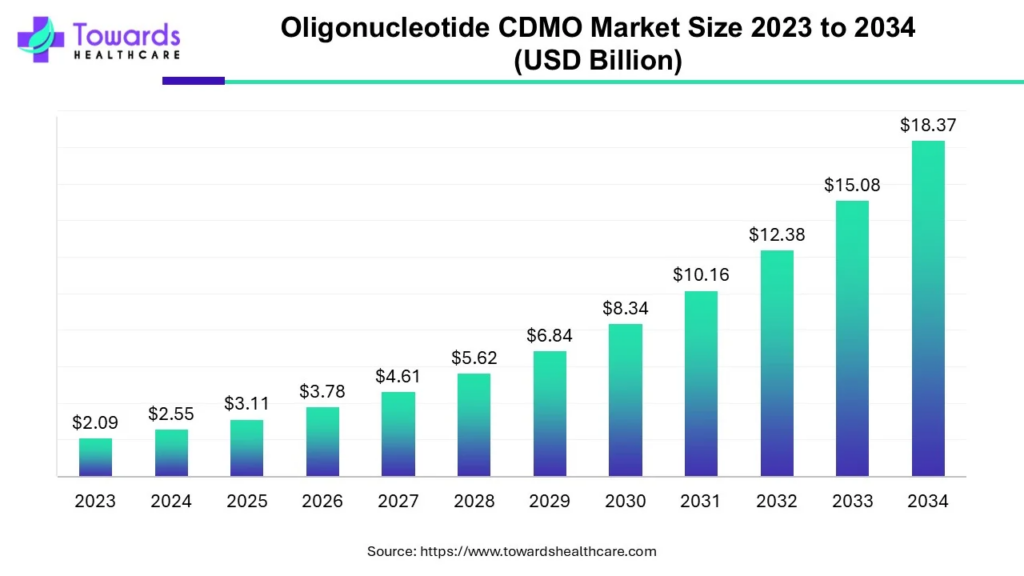
The global oligonucleotide CDMO market is one of the fastest-growing segments in pharmaceutical outsourcing. According to Towards Healthcare the global oligonucleotide CDMO market size is calculated at US$ 2.55 in 2024, grew to US$ 3.11 billion in 2025, and is projected to reach around US$ 18.37 billion by 2034. The market is expanding at a CAGR of 21.83% between 2025 and 2034. The rise in next-generation sequencing for various genes-related research and study is driving the oligonucleotide CDMO market.
(Source- Towards Healthcare)
Three macro trends are reshaping this market-
Oligonucleotide drug success – Approvals and strong performance of GalNAc-conjugated siRNA therapies are validating the modality and driving new pipeline investments that require external manufacturing capacity.
Increasing molecular complexity – Advanced chemical modifications and conjugation strategies are pushing sponsors to partner with specialized CDMOs rather than generalist API manufacturers.
Supply chain diversification – Geopolitical pressures are encouraging companies to dual-source oligonucleotide manufacturing across multiple regions.
Oligonucleotide CDMO Services: Capabilities, Molecule Classes & Drivers
An oligonucleotide CDMO is a specialized contract organization that handles the chemical synthesis, purification, analytical testing, and GMP-compliant production of oligonucleotide drug substances. Unlike conventional small molecule or biologics CDMOs, oligonucleotide manufacturers operate at the intersection of chemistry and molecular biology, working with highly modified synthetic sequences that demand precise control at every stage of the manufacturing process. Customers include large pharmaceutical companies, emerging RNA therapeutics developers, gene therapy companies, and academic research programs requiring clinical-grade material.
Full Service Spectrum
A fully integrated oligonucleotide CDMO typically offers: process development and optimization for solid-phase oligonucleotide synthesis (SPPS); scale-up from milligram to multi-kilogram quantities; GMP manufacturing of oligonucleotide APIs; downstream purification using ion-exchange and reversed-phase chromatography; analytical characterization including sequence confirmation, purity assessment, and residual impurity profiling; conjugation services for GalNAc, cholesterol, and other targeting ligands; LNP formulation and drug product manufacturing; regulatory support including Drug Master File (DMF) preparation and IND/NDA documentation; and long-term commercial supply agreements.
Molecule Classes and Therapeutic Areas
Oligonucleotide CDMOs manufacture across a wide range of molecule classes: antisense oligonucleotides (ASOs), small interfering RNA (siRNA), microRNA (miRNA) mimics and inhibitors, aptamers, CRISPR guide RNAs (gRNAs), splice-switching oligonucleotides, and immunostimulatory sequences. These molecules are advancing across therapeutic areas including rare genetic disorders, hepatology, cardiovascular disease, CNS conditions, oncology, and infectious diseases. The breadth of chemistry modifications — phosphorothioate backbones, 2′-MOE, LNA, and GalNAc conjugates — demands a CDMO with deep platform expertise rather than commodity synthesis capacity.
Recent News-
-

Ofichem to Acquire Kinentia Biosciences and Expand Into U.S. Market
-

Shilpa Medicare Launches Dedicated Complex Small-Molecule CDMO
-
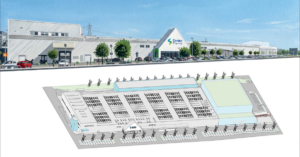
CordenPharma Commits $93.1 Million to Expand Injectable Manufacturing in Italy
-
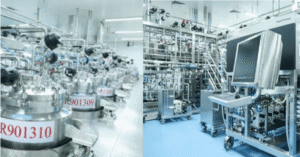
Aurisco Pharmaceutical Becomes First Generic Oligonucleotide API Manufacturer to Pass USFDA Inspection
-
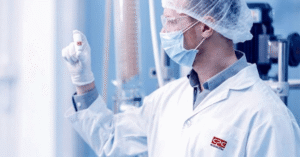
CPC Scientific Completes FDA Pre-License Inspection for Hepcludex® API Manufacturing
-
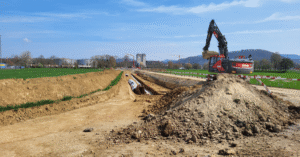
Bachem to Invest More Than CHF 500 Million(US$620M) in Sisslerfeld Manufacturing Site
Growth Drivers
- Validated RNA therapeutics – Approved ASO and siRNA drugs for rare diseases and other conditions are driving sustained commercial manufacturing demand.
- Expanding clinical pipeline – Hundreds of oligonucleotide programs in development require outsourced GMP synthesis.
- High infrastructure costs – Specialized synthesis equipment and controlled facilities make outsourcing more economical for most pharma companies.
- Growth of personalized medicines – Individualized ASOs for ultra-rare diseases are creating demand for rapid, small-scale GMP manufacturing.
Growth Inhibitors
- Limited synthesizer capacity – Global GMP oligonucleotide synthesizer capacity is constrained, with long lead times for new equipment.
- Raw material supply risks – Dependence on specialized phosphoramidites, modified nucleosides, and solid-phase supports creates cost and availability pressures.
- Regulatory complexity – Strict requirements for impurity profiling, sequence fidelity, genotoxic control, and stability increase compliance challenges.
- Technology transfer risks – Complex or heavily modified sequences often require customized process development, causing potential delays.
CDMO Outsourcing: How to Choose the Right Oligonucleotide CDMO Partner
Selecting an oligonucleotide CDMO requires a fundamentally different evaluation framework than assessing a small-molecule API manufacturer. The criteria below reflect the genuine complexity of this manufacturing category and are written for CMC directors and external manufacturing leads actively engaged in partner selection.
1. Synthesis Platform and Oligonucleotide Type Expertise (ASO vs. siRNA vs. CRISPR)
Not all oligonucleotide CDMOs are equally capable across modalities. ASO manufacturing favors single-strand synthesis at multi-kilogram scale, with expertise in phosphorothioate chemistry and 2′-modified variants such as 2′-MOE or 2′-F. siRNA manufacturing requires robust duplex annealing processes and often higher purity specifications due to immune activation risks. CRISPR guide RNA synthesis introduces additional length and sequence complexity. Evaluate whether the CDMO has published process data, regulatory submissions, or commercial track records specific to your molecule class — not just general nucleic acid synthesis capability.
2. GMP Oligonucleotide Manufacturing Scale and Synthesizer Capacity
Capacity adequacy must be assessed against your development timeline and projected commercial volumes. Ask for specific synthesizer models, column scales, and campaign throughput data. Understand whether capacity is dedicated to oligonucleotide manufacturing or shared with peptide or small-molecule programs, which can affect scheduling reliability. CDMOs with multiple synthesizer trains at different scales offer better flexibility for transitioning from clinical to commercial manufacturing without a disruptive site transfer.
3. Downstream Purification Capability and Impurity Profile Management
Purification is frequently the rate-limiting step in oligonucleotide manufacturing and a primary driver of yield and cost of goods. Assess the CDMO’s HPLC platform — ion-exchange, reverse-phase, and hydrophobic interaction chromatography each have different strengths for specific sequence types. Critically, evaluate their demonstrated ability to manage process-related impurities including short-sequence failures, diastereomers, and depurination products. A CDMO with a well-characterized impurity panel and established control strategy will support a materially smoother regulatory submission.
4. Analytical Characterization: Sequence Confirmation, Purity, and Residual Impurities
Oligonucleotide drug substance requires a comprehensive analytical package that differs substantially from small-molecule or biologic testing. Confirm the CDMO has established, validated methods for sequence confirmation by mass spectrometry (including LC-MS/MS), chain length distribution, purity by AEX-HPLC, residual solvents, elemental impurities, phosphoramidite residuals, and identity testing. The breadth and regulatory acceptance history of their analytical package is a direct predictor of submission readiness and regulatory risk.
5. Regulatory Submission Track Record (IND, NDA, DMF Filings for Oligonucleotides)
A CDMO’s history of supporting oligonucleotide IND and NDA filings — ideally with successful outcomes — is among the strongest indicators of their regulatory competence. Ask specifically about the number of INDs supported as the drug substance manufacturer, any FDA or EMA interactions on CMC topics, and whether they maintain an active Drug Master File (DMF) that has been referenced and accepted. Experience with ICH Q11 drug substance development and manufacturing process descriptions for oligonucleotides is particularly valuable.
6. Conjugation and Delivery System Capabilities (GalNAc, LNP)
For most siRNA programs and a growing number of ASO programs, conjugation chemistry is inseparable from the manufacturing process. GalNAc conjugation, which enables targeted hepatic delivery, requires specialized chemistry expertise and is now near-standard for liver-targeting programs. LNP encapsulation for oligonucleotide payloads requires microfluidics or T-junction mixing platforms with tightly controlled particle sizing. A CDMO that integrates conjugation into the oligonucleotide synthesis workflow — rather than outsourcing it — typically offers shorter timelines, better yield data, and a simpler supply chain for sponsors.
7. Plasmid and Starting Material Supply Chain Security
Oligonucleotide manufacturing depends on reliable access to phosphoramidite building blocks, controlled nucleotides, and specialty reagents. Assess the CDMO’s supplier qualification status, inventory practices, and whether they dual-source critical raw materials. For programs with non-standard or novel modifications, understand whether the CDMO manufactures custom phosphoramidites in-house or relies on single external suppliers — a potential single point of failure for your supply chain.
8. Technology Transfer Success Rate and Timeline Performance
Technology transfers in the oligonucleotide space are operationally complex and frequently underestimated. Request the CDMO’s historical data on transfer timelines relative to original project plans, including both incoming transfers from sponsors and outgoing transfers when programs have moved. A CDMO with a structured technology transfer process, dedicated project management, and experience receiving programs from early-phase academic or virtual biotech sponsors will be better equipped to absorb your program without extended delays.
Five Red Flags When Evaluating an Oligonucleotide CDMO
- Vague synthesizer capacity claims: CDMOs that describe capacity without specifying synthesizer models, column scales, and available campaign slots may be overstating throughput. Request a realistic capacity utilization assessment before committing to a timeline.
- No dedicated oligonucleotide manufacturing suite: GMP synthesis in shared facilities with peptides or small molecules raises cross-contamination concerns and creates scheduling competition that can delay your program.
- Limited analytical depth: If the CDMO cannot demonstrate validated mass spectrometry-based sequence confirmation or has no established impurity reference standards, regulatory submissions will require significant catch-up work.
- No DMF or regulatory citation history: Absence of a referenced Drug Master File, or a DMF that has never been reviewed by a major regulatory agency, is a meaningful indicator of submission inexperience that could translate into CMC deficiencies.
- High project manager turnover: In a specialist manufacturing environment, continuity of technical staff directly affects program quality. High attrition in project-facing roles is a leading indicator of operational instability that compounds over the lifecycle of a multi-year program.
Five Questions to Ask Shortlisted Oligonucleotide CDMO Partners Before Signing a Contract
- How many oligonucleotide INDs have you supported as the drug substance CDMO in the last three years, and what molecule types did they cover?
- What is your demonstrated batch success rate for GMP oligonucleotide synthesis campaigns at the scale relevant to our program, and what drove any out-of-specification events?
- Can you provide a technology transfer timeline case study — from contract execution to first GMP batch release — for a program comparable in complexity to ours?
- How do you manage phosphoramidite supply continuity, and which of your critical starting materials are single-sourced?
- What is your process for managing impurity specification negotiations with regulatory agencies, and can you share any relevant precedents from your DMF or IND submissions?
Frequently Asked Questions About Oligonucleotide CDMO
What is an oligonucleotide CDMO?
An oligonucleotide CDMO is a contract development and manufacturing organization that specializes in producing synthetic oligonucleotide drug substances for pharmaceutical and biotech companies. These organizations provide the specialized chemistry infrastructure, GMP manufacturing suites, purification platforms, and analytical capabilities required to develop and manufacture therapeutic oligonucleotides — including antisense drugs, siRNA, and related nucleic acid modalities — at clinical and commercial scale.
What CDMOs specialize in oligonucleotide manufacturing?
A number of established organizations operate dedicated oligonucleotide manufacturing platforms, ranging from large global contract manufacturers with multi-kilogram synthesis capacity to specialized nucleic acid CDMOs focused exclusively on RNA and DNA therapeutics. Selecting the right partner depends on the oligonucleotide type, development stage, scale requirements, and conjugation needs of a specific program. PharmaSource provides a searchable database of qualified oligonucleotide CDMOs with capability-level filtering.
What types of oligonucleotides do CDMOs manufacture?
Oligonucleotide CDMOs manufacture a broad range of therapeutic nucleic acid molecules, including antisense oligonucleotides (ASOs), small interfering RNAs (siRNAs), splice-switching oligonucleotides (SSOs), microRNA mimics and inhibitors, aptamers, and CRISPR guide RNAs. Each modality involves distinct chemistry, length, modification profiles, and analytical requirements. Some CDMOs specialize in one or two modality types, while others offer a broader nucleic acid platform across the full oligonucleotide synthesis outsourcing spectrum.
What are the manufacturing challenges for therapeutic oligonucleotides?
The primary manufacturing challenges include managing synthesis yield and sequence fidelity over long oligonucleotide chains, controlling process-related impurities such as failure sequences and diastereomers, achieving sufficient purification resolution at commercial scale, securing reliable supply of specialty phosphoramidite building blocks, and demonstrating manufacturing consistency for regulatory submissions. Chemical modifications — such as phosphorothioate backbones and 2′-sugar variants — add further chemistry complexity and require highly controlled synthesis conditions.
What GMP requirements apply to oligonucleotide manufacturing?
Therapeutic oligonucleotides manufactured for clinical use must comply with ICH Q7 Good Manufacturing Practice for Active Pharmaceutical Ingredients and the relevant sections of ICH Q11 on development and manufacture of drug substances. Regulatory agencies including the FDA and EMA apply current GMP standards to oligonucleotide drug substance manufacturing, covering validated analytical methods, impurity controls, process validation, and stability programs. GMP oligonucleotide manufacturing also requires compliance with ICH Q3D elemental impurities guidelines and applicable regional pharmacopeial standards.