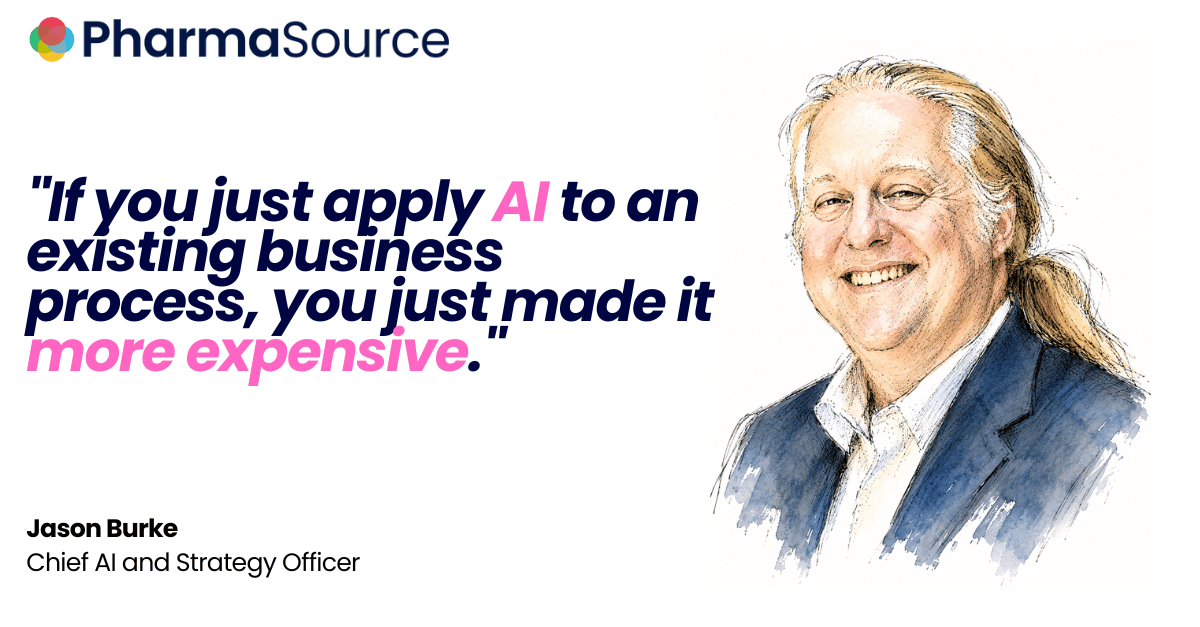
“If you just take AI and you apply it to an existing business process, you just made the existing process more expensive.”
— Jason Burke, Chief AI and Strategy Officer
In January 2026, the FDA and the European Medicines Agency published a joint set of ten guiding principles for good AI practice in drug development. The document covers everything from risk-based validation and data governance to life cycle management and human-centric design. It runs to two pages. For an industry accustomed to dense regulatory guidance, that brevity raised eyebrows.
AI adoption across pharmaceutical manufacturing and R&D is accelerating, and organizations are under pressure to show regulators and their own boards that they have a credible approach. But according to Jason Burke, the biggest obstacle is a misunderstanding of what AI actually requires.
Jason Burke is a Chief AI and Analytics Officer who works exclusively in life sciences and healthcare. He has held senior roles at SAS, Microsoft, GSK, Quintiles, and UNC Health, where he founded the enterprise analytics and data sciences organization. His work focuses on helping organizations build the institutional capabilities, such as data foundations, governance models, workflows, and talent, required to move from AI experimentation to sustainable, measurable performance improvement.
The FDA-EMA Principles: A First Step, Not a Roadmap
When the joint principles landed, Burke’s immediate reaction was positive, but measured. The collaboration itself, he says, was the most important signal.
“It’s very difficult for the life sciences industry to come up with a meaningful approach for adopting these technologies when there’s no good alignment between the US and the EU. Clear alignment from the beginning is exactly what we want to see.”
Jason Burke
Organizations operating across both jurisdictions (CDMOs running sites in the US and Europe, biotech companies filing in both regions) need consistent frameworks they can build against. A divergent regulatory posture on AI would force parallel compliance programs and slow adoption.
Burke draws a direct line between the FDA-EMA principles and existing quality frameworks. Several of the ten principles — risk-based approaches, data governance, life cycle management — are extensions of how the industry already thinks about quality systems. That continuity is intentional, and it’s useful. It means organizations don’t need to build entirely new governance structures from the ground up.
But Burke is clear that the principles are a foundation, not a finished building. The real-world complexity of implementing them, particularly around non-deterministic AI systems that can’t be validated the same way traditional software is, still needs to be worked through by both industry and regulators together.
“I thought what they brought forward was a very solid first step,” he says, “but there’s a lot more work to be done, particularly as we think about the pace at which AI is evolving and the rate of change we expect to see in this space.”
The Data Problem
“The challenges in getting value from AI are usually related to data, not AI. AI models work. The question is, what are you giving them?”
Jason Burke
The issue, he argues, is that most organizations have never properly invested in data governance, data strategy, or data architecture. That gap was manageable when data was supporting human decision-making. It becomes critical when AI is doing the processing.
In manufacturing specifically, the stakes are high. To use AI for quality monitoring, deviation detection, or demand forecasting, an organization needs what Burke calls “single sources of truth” — data that is trusted, consistently defined, and traceable. Without that foundation, AI models don’t just underperform; they can actively make things worse.
“AI can contribute to something called data sprawl,” he says. “Everywhere you’ve got AI, you now have more copies of data flying around as opposed to a structured approach for managing your assets.”
The FDA-EMA principles address this. Principle 6, data governance and documentation, requires that data source provenance, processing steps, and analytical decisions are documented in a detailed, traceable, and verifiable manner, in line with GxP requirements. For organizations that haven’t yet built those capabilities, that principle lands as a significant compliance burden. For those who have, it’s an accelerant.
Good data, Burke explains, has specific attributes: consistency, completeness, reliability, and timeliness. But beyond structural quality, the more important question is semantic: what can humans reasonably conclude from this data, and what decisions are appropriate to make based on it? Organizations that can answer those questions clearly are the ones positioned to get actual value from AI.
The Validation Gap: When Software Stops Being Deterministic
There is a specific technical problem at the heart of AI adoption in regulated pharmaceutical environments that the industry has not fully resolved.
Traditional software in GxP environments is deterministic: the same input produces the same output, every time. That property is what makes validation possible. AI systems, particularly machine learning models, don’t work that way. Their outputs vary with each execution. They also vary based on training data, model updates, and the distribution of inputs they encounter in production.
“We all know how to design systems and execute processes that are 21 CFR Part 11 compliant and can be validated,” he says. “But AI systems bring something different to the table; they don’t operate deterministically. If a piece of software does not operate deterministically, how do you manage the variability and develop a defensible approach from a regulatory and audit perspective?”
This is where the FDA-EMA principles’ emphasis on life cycle management and risk-based performance assessment becomes operationally important. Principles 8 and 9 require ongoing monitoring, periodic re-evaluation, and systems for capturing and addressing issues, including data drift — the gradual degradation in model performance as the real-world data distribution changes over time.
For manufacturing organizations, this means AI cannot be treated as a validated system that is deployed and then left alone. It requires ongoing oversight, which in turn requires clear ownership and competency. That’s a different operating model than most QA functions are currently built for.
Burke sees human-in-the-loop oversight as a requirement given where the technology and the industry’s understanding of it currently stand. There’s also a trust problem worth naming: research in AI consistently shows that when people see a computer output, they tend to assume it’s correct. In a quality-critical manufacturing environment, that assumption is dangerous.
“It’s very important that we don’t become undisciplined in our oversight of these processes,” he says.
Tools vs. Solutions: The Mistake Most Organizations Are Making
Burke explains what he sees as the most widespread strategic error in AI adoption across pharma right now. Organizations are investing in AI tools when they need AI solutions; and they’re not the same thing.
“AI tools are things like ChatGPT, Claude, and Microsoft Copilot. They’re fabulous. They’re the right place to start. But those tools do not deliver transformational impact. They don’t institutionalize and automate organizational workflows. That’s in the realm of AI solutions.”
Jason Burke
AI tools support individual knowledge workers. They improve productivity at the person level. AI solutions connect organizational workflows, automate processes that currently require human coordination, and access enterprise resources at scale. The return on investment is in a different category.
A CDMO that deploys AI tools across its workforce will see modest productivity gains. A CDMO that deploys AI solutions to automate batch record review, predict equipment failures, or optimize scheduling across multiple client programs is building a structural cost advantage.
Burke also makes a point about where the biggest near-term AI impact is landing in pharma. Drug discovery and development get most of the attention and most of the headlines. But the immediate, measurable returns for most organizations are in business process transformation: quality documentation, regulatory submissions, supply chain forecasting, and manufacturing operations.
“The immediate impact for most organizations is in business process transformation,” he says. “That’s where we typically see the biggest lift.”
Where This Is Heading
The FDA and EMA publishing joint principles in January 2026 is the start of a more structured engagement. Burke hopes the principles will lead to more detailed consensus and standards, particularly as regulators work through the specific validation and oversight challenges that non-deterministic AI systems create.
The organizations that will be well-positioned when that detailed guidance arrives are those that have already done the foundational work: built data governance programs they can stand behind, established clear ownership for AI oversight, and made the distinction between deploying tools and deploying solutions that actually transform how the business operates.
As Burke puts it: “We all have to learn as we go forward on how to balance the interests and the opportunities with AI and data sciences in this space.”